
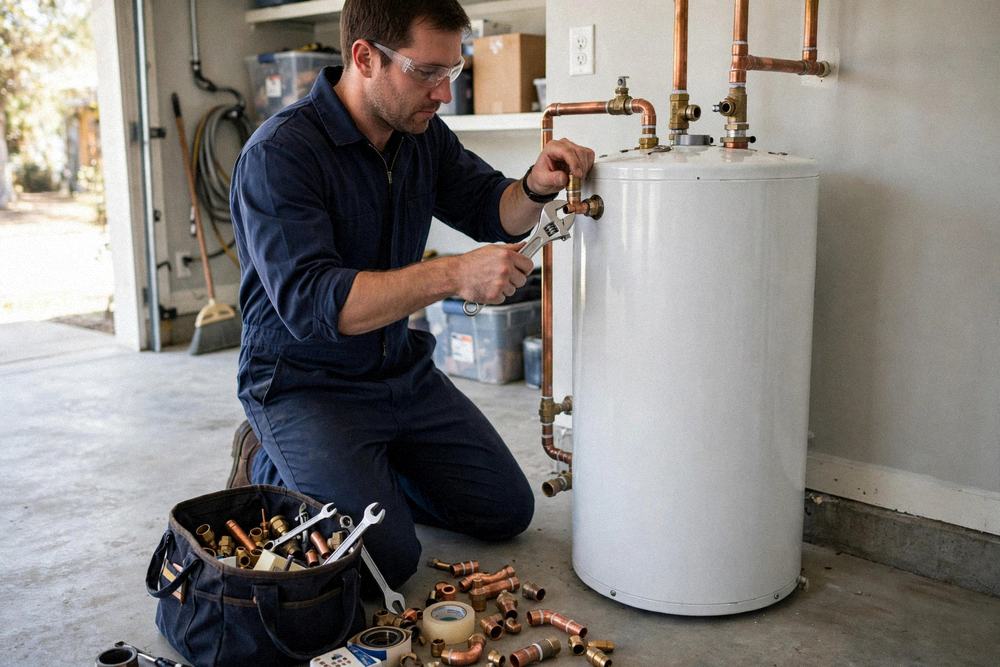
A replacement swaps an old heater for a new one. An installation puts a heater where there was not one before. A new build. A home addition. A garage turned into living space. A tank swapped for a tankless unit that needs new venting and a new gas line.
Nampa HeatPros installs water heaters in Nampa, Idaho. Tank and tankless, gas and electric. We handle the lines, the venting, and the inspection, and we check whether a permit is needed. Most tank installs take 3 to 5 hours. Most tankless installs take half a day. We give you a written quote before any work starts.
How Much Does Water Heater Installation Cost in Nampa?
Here are the national figures, from HomeGuide, January 2026, installed.
A first time install costs more than a swap. A swap reuses the water lines, the gas line or circuit, and the venting. A first time install builds all of that from nothing. A new gas line, new venting, a new electrical circuit, and new water lines all add labor and parts. That is why no installer can quote a first time install from a photo alone. We visit, we look, and we quote in writing.
Three extras can add to the bill. Removing and disposing of an old unit runs about $75 to $500 if it is not included. A permit and inspection, if one is needed, runs about $50 to $200. An expansion tank, where code requires one, runs $150 to $350 installed. Ask whether your quote includes all three before you compare it with another quote. These are national figures, not Nampa prices.
Water Heater Installation for New Homes in Nampa
Nampa is growing fast. The population is about 120,000 now, up nearly 20 percent since 2020. New homes are going up in Copper River Basin, Karcher Estates, Sundance, and out by Ten Mile Road. Every one of them needs a water heater, and the install happens in two stages.
First comes the rough in. While the walls are still open, we run the water lines, the gas line or electrical circuit, and the venting. We set the drain pan and the shutoff valves. Rough in is the cheapest time to do this work, because nothing is finished yet.
Then comes the finish. Once the home is framed and the walls are up, we set the unit, connect it, and test it. A tank heater takes 3 to 5 hours at this stage. A tankless unit takes half a day. The inspection follows, and the heater is ready when you move in.
If you are building, talk to your plumber before the walls close. The heater location decides the venting route, the gas line run, and the water line layout. A heater placed well costs less to install and less to service for the next 15 years.
Installing a Water Heater in a Home Addition or Remodel
An addition, a finished basement, a garage turned into living space, or an accessory dwelling unit all need hot water. The question is whether the existing heater can serve the new space, or whether the new space needs its own.
If the existing heater is sized for the old house only, adding a bathroom or a kitchen can leave everyone with lukewarm water. A 40 gallon tank that served two people will not serve four. In that case, the addition needs a bigger tank, a second heater, or a tankless unit that heats water on demand.
A tankless unit is often the better answer for an addition. It mounts on a wall, takes little space, and heats water only when the new bathroom or kitchen calls for it. It needs a gas line and venting, or a dedicated electrical circuit, which we run as part of the install.
An accessory dwelling unit usually needs its own heater, because it has its own kitchen and bathroom. We size it to the unit, not to the main house. A 40 gallon tank or a small tankless unit usually does it.
Converting from Tank to Tankless
A tank to tankless conversion is the most common install we do in existing homes. The old tank comes out, and a tankless unit goes in its place. The work is more than a swap, because a tankless unit needs things the tank did not.
Gas or Electric: Which Fuel for a New Install?
If you are installing a heater where there was not one, you may have a choice of fuel. A gas heater heats water faster and recovers faster after heavy use, and gas tankless units are the most common choice for conversions. Gas needs a gas line and venting, which adds cost on a first time install. An electric heater is simpler to install, with no gas line and no venting. An electric tank heater is the cheapest install of all. An electric tankless unit needs a heavy dedicated circuit, and it heats slower than gas, so it suits smaller homes and fewer fixtures. If your home already has a gas line, gas is usually the better buy for a tankless unit. If your home is electric only and you want a tank, electric is the simplest install.
What Size Water Heater Do You Need?
The wrong size is the most common install mistake. Too small, and the water runs out. Too big, and you pay to heat water nobody uses. A 40 gallon tank suits one to three people. A 50 gallon tank suits three to five people, or a family of four. For tankless, size by flow rate: one or two fixtures need at least 3.5 gallons per minute, two or three need 5, and three or four need 7 or more. Cold inlet water in winter makes any heater work harder, so a unit that is just big enough in July can fall short in January, when Nampa lows average 23 degrees. The full sizing guide is on our replacement page.
How a Water Heater Installation Works
You should know what happens on install day. Here is the job, step by step.
- We visit and quote. We look at the site, check the gas, electric, water, and venting, and give you a written quote with the unit, labor, and extras split out, plus any permit fee if one is needed. You approve it, then we book the job.
- We run the lines. Water lines, gas line or electrical circuit, and venting. On a new build, this happens while the walls are open. On a conversion, we run them through the shortest safe route.
- We set the unit. We mount or set the heater, connect the water, gas, or electric, and fit the venting and the condensate drain where needed.
- We fit the extras. An expansion tank where code requires one. A new temperature and pressure relief valve. A drain pan where the heater sits above a finished space.
- We test and walk you through it. We fill the unit, check for leaks and pressure, and show you the temperature setting, the shutoff, and the first flush or descale date.
Do You Need a Permit to Install a Water Heater in Nampa?
It depends on the job. Some water heater installs need a permit, and some do not. We check with the City of Nampa before we start, and if a permit is needed we handle it. A permit costs about $50 to $200 nationally, according to HomeGuide, when one is needed, and the work is inspected after install. The inspection catches mistakes in venting, gas, and pressure before they become hazards, and a permitted install protects your home insurance and your home value. It is part of the quote, not an extra you chase yourself.
Installing a Water Heater in Nampa Hard Water
Nampa water comes from city wells in the Snake River Plain Aquifer. The City of Nampa 2024 water quality report puts hardness at none to 7.08 grains per gallon, depending on which well feeds your part of town. Water counts as hard at 7 grains per gallon and up.
Hard water shortens heater life. Scale settles in the tank, coats the elements, and clogs a tankless heat exchanger. An install in Nampa should come with a plan for the water, not just a new unit.
Why Nampa Homeowners Call Nampa HeatPros for Installation
Water Heater Installation Across Nampa
We drive to homes all over Nampa, and to Meridian, Caldwell, Kuna, Middleton, Star, and Boise. In Nampa, that means downtown and the historic streets near the Nampa Depot, North Nampa, South Nampa around Lake Lowell, East Nampa along Ustick Road, the NNU area, West Nampa near Garrity Boulevard, and the Karcher and Greenhurst area.
New builds in Copper River Basin, Karcher Estates, Sundance, and the Ten Mile corridor are where most first time installs happen. Older homes near downtown, around Nampa High School and the streets off 1st Street South, are where most tank to tankless conversions happen.
Water Heater Installation in Nampa: FAQs
How long does a water heater installation take?
Most tank installs take 3 to 5 hours. A tankless install takes half a day, longer if the job needs a new gas line or venting. A first time install in a new build happens in two stages, rough in while the walls are open, then finish when the home is framed.
How much does water heater installation cost in Nampa?
Nationally, a standard tank heater installed runs $600 to $3,100, and a tankless unit installed runs $1,400 to $5,600, according to HomeGuide, January 2026. A first time install costs more than a swap, because the gas line, venting, and water lines do not exist yet. We give you a written quote for your home before any work starts.
Can you install a tankless water heater in an older home?
Yes, in most cases. The job needs new venting, a bigger gas line, and a condensate drain. We check the gas supply and the venting route before we quote, because those two decide whether the conversion works and what it costs.
Do I need a permit to install a water heater in Nampa?
It depends on the job. Some water heater installs need a permit, and some do not. We check with the City of Nampa before we start, and if a permit is needed we handle it. It is part of the quote.
Book Your Water Heater Installation in Nampa Today
Building a new home, adding a room, or switching to tankless? Call Nampa HeatPros. We will visit, size the unit to your household, and give you a written quote with everything split out. Then we install it, permit and all. That is how water heater installation Nampa ID should work.
Related Reading
Our Service Area
We serve Nampa and the towns around it. Pick your area to see water heater repair there.