
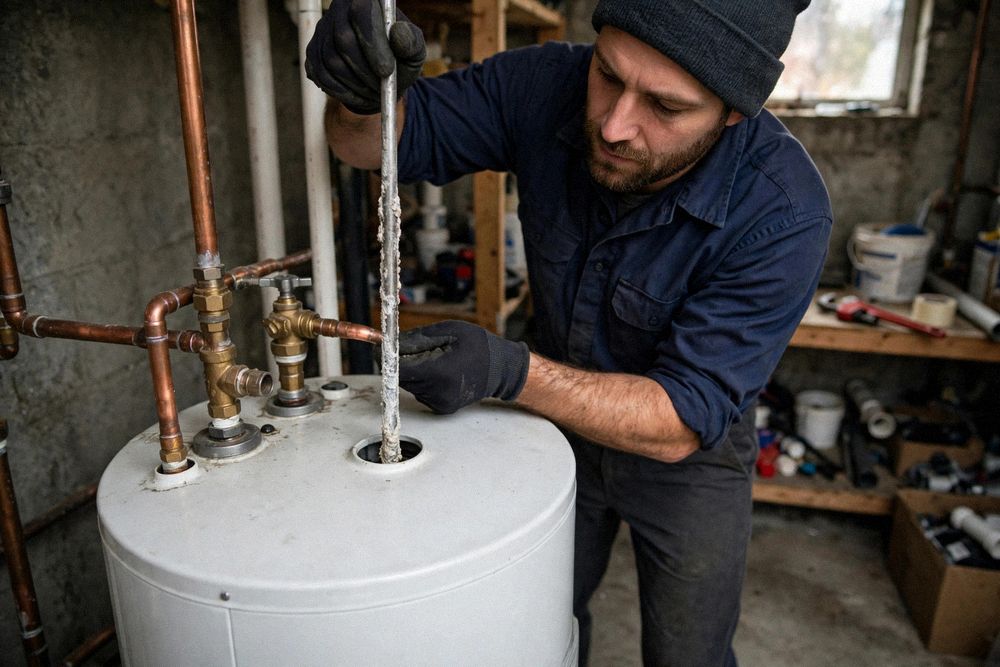
Your hot water smells like rotten eggs, or it runs rusty. Or your tank is 6 years old and nobody has ever checked the anode rod. The anode rod is a small part that protects the whole tank from rust. When it wears out, the tank rusts next. Replacing the rod is the cheapest way to make a tank last its full life.
Nampa HeatPros replaces anode rods in Nampa, Idaho. We check the rod, replace it when it is worn, and tell you straight what condition your tank is in. A rod replacement costs a fraction of a new heater.
What an Anode Rod Does
An anode rod is a long metal rod that screws into the top of the tank and hangs down inside it. It is usually made of magnesium or aluminum zinc. Its job is simple: it rusts so the tank does not.
Inside a tank, water and steel want to react. The rod gives that reaction something easier to attack. The rod corrodes first, and the steel tank stays sound. That is why plumbers call it a sacrificial rod. It gives its own life to save the tank.
A new rod is about 40 inches long and thick as your thumb. Over time it shrinks as it corrodes. When it is gone, the water starts on the tank itself. Rust follows, then a leak. A tank that leaks cannot be fixed. It has to be replaced.
The rod also affects your water. A magnesium rod can feed the bacteria that make hot water smell like rotten eggs. An aluminum zinc rod does not feed them in the same way. That is why the type of rod matters, not just whether it is there.
Signs Your Anode Rod Is Gone
Anode Rod Replacement Cost in Nampa
Here are the national figures, labelled as national, with sources and dates.
These are national figures, not Nampa prices. Nampa prices vary by unit, access, and how much scale is in the tank. We give you a written quote for your home before any work starts.
Rotten Egg Smell and the Anode Rod
Hot water that smells like rotten eggs is the most common anode rod complaint in Nampa. The smell comes from hydrogen sulfide gas. Sulfate reducing bacteria live in the tank, and they react with a magnesium anode rod. The rod feeds the reaction.
The fix is usually an aluminum zinc rod. Aluminum zinc does not feed the bacteria in the same way, so the smell goes away. We also flush the tank to clear the bacteria and the sediment they live in.
Three things to know. First, the smell is in the hot water only. If the cold water smells too, the cause is the water supply, not the heater. Second, a flush alone will not fix it. The rod has to change, or the smell comes back. Third, the smell does not mean the water is unsafe to use, but it does mean the rod needs attention. Call us and we will test it.
If the smell stays after an aluminum zinc rod and a flush, the bacteria may be in the well or the supply lines. That is a water treatment job, not a heater job. We tell you straight when the problem is bigger than the rod.
How Often to Check the Anode Rod in Nampa
The U.S. Department of Energy says to inspect the anode rod every 3 to 4 years. In Nampa, check it sooner. Nampa water is hard, and hard water wears the rod faster.
Nampa water comes from city wells in the Snake River Plain Aquifer. The City of Nampa 2024 water quality report puts hardness at none to 7.08 grains per gallon, depending on which well feeds your part of town. Water counts as hard at 7 grains per gallon and up.
In Nampa hard water, check the rod after 2 years, not 5. A rod that is checked on time gets replaced before the tank starts to rust. A rod that is never checked runs out, and the tank rusts in silence until the water runs brown or the tank leaks.
The check is simple. We remove the rod and look at it. A good rod is thick and solid. A worn rod is thin, pitted, or down to a wire core. A rod that is gone is just a thin wire, or nothing at all. If the rod is worn, we replace it on the same visit.
Put the rod check on the same schedule as the yearly flush. A flush costs $75 to $250 nationally, according to HomeGuide. A flush and a rod check together take about an hour, and they are the two cheapest ways to make a tank last.
How an Anode Rod Replacement Works
- We check the rod. We shut off the water and power, or gas, and remove the rod from the top of the tank. We look at it and show it to you. A worn rod is easy to see.
- You get an upfront price. We tell you the price before any work starts, with parts and labor split out. You approve it, then we fix it. The price does not change halfway through.
- We fit the new rod. We screw the new rod into the top of the tank. If the tank is in a tight space, we use a flexible rod that bends to fit. If the old rod is seized, we work it loose with care so the tank fitting is not damaged.
- We flush and test. We flush the tank to clear sediment and rust, restore the water and power, and check the water at the tap. We tell you when the next rod check is due, usually in 2 years in Nampa hard water.
Anode Rod or New Tank?
A rod replacement is the right call when the tank is sound. A new tank is the right call when the tank has rusted through. Here is how we tell the difference.
Why Nampa Homeowners Call Nampa HeatPros for Anode Rod Replacement
Anode Rod Replacement Across Nampa
We drive to homes all over Nampa, and to Meridian, Caldwell, Kuna, Middleton, Star, and Boise. In Nampa, that means downtown and the historic streets near the Nampa Depot, North Nampa, South Nampa around Lake Lowell, East Nampa along Ustick Road, the NNU area, West Nampa near Garrity Boulevard, and the Karcher and Greenhurst area.
Older homes near downtown, around Nampa High School and the streets off 1st Street South, often have tanks past 10 years old with rods that were never checked. Newer homes in Copper River Basin, Karcher Estates, Sundance, and the Ten Mile corridor have newer tanks, but Nampa hard water wears their rods just as fast. Homes near Lake Lowell and Heron Ridge sit close to the Deer Flat National Wildlife Refuge, where winter nights run cold and garage heaters work hard.
If you live near the Ford Idaho Center, the Warhawk Air Museum, Lakeview Park, or Northwest Nazarene University, you are in our service area.
Anode Rod Replacement in Nampa: FAQs
What does an anode rod do?
It protects the tank from rust. The rod corrodes first, so the steel tank stays sound. When the rod is gone, the water starts on the tank itself. Rust follows, then a leak.
How often should I replace the anode rod?
Check it after 2 years in Nampa hard water. The U.S. Department of Energy says to inspect every 3 to 4 years, but Nampa water wears the rod faster. A rod that is checked on time gets replaced before the tank starts to rust.
Why does my hot water smell like rotten eggs?
Sulfate reducing bacteria in the tank react with a magnesium anode rod, and the reaction makes hydrogen sulfide gas. The fix is usually an aluminum zinc rod, plus a flush. The smell is in the hot water only.
How much does anode rod replacement cost?
Nationally, an anode rod replacement runs $125 to $350, parts and labor, according to Fixr and HomeGuide. These are national figures. We give you a written quote for your home before any work starts.
Can an anode rod save a leaking tank?
No. A leaking tank has rusted through, and no rod can fix it. A rod protects a sound tank. If the tank leaks, replacement is the only option.
Book Your Anode Rod Replacement in Nampa Today
Rusty water, rotten egg smell, or a tank past 6 years with no rod check, the fix is a $125 to $350 rod, not a $1,400 replacement. Call Nampa HeatPros. We will check the rod, show it to you, and replace it the same day in most cases. That is how anode rod replacement Nampa ID should work.
Our Service Area
We serve Nampa and the towns around it. Pick your area to see water heater repair there.