
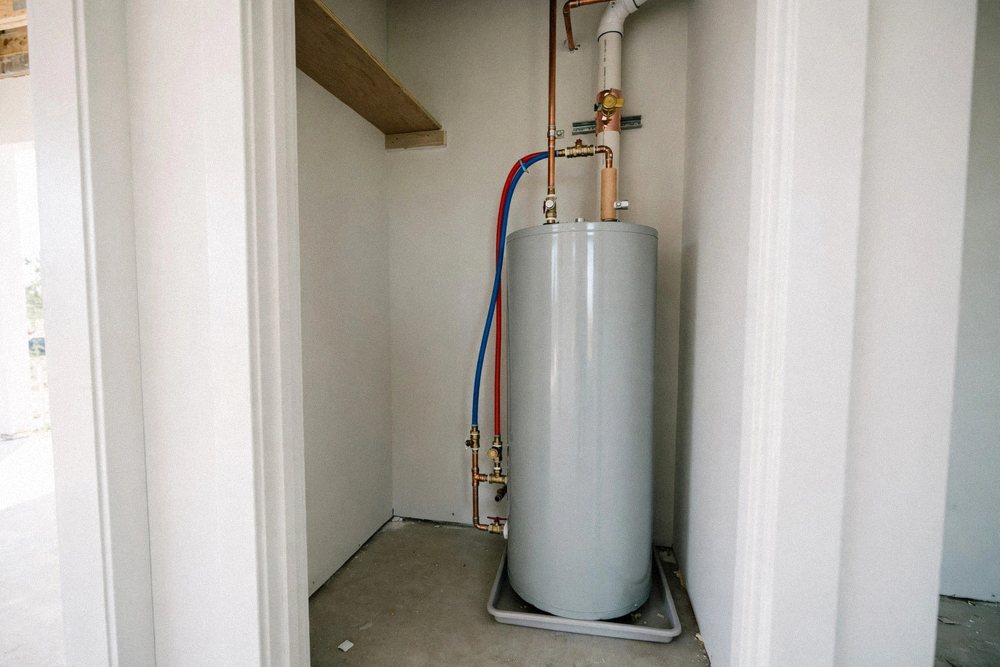
A new home water heater Nampa buyers inherit is often a builder grade tank. Check its age, type, size, and safety parts before you sign. A new build can still have a unit that is too small, badly vented, or hurt by hard water. This guide shows what to check, what to keep, and when to change it.
What a New Home Water Heater Nampa Buyer Gets From the Builder
Most new homes in Nampa get a tank water heater. The builder picks a unit that meets code and keeps the build cost down, often a 40 gallon or 50 gallon gas tank, or an electric tank if the house has no gas line. Brands are often Rheem, Bradford White, A.O. Smith, or State. The model is often a base model, not picked for your family size or Nampa water.
Some new builds get a tankless unit, more often in larger homes with a gas line sized for it. A tankless unit heats water only when a tap opens. Brands here include Navien, Rinnai, Noritz, and Rheem. It needs the right gas line, vent, and condensate drain.
Where the unit sits matters too. In Nampa, a tank often sits in the garage, in a utility closet, or in a small mechanical room. A gas unit in a garage must sit 18 inches above the floor. Ask the builder where the unit is and where the shutoff valves are, and get the model number, serial number, install date, and warranty papers.
What to Check at the Home Inspection
A home inspector looks at the water heater, but you should look too. Hot water at the tap does not mean the unit is in good shape.
- Age from the serial number. Find the rating plate on the side of the tank. The first four digits often give the month and year it was built. A tank lasts 8 to 12 years, based on the US Department of Energy. A tankless unit lasts 15 to 20 years.
- TPR valve and discharge pipe. The temperature and pressure relief valve, called the TPR valve, opens at 150 psi or 210 degrees F. It must have a discharge pipe that ends within 6 inches of the floor, with no valve, cap, or smaller pipe in the line. It must not drip.
- Venting. A gas tank needs a vent that carries exhaust gas out of the house, going up with a steady slope, with no sag, gap, or rust hole. Bad venting can let carbon monoxide, a gas with no smell, back into the house.
- Combustion air. A gas unit needs air to burn clean. If it sits in a small closet, it needs vents in the door or a duct from outside. A sealed closet can starve the burner for air, which leads to soot and backdrafting.
- Gas shutoff and water shutoff. Find the gas shutoff valve on the gas line near the unit. Find the cold water shutoff valve on top of the tank. If a tank leaks, shut off the water first, then the gas or the power.
- Rust and corrosion. Look at the top fittings, the bottom ring, the drain valve, and the TPR valve fitting. Heavy rust, green crust on copper, or water stains on the floor point to a leak or a slow weep.
- Expansion tank. When water heats, it expands. An expansion tank sits above or beside the main tank and takes up that extra pressure. If it is missing and your home has a pressure reducing valve, ask a plumber if you need one.
- Drain pan and drain. A tank in a finished space or over a living area should sit in a drain pan that catches a slow leak and sends water to a drain. Check that the pan has a drain line.
Take photos for your move in file.
Tank or Tankless for a New Home
The choice is about space, fuel, cost, and how your family uses water.
| Item | Tank | Tankless |
|---|---|---|
| Life, DOE | 8 to 12 years | 15 to 20 years |
| Hot water limit | Runs out when the tank empties | Runs as long as water and fuel last, if sized right |
| Maintenance | Flush yearly, anode rod check every 3 to 4 years | Descale yearly in hard water |
A tank stores hot water and sends it out when you open a tap. A 40 gallon tank fits 1 to 3 people. A 50 gallon tank fits 3 to 5 people, including a family of 4. When the tank empties, you wait for it to reheat.
A tankless unit has no stored water to run out. Size is measured in GPM, gallons per minute. A unit rated at 3.5 GPM fits 1 to 2 fixtures at once, 5 GPM fits 2 to 3 fixtures, and 7 GPM or more fits 3 to 4 fixtures. In Nampa, cold water in winter needs a bigger rise to reach 120 degrees F, which cuts the real flow rate. Size for winter, not for summer.
Fuel matters. A gas tankless unit needs a larger gas line than a gas tank. In a new build, the builder can size the gas line and vent from the start. In a resale home, a switch often means a new gas line and vent. Labor for a tank to tankless switch runs 600 to 2,500 dollars, national, HomeGuide 2026. Labor for a tank swap runs 200 to 1,000 dollars, national, HomeGuide 2026. Install time is 3 to 5 hours for a tank and half a day for a tankless unit.
Energy savings are real but limited. The US Department of Energy says a tankless unit is 24 to 34 percent more efficient than a tank for homes that use 41 gallons of hot water per day or less. Water heating is about 18 percent of a typical home energy use, based on the same DOE source.
Sizing for Your Household
Size is about your busiest hour, not your average day. Think about a winter morning, with two showers, the dishwasher, and a load of laundry all at once. That is your peak. A unit that is too small will run out or go lukewarm then.
For a tank, a 40 gallon tank fits 1 to 3 people and a 50 gallon tank fits 3 to 5 people. A family of 4 often needs a 50 gallon tank. Check the First Hour Rating on the yellow EnergyGuide label, which tells you how many gallons the unit can deliver in the first hour.
For a tankless unit, add up the fixtures you will run at once. A shower uses about 2 to 2.5 GPM. Two showers at once need about 4 to 5 GPM. Two showers plus a kitchen faucet need about 6 to 7 GPM. Do not copy the old size without thought.
For help with sizing and install options, see our page on water heater installation in Nampa. That page covers install steps, cost ranges, and what a first time install needs that a swap does not.
Hard Water and Winter in Nampa
Nampa water and Nampa winter both shorten water heater life if you ignore them. Hard water leaves mineral scale inside a tank and inside a tankless heat exchanger. The City of Nampa 2024 Consumer Confidence Report lists hardness from none to 7.08 GPG, grains per gallon. Scale coats the bottom of a tank, cuts efficiency, and can cause popping noises. In a tankless unit, scale cuts flow and can cause error codes. A tank flush costs 75 to 250 dollars, national, HomeGuide 2026. A tankless descale costs 75 to 300 dollars, national, HomeGuide 2026.
Winter is the other factor. Nampa has 132 freezing nights per year, based on NOAA data for 1991 to 2020, and the average low in January is 23 degrees F, based on the same NOAA source. Pipes in a cold garage or in an outside wall can freeze. Insulate exposed hot and cold lines, and keep the garage door closed on the coldest nights.
Nampa grew about 20 percent since 2020, to a population of 120,384, based on the Census July 2025 estimate. About 70 percent of homes are owner occupied. The median home was built in 2000, and about 26 percent were built before 1980.
Keep the Builder Unit or Replace It
Keep the unit if it is less than 5 years old, the right size, with a correct vent and TPR valve, and no rust or leak. Flush it in the first year and check the anode rod at year 3 or 4. A well kept tank can reach the full 8 to 12 year life.
Replace the unit if it is past half its life and a repair quote is high. The 50 percent rule is simple. If a repair quote is more than half the cost of a replacement, and the heater is past half its expected life, replace it. For a tank, half life is 4 to 6 years. For a tankless unit, half life is about 7 to 10 years. A 9 year old tank that needs a 700 dollar repair is a replace case.
Replace it sooner if you see rusty water from the hot tap only, a leak at the base, popping that stays after a flush, water that runs out fast, a pilot that will not stay lit, or a tankless unit that throws the same error code again and again. A tank to tankless swap needs a gas line check, a vent change, and a condensate drain. Get the full quote in writing first.
For cost detail, see our page on water heater repair cost in Nampa. For a full swap, see our page on water heater replacement in Nampa.
What It Costs
All prices here are national figures, labelled national, with source and date. Nampa prices can differ. Repair costs run 150 to 750 dollars, average 450 dollars, national, Fixr, updated Aug 29, 2025. Angi lists a repair average of 616 dollars, with most jobs at 228 to 1,017 dollars, national, Angi, Aug 2026, based on 16,111 projects. Labor runs 75 to 150 dollars per hour, average 90 dollars, national, Fixr, updated Aug 29, 2025.
Replacement costs run 900 to 3,000 dollars, average about 1,400 dollars, national, Fixr, updated Aug 29, 2025. A tank install runs 600 to 3,100 dollars, national, HomeGuide 2026. A tankless install runs 1,400 to 5,600 dollars, national, HomeGuide 2026. A hybrid install runs 2,000 to 4,600 dollars, national, HomeGuide 2026. Removal runs 75 to 500 dollars, national, HomeGuide 2026. A permit runs 50 to 200 dollars, national, HomeGuide 2026. The 25C federal credit ended Dec 31, 2025.
First Year Maintenance
The first year sets the life of the unit. In the first month, take a photo of the rating plate, write down the install date and the model, and test the hot water at each tap. Note any tap that runs lukewarm or takes a long time to get hot.
Set the temperature to 120 degrees F, the set point listed by the US Department of Energy. Hotter water wastes energy, raises the scald risk, and speeds scale buildup.
Flush a tank in the first year to clear sediment from the bottom of the tank. Descale a tankless unit in the first year; in Nampa hard water, a yearly descale is the norm. Check the TPR valve every 6 months, based on US Department of Energy guidance. Look for drips and rust.
Check the anode rod every 3 to 4 years, based on US Department of Energy guidance. The rod corrodes first, so the tank steel does not. When the rod is gone, the tank starts to rust from inside. Look at the vent and gas line once a year for rust, a loose joint, and soot near the burner. Keep a log of each flush, descale, and repair, with receipts kept with the warranty papers.
Our page for new home buyers in Nampa covers the buyer view in more depth. If your unit is tankless, our page on tankless water heater repair in Nampa covers error codes, descaling, and common tankless faults.
FAQs
How old is the water heater in a new home?
Check the rating plate on the side of the tank. The serial number often encodes the build date in the first four digits. A tank lasts 8 to 12 years, based on the US Department of Energy. A tankless unit lasts 15 to 20 years. A new build unit should be less than a year old.
Should I keep the builder water heater or upgrade to tankless?
Keep the builder tank if it is new, the right size, and in good shape. Upgrade to tankless at build time if you want endless hot water and a longer life, and if the builder can size the gas line and vent right. A later switch costs more, with labor at 600 to 2,500 dollars, national, HomeGuide 2026.
What size water heater does a new home in Nampa need?
A 40 gallon tank fits 1 to 3 people. A 50 gallon tank fits 3 to 5 people, including a family of 4. For tankless, a 3.5 GPM unit fits 1 to 2 fixtures, a 5 GPM unit fits 2 to 3 fixtures, and a 7 GPM unit or more fits 3 to 4 fixtures.
How often should I flush a water heater in Nampa?
Flush a tank once a year and descale a tankless unit once a year. Nampa hardness runs from none to 7.08 GPG, based on the City of Nampa 2024 Consumer Confidence Report. Check the TPR valve every 6 months and the anode rod every 3 to 4 years, based on US Department of Energy guidance.
Get Your New Home Water Heater Nampa Checked Before Move In Day
Do not wait for a cold shower or a leak to learn about your unit. Get the age, the size, the vent, the TPR valve, and the gas shutoff checked before you move in. Bring the rating plate photo. We will tell you plain what to keep, what to fix, and what to budget for next.
Our Service Area
We serve Nampa and the towns around it. Pick your area to see water heater repair there.