
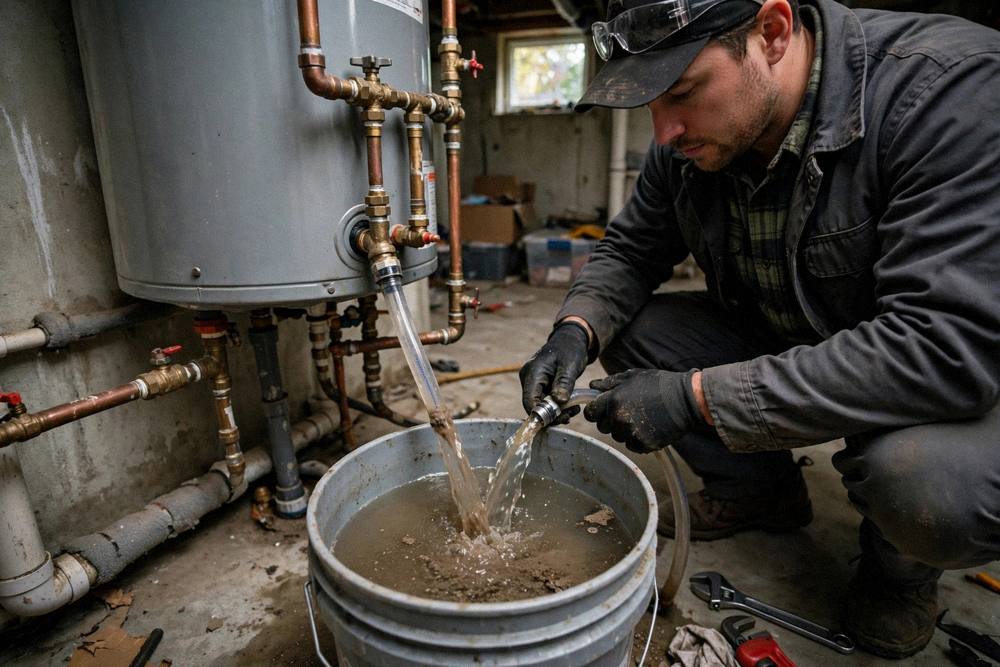
Water heater sediment buildup in Nampa is the most common water heater problem in the city. Nampa water is hard, and hard water lays minerals down in the tank as sediment. That sediment steals hot water, raises bills, and shortens heater life. This page tells you the signs, the damage it does, and how a flush fixes it.
Nampa HeatPros flushes water heaters in Nampa, Idaho. A yearly flush is the best money you can spend on a heater in this town.
What Is Sediment Buildup?
Sediment is the mineral grit that settles at the bottom of a water heater tank. Nampa water comes from city wells in the Snake River Plain Aquifer. The City of Nampa 2024 water quality report puts hardness at none to 7.08 grains per gallon. Water counts as hard at 7 grains per gallon and up.
Hard water carries calcium and magnesium. When the heater warms the water, those minerals drop out and sink to the bottom of the tank. Over months and years, they form a layer of grit and scale. In a tankless unit, the same minerals coat the inside of the heat exchanger as scale.
A thin layer is normal in any hard water town. A thick layer is a problem. A tank that has never been flushed can hold inches of sediment.
Signs Your Water Heater Has Sediment
Sediment shows itself in five ways. If you see two or more of these, your tank needs a flush.
What Damage Does Sediment Cause?
Sediment does more than steal hot water. Left alone, it damages the heater itself.
How to Fix Sediment Buildup
A flush clears sediment from a tank heater. Here is how it works.
We shut off the power or gas, shut off the cold water to the tank, and attach a hose to the drain valve at the bottom of the tank. We drain the tank, then flush clean water through it until the water runs clear.
The job usually takes about an hour. A tank flush costs $75 to $250 nationally, according to HomeGuide. If the drain valve is clogged with sediment, or if the valve itself has failed, we replace it as part of the job.
A flush fixes sediment. It does not fix a tank that has already rusted through. If the tank leaks, or if the water runs rusty after a flush, the tank is failing, and replacement is the only option.
A tankless unit needs a descale, not a flush. We isolate the unit, pump a descaling solution through the heat exchanger, flush it clean, and clean the inlet filter. A descale costs $75 to $300 nationally, according to HomeGuide.
How to Prevent Sediment in Nampa Hard Water
You cannot stop Nampa water from being hard. You can stop sediment from building up.
When Sediment Means Replacement
A flush fixes sediment in a sound tank. It cannot save a tank that sediment has already damaged. Here is how to judge it.
If the tank is under 10 years old and the water runs clear after a flush, the tank has years left. If the tank is past 10 years old and the water runs rusty after a flush, the tank is failing. A tank heater lasts 8 to 12 years, according to the U.S. Department of Energy.
If the tank leaks, at any age, replacement is the only option. A leaking tank cannot be fixed. Our replacement page covers costs, sizing, and install times.
Why Nampa Homeowners Call Nampa HeatPros
Water Heater Sediment Buildup Across Nampa
We drive to homes all over Nampa, and to Meridian, Caldwell, Kuna, Middleton, Star, and Boise. In Nampa, that means downtown, North Nampa, South Nampa around Lake Lowell, East Nampa along Ustick Road, the NNU area, West Nampa near Garrity Boulevard, and the Karcher and Greenhurst area.
Older homes near downtown, around Nampa High School and the streets off 1st Street South, often have heaters that have never been flushed. Newer homes in Copper River Basin, Karcher Estates, Sundance, and the Ten Mile corridor often have tankless units, and sediment there shows as scale.
Sediment Buildup in Nampa: FAQs
What causes sediment buildup in a water heater?
Hard water. Nampa water runs up to 7.08 grains per gallon, according to the City of Nampa 2024 water quality report. When the heater warms the water, calcium and magnesium drop out and settle at the bottom of the tank as sediment.
How do I know if my water heater has sediment?
Popping or rumbling noises are the clearest sign. Lukewarm water, hot water that runs out fast, high energy bills, and rusty water are the others.
How much does it cost to flush a water heater?
Nationally, a tank flush costs $75 to $250, according to HomeGuide, 2026. A tankless descale costs $75 to $300. These are national figures, not Nampa prices.
How often should I flush my water heater in Nampa?
Once a year. Nampa water is hard, and sediment builds fast. A yearly flush keeps the layer thin and the heater efficient. A tankless unit needs a yearly descale instead.
Can sediment buildup ruin a water heater?
Yes. Sediment overheats the tank bottom, burns out elements, speeds up rust, and shortens heater life. A tank that is flushed yearly lasts its full 8 to 12 years.
Book Your Water Heater Flush in Nampa Today
Popping noises, lukewarm water, or bills that keep climbing all point the same way. Tell us what your heater is doing and how old it is. We will flush it, check the anode rod, and tell you straight what it needs. That is how water heater sediment buildup Nampa ID should work.
Our Service Area
We serve Nampa and the towns around it. Pick your area to see water heater repair there.