
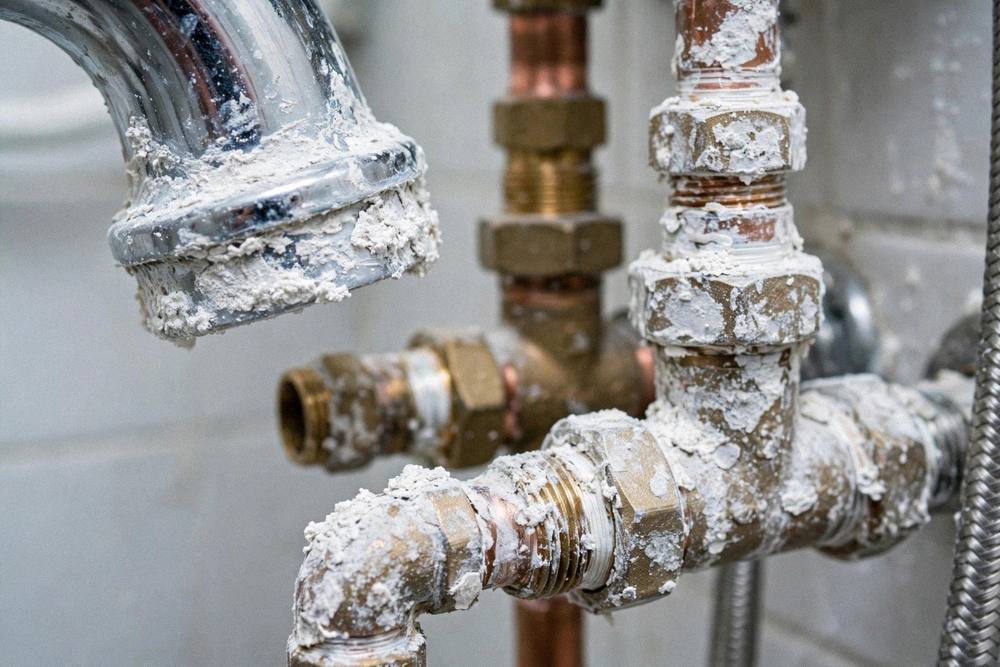
Hard water scale in Nampa builds up inside water heaters on city water. Nampa water runs from none to 7.08 grains per gallon in hardness, based on the City of Nampa 2024 Consumer Confidence Report. It coats heating parts, cuts hot water, and shortens heater life. A yearly flush and a yearly descale keep it under control.
What Hard Water Scale Is
Nampa water carries calcium and magnesium, two minerals that dissolve as water moves through rock and soil. When the water heats up inside a water heater, the minerals drop out and stick to hot surfaces. That crust is scale, mostly calcium carbonate, and it is hard as rock once it sets.
The City of Nampa 2024 Consumer Confidence Report puts Nampa water hardness at none to 7.08 grains per gallon. On the United States Geological Survey scale, water from 121 to 180 milligrams per liter counts as hard, and one grain per gallon equals 17.1 milligrams per liter, so 7.08 grains per gallon works out to about 121 milligrams per liter. Nampa water sits right at the line where water turns hard, and no part of the city runs harder than 7.08 grains per gallon.
Scale forms faster as water gets hotter. A water heater runs hotter than any other fixture in the home, so it collects scale faster too. A showerhead shows a white crust. A water heater hides the same crust inside a tank or a heat exchanger, where you cannot see it until it starts to cause trouble.
How Scale Hurts a Tank Water Heater
In a tank heater, scale settles at the bottom of the tank as sediment. On a gas unit, the burner fires under that layer. Water trapped under the sediment boils in small bursts and makes the popping and rumbling noise many Nampa homeowners hear from the garage. The burner has to heat through the crust, so the unit runs longer and burns more gas.
On an electric unit, the lower heating element sits in the sediment. Scale coats the element and buries it. A coated element cannot pass heat to the water, so it runs hotter than it should and burns out early. The upper element then tries to heat the whole tank alone, and the house runs out of hot water mid shower. Element replacement runs $100 to $350 nationally, based on HomeGuide 2026, but a new element in a tank full of scale fails early too.
Scale also eats the anode rod faster. The anode rod is a metal rod inside the tank that rusts so the tank does not, and the United States Department of Energy says to check it every 3 to 4 years. In hard water, the rod works harder and wears out faster. Once the rod is gone, the tank rusts from the inside out. A tank lasts 8 to 12 years, based on the Department of Energy, and one that never gets flushed in Nampa hard water often fails at the short end of that range, by leaking.
How Scale Hurts a Tankless Water Heater
A tankless unit has no tank to hold sediment. It has a heat exchanger instead, a coil of narrow passages that heats water as it flows through. Scale coats the inside of those passages and narrows them, so less water flows through. The shower then runs weak and swings hot and cold.
Scale also trips error codes. When the heat exchanger cannot pass heat to the water, the metal runs hot and the unit shuts down to protect itself. Rinnai code 14, Navien code E016, and Takagi code 111 all point at heat and scale in one way or another. Reset once, twice at most, then call us. A tankless repair runs $300 to $1,300 nationally, based on HomeGuide 2026.
Tankless makers call for a descale on the schedule in the owner manual, more often in hard water areas. In Nampa, that means a descale once a year, and a tankless descale runs $75 to $300 nationally, based on HomeGuide 2026. A unit that goes years without a descale can need a heat exchanger replacement, and that runs $600 to $1,300 nationally, based on HomeGuide 2026. A tankless unit lasts 15 to 20 years, based on the Department of Energy, but only if scale does not eat that life away.
The Signs of Hard Water Scale in Your Home
The first sign is often noise. A tank that pops, rumbles, or crackles while it heats has sediment at the bottom. The second sign is less hot water. A tank that used to fill a tub now runs cold halfway through, and a tankless unit that ran two showers now struggles with one.
The third sign is white crust and white flakes. White crust on faucets and showerheads is the same mineral that coats the inside of the heater. White flakes in a faucet aerator often come from scale breaking loose inside the heater and riding out with the hot water.
The fourth sign is a rising bill. A scaled heater runs longer to make the same hot water, and longer run time means more gas or more electricity. If the bill climbs and nothing else changed, the heater is working harder than it should.
The fifth sign is rusty water or a leak at the base of the tank. Scale itself does not cause rust, but a tank that runs hot under sediment corrodes faster once the anode rod is gone. Water at the base means the tank has failed.
What a Flush and a Descale Cost in Nampa
A tank flush runs $75 to $250 nationally, based on HomeGuide 2026, and a tankless descale runs $75 to $300 nationally, based on HomeGuide 2026. Those are national figures, and Nampa prices are not yet confirmed, so get a written price before we start.
A flush takes about an hour on a tank unit. We drain the tank, wash the sediment out, and check the anode rod. A descale on a tankless unit takes longer. We run a descaling solution through the heat exchanger in a loop for 45 to 90 minutes, then flush it with clean water.
A tank replacement runs $600 to $3,100 installed nationally, based on HomeGuide 2026, and a tankless replacement runs $1,400 to $5,600 installed nationally, based on HomeGuide 2026. A yearly flush or descale costs a small part of a replacement, and it is the main thing that keeps a heater alive to the end of its expected life.
How to Slow Scale Down: Flush, Descale, Soften
The first step is a flush every year on a tank unit. A tank flushed on schedule sheds loose sediment before it hardens into rock. A tank that goes three years without a flush often holds a crust that a garden hose flush cannot remove.
The second step is a descale every year on a tankless unit. The heat exchanger is narrow and scales up fast in Nampa water. A yearly descale keeps the passages open and the error codes away.
The third step is to keep the temperature at 120 degrees Fahrenheit. The Department of Energy sets 120 degrees as the setting that saves energy for most households, and it also slows scale. A tank set to 140 degrees scales up faster than a tank set to 120 degrees.
The fourth step is a water softener, for homes that want to stop scale at the source. A softener swaps calcium and magnesium out of the water before it reaches the heater. It costs more than a flush and needs salt and upkeep, but it is the only fix that stops scale from forming at all. We do not sell softeners.
When Scale Means Repair and When It Means Replace
If the repair quote is more than half the cost of a replacement and the heater is past half its expected life, replace it. That is the 50 percent rule. A tank lasts 8 to 12 years, so half its life is 4 to 6 years. A tankless unit lasts 15 to 20 years, so half its life is 7 to 10 years.
A tank under 8 years old with scale noise and a working burner usually needs a flush and a new anode rod, not a new tank. A tank over 10 years old with a leaking base needs a replacement, and no flush will save it. A tankless unit that throws scale codes but still heats after a descale usually has years left. A tankless unit with a heat exchanger that leaks needs a new heat exchanger or a new unit, and the 50 percent rule decides which one.
If the heater is past half its life, get the full picture in one written price before you decide. A permit, if one is needed, runs $50 to $200 nationally, based on HomeGuide 2026, and we check with the City of Nampa before we start.
Questions Nampa Homeowners Ask About Hard Water Scale
Does Nampa have hard water?
Yes. The City of Nampa 2024 Consumer Confidence Report puts Nampa water hardness at none to 7.08 grains per gallon. That puts the hardest Nampa water right at the line the United States Geological Survey calls hard, and every Nampa home should plan on scale.
How often should I flush my water heater in Nampa?
Once a year. A tank flush every year keeps sediment from hardening into rock, and a tankless descale every year keeps the heat exchanger open. Homes on a private well should test the water first.
Will a water softener stop scale in my water heater?
Yes, a softener removes the calcium and magnesium before the water reaches the heater, so scale stops forming. It is the only fix that stops scale at the source. A yearly flush still helps, because a softener does not remove sediment that is already in the tank.
Can hard water scale kill a water heater?
Yes. Scale coats heating parts, forces the unit to run longer, and wears out elements, burners, and heat exchangers early. A tank that never gets flushed in Nampa hard water often fails early, by leaking.
If your water heater pops, rumbles, or runs out of hot water too soon, scale is the first thing we check. Ask Nampa HeatPros for a flush or a descale, and we will tell you in plain words what your heater needs next. Our flushing page explains the tank flush step by step, our tankless descaling page covers the tankless service, and our hard water blog walks through the Nampa water numbers in full.
Our Service Area
We serve Nampa and the towns around it. Pick your area to see water heater repair there.