
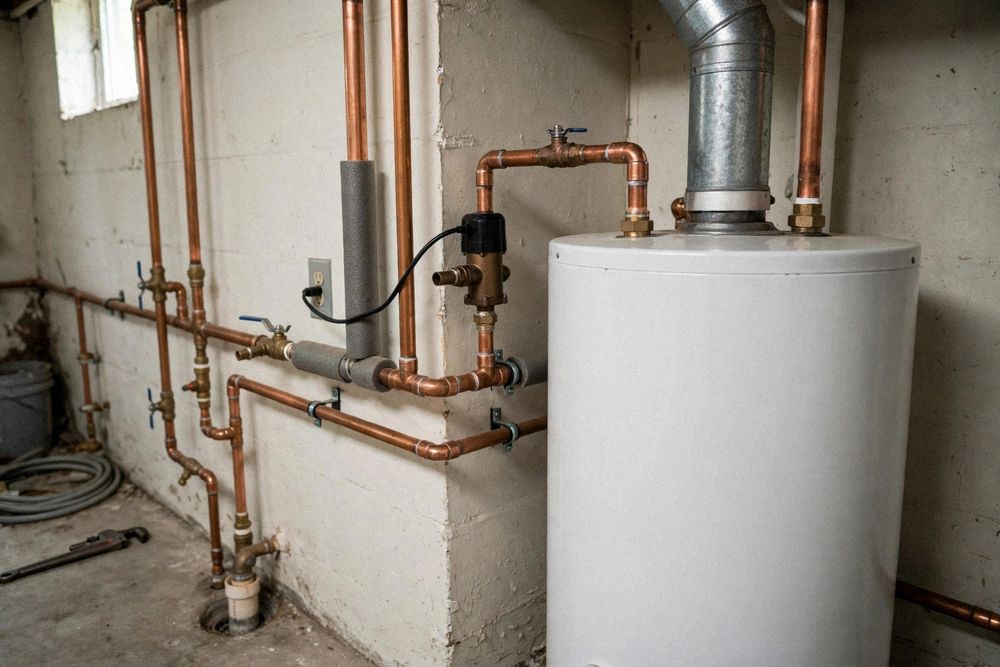
A hot water recirculation pump keeps hot water close to your far taps, so the shower in the back bath turns hot in seconds, not after a long cold run down the drain. It does not make more hot water, and it does not fix a heater that runs out. It fixes the wait.
Why Hot Water Takes So Long in Larger Nampa Homes
Open a far tap and the water that comes out first sat in the pipe since the last use. That water has cooled. You run it down the drain until fresh hot water travels all the way from the heater to the tap. The longer the pipe run, the longer the wait and the more water goes down the drain.
Nampa has plenty of long runs. The median home in Nampa was built in 2000, and about 26 percent were built before 1980, according to Census housing data cited in our local research. Newer homes in North Nampa, near Lake Lowell, and around Karcher Road are often larger, with the heater in the garage and the main bath at the far end of the house.
The waste adds up. The EPA WaterSense Guide for Efficient Hot Water Delivery Systems, dated July 24, 2014, states that the average home wastes more than 3,650 gallons of water per year waiting for hot water to arrive at the tap. That is a national average, not a Nampa meter reading. The wait costs water first, and heat second, because the water you ran down the drain was heated once already.
> The average home wastes more than 3,650 gallons of water per year waiting for hot water to arrive at the tap. Source: EPA WaterSense Guide for Efficient Hot Water Delivery Systems, July 24, 2014.
How a Hot Water Recirculation Pump Works
The pump moves water in a loop. It pulls cooled water out of the hot line near the far fixture, sends it back to the heater, and lets fresh hot water take its place in the line. The tap then opens onto water that is already warm. The pump is small, about the size of a fist, and it mounts at the heater or under the far sink, based on the type of system. The heater still does all the heating.
Dedicated Return Line vs Crossover Valve
A dedicated return line is a third pipe. It runs from the far fixture back to the heater, next to the hot and cold lines. Water goes out through the hot line and back through this return line, in a closed loop. The cold line stays cold, because it never carries return water. This is the best choice when the house is new, open for a remodel, or already plumbed with a return line.
A crossover valve is the retrofit answer. It is a small valve that fits under the far sink and links the hot line to the cold line at that one spot. The pump pushes cooled water out of the hot line, across the valve, and back to the heater through the cold line. No new pipe goes in the wall. That is why most finished homes in Nampa get a crossover valve system. It uses the pipes that are already there.
| Feature | Dedicated return line | Crossover valve |
|---|---|---|
| New pipe in the wall | Yes, a third pipe from the far fixture to the heater | No, uses the cold line as the return path |
| Cold tap stays cold | Yes | Mostly, warm for a short time after a cycle |
| Best for | New builds, remodels, homes already plumbed for it | Finished homes, most Nampa retrofits |
Controls: Timer, Thermostat, and Demand
The control decides when the pump runs, and it decides most of the running cost. A pump that runs only when you need hot water loses far less heat than one that runs all day.
A timer runs the pump at set hours, such as the morning shower window and the evening kitchen window, and it rests the rest of the day. A thermostat, also called an aquastat, watches the temperature in the loop and runs the pump when the loop cools below a set point. It keeps the loop warm around the clock unless you pair it with a timer.
A demand control runs the pump only when someone asks for hot water, with a push button by the bath, a motion sensor in the main bath, or a smart control that learns your pattern. You press the button, wait a short time while the loop primes, then open the tap to hot water. This uses the least energy, because the loop rests until it is needed.
The 2021 International Residential Code energy rules require controls that shut the pump off when the loop is hot, and limit water sent into cold piping to 104 degrees Fahrenheit, per Ember and Tank.
What It Costs to Install
All prices here are national, not Nampa prices. No Nampa price has been verified, so treat these as a planning range.
HomeServe, December 22, 2025, puts a retrofit system that uses your existing pipes at about $500 to $1,500 installed, and a dedicated return loop at about $2,000 to $7,000 installed. Pump and controls alone, equipment only, run about $200 to $750 in that same guide. The wide range on the dedicated loop comes from pipe length, how many walls must open, pipe insulation, and smart controls.
Fixr, updated August 29, 2025, puts water heater repair labor at $75 to $150 per hour, average $90 per hour, national, so access matters. A pump at an open heater takes less time than a pump in a tight closet.
Do not judge the job by the box price alone. The rest is labor, valves, a check valve to stop backward flow, pipe insulation, and the control. The cheapest time to add a loop is when the heater is being replaced, when the pipes are already open. Our water heater installation in Nampa page covers replacement timing and sizing in full.
Water Saved vs Energy Used: The Honest Math
A recirculation system saves water, but it does not always save money. It can cost more in energy than it saves in water if the control is wrong.
The pump itself uses little power. A small pump draws about 25 watts, about the same as a light bulb, according to hvacbase.org, updated October 8, 2026. Run nonstop, it uses about 219 kilowatt hours per year, about $39 per year at 18 cents per kilowatt hour. On a timer for four hours a day, it costs under $7 per year. The heat loss is the problem.
A loop kept hot sheds heat through the pipe walls all day, and the heater must replace that heat. The Residential Energy Services Network rating method, as shown in a 2017 Florida Solar Energy Center report for the Florida Building Commission and cited by Ember and Tank, puts numbers on this. An insulated loop running nonstop or on a timer uses about 2.4 times the water heating energy of a normal layout with no loop. A push button demand system uses about the same as no loop at all. The control, not the pump, sets the energy cost.
Insulate the hot line and the return line, set the control to your routine, and set the heater to 120 degrees Fahrenheit, per the DOE. Water heating is about 18 percent of a typical home energy use, per the DOE, so a loop that doubles that share is not a small change. Buy the system for comfort and for water saved, not as a money maker. Our water heater repair cost in Nampa page shows how national prices are built.
Does It Work With a Tank Heater? With a Tankless Heater?
Yes to both, but the tankless case needs more care. A tank heater stores hot water all day, so the pump just moves water that is already hot. A 40 gallon tank still suits 1 to 3 people, and a 50 gallon tank still suits 3 to 5, with or without a loop. If your tank runs out fast now, fix that first. Our water heater replacement in Nampa page covers sizing.
A tankless heater heats water only when water flows. It needs a minimum flow to fire, often about 0.5 to 0.75 gallons per minute, according to trade guides on tankless recirculation. A loop pump moving water at a low flow can sit below that minimum, so the burner may cycle on and off, or may not fire at all. That cycling wears the heat exchanger and wastes gas. That is why some tankless models are built for recirculation and some are not.
Recirculation ready tankless models, such as the Navien NPE A2 series with a pump inside the unit, handle the loop with internal logic and a return port, according to WaterHeating.ca, published September 7, 2026 and updated September 19, 2026. Note that a tankless unit alone does not fix the wait, because it heats on demand but the pipe run stays long. Rinnai also documents recirculation on its condensing tankless models. Other models need an external pump matched to the unit, with the flow set high enough to fire the burner cleanly. The model name matters, so have it ready when you call. Our tankless water heater repair in Nampa page lists the common error codes and the reset rule: reset once, twice at most, then call for help.
Nampa Hard Water and Winter: What They Do to the Loop
Nampa water is hard enough to matter. The City of Nampa 2024 Consumer Confidence Report puts hardness at none to 7.08 grains per gallon. It is hard enough to lay scale inside a hot heater and inside a loop that reheats the same water again and again. Scale narrows passages, coats the heat exchanger, and makes the heater work harder for the same hot water.
A loop reheats the same water on each pass, so minerals get repeated chances to come out of the water and stick. A loop that runs nonstop gives scale more passes than a loop that runs on demand, so use a timer or demand control here. Nampa also sees about 132 freezing nights per year, with a January average low of 23 degrees Fahrenheit, per NOAA data for 1991 to 2020, so insulate the loop pipes before winter. A pump does not freeze proof a pipe.
Tankless descaling runs $75 to $300, national, per HomeGuide 2026, and a tank flush runs $75 to $250, national, per the same source. In Nampa hard water, plan on a yearly descale for a tankless unit, and a yearly flush for a tank. Our water heater maintenance in Nampa page covers flushing and descale timing in full.
Maintenance: What to Check Each Year
Listen to the pump first. A healthy pump hums low and steady. A loud pump has air, a worn bearing, or scale, so turn the control off and call for a look.
Check the check valve second. It stops water from flowing backward when the pump is off. If it sticks open, some fixtures run cool while others run hot. If it sticks shut, the loop stops and the wait comes back.
When It Is Worth It and When It Is Not
A loop is worth it when the wait is long, the far fixtures get used every day, and the house has a clear return path or a good crossover spot. It is not worth it when the wait is short or the heater itself is the real problem.
| Your situation | Verdict |
|---|---|
| Far bath takes 45 seconds or more to turn hot, used daily | Worth a quote, crossover valve likely fits |
| Two or three far baths, all used daily | Worth a quote, dedicated loop may fit better |
| Tankless install, far bath still waits | Worth it, loop is the fix for the wait |
| Wait is under 15 seconds at every tap | Not worth it, save the money |
| Heater runs out of hot water now | Not worth it yet, fix sizing first |
FAQs
Does a recirculation system give instant hot water?
No, not instant. It gives hot water in seconds at a tap on the loop, instead of after a long cold run. The loop stages warm water near the tap, so the wait drops a lot, but a short prime time remains, mainly with a demand control. A tap not on the loop still waits as before.
How much does it cost to run each year?
The pump power is small, about $39 per year nonstop or under $7 per year on a 4 hour timer, at 18 cents per kilowatt hour, per hvacbase.org, October 8, 2026. The larger cost is heat lost from a loop kept hot, which can reach about 2.4 times normal water heating energy if it runs nonstop, per RESNET.
Will it work with my tankless water heater?
It can, if the model is built for it or the external pump is matched to it. Some models have a pump inside and a return port, such as the Navien NPE A2 series, per WaterHeating.ca, September 2026. Have the model name ready, and do not add a loop to a tankless unit by guess.
Does Nampa hard water damage the pump?
Hard water lays scale in the heater and in the loop, and a loop reheats the same water again and again, so scale builds faster than without a loop. Nampa hardness runs none to 7.08 grains per gallon, per the City of Nampa 2024 Consumer Confidence Report. Plan a yearly descale for tankless units and a yearly flush for tanks.
Get Hot Water Faster in Your Nampa Home
If the far bath in your Nampa home takes a minute to turn hot, a hot water recirculation pump may be the fix, and the right fix starts with the return path and the control, not with the pump in the box. Tell us how long the wait is, which bath is farthest, and whether your heater is a tank or a tankless unit. We will check for a return line and give you a written price for the system that fits your house.
Our Service Area
We serve Nampa and the towns around it. Pick your area to see water heater repair there.