
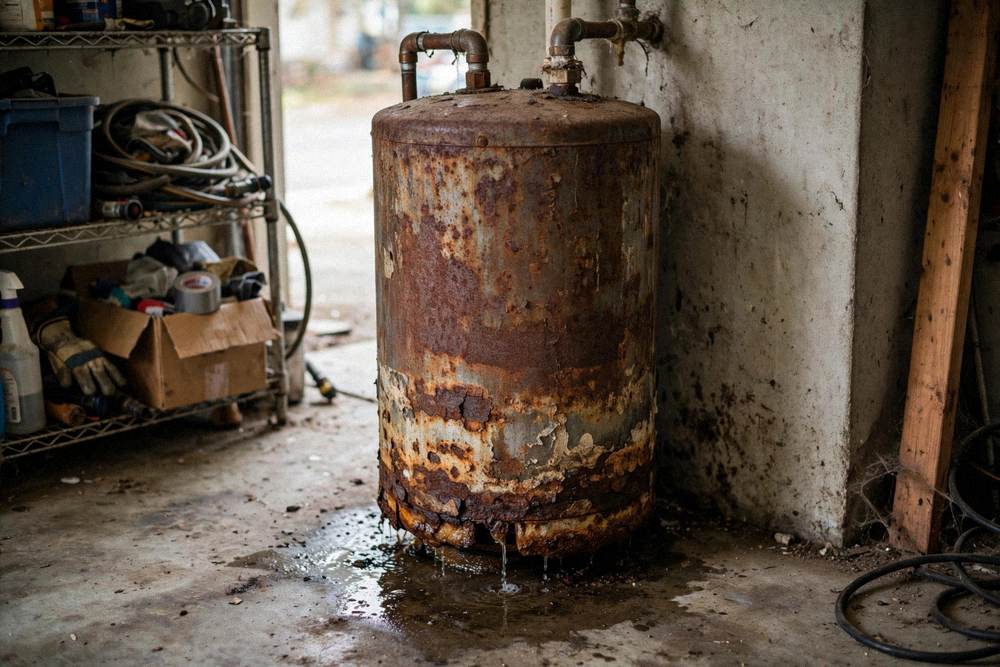
A water heater rarely fails without warning. It gives you signs first, sometimes weeks or months before it stops working: water at the base, rusty water from the hot tap, popping noises, hot water that runs out fast, bills that climb for no clear reason, and repairs that keep coming back. One sign on its own may only mean a part needs fixing. Two or three signs together on an older unit mean the tank is telling you it is done. These are the water heater needs replacing warning signs to watch for, plus how to check your heater age and the simple rule that decides repair or replace.
How Long Should a Water Heater Last?
A standard tank water heater lasts 8 to 12 years. A tankless unit lasts 15 to 20 years with regular maintenance. Those are US Department of Energy figures, and they are averages, not guarantees. A tank flushed every year in soft water can reach the top end. A tank never flushed in Nampa hard water can fail years early.
The first thing to do is find out how old your heater is. Look for the manufacturer label on the side of the tank. It carries a serial number, and for most major brands, Rheem, Bradford White, A.O. Smith, Navien, Rinnai, Noritz and State, the first four digits of the serial number give the month and year the unit was built. A serial number starting with 0315 means March 2015. That makes the unit 11 years old in 2026, past the middle of its expected life.
Age alone does not mean replacement. An older unit that still works well, makes plenty of hot water, and shows no rust or leaks may have years left. Age becomes the deciding factor when it shows up with one of the seven signs below. A 4 year old tank with a leak at a fitting needs a repair. A 12 year old tank with a leak at the base needs a replacement.
> The US Department of Energy puts tank water heater life at 8 to 12 years and tankless life at 15 to 20 years. The anode rod is the part that decides where in that range your tank lands: inspect it every 3 to 4 years, and replace it when it is worn down, or the tank starts rusting from the inside.
The 7 Water Heater Needs Replacing Warning Signs
1. Water Pooling Around the Base
Water at the base of the tank is the clearest sign of all, and it rarely gets better. First, make sure the water is really coming from the tank. Towel the floor dry, lay paper towels in a ring around the base, and check where the wet spot comes back first. Water can travel down from a fitting on top, and a drip at a fitting is a repair, not a replacement.
But water coming from the tank body itself means the steel has rusted through from the inside, and no repair can reverse that. A tank body leak cannot be patched for the long term. If the tank is leaking from the bottom, it needs to be replaced, and soon, because the leak only gets worse and the water on the floor is already doing damage. Our blog on leaking water heater what to do covers the first 10 minutes when you find water under the tank.
2. Rusty or Discolored Hot Water
Run the hot tap and look at the water. If it comes out brown, yellow, or rusty, and the cold water runs clear, the rust is coming from inside the hot water tank. That means the glass lining inside the tank has cracked and the steel is corroding.
Check the anode rod first. It is a metal rod inside the tank that corrodes in place of the steel, and it should be checked every 3 to 4 years. If the rod is gone and the water is rusty, the tank is already rusting. A new rod can slow it down, but it cannot undo rust that has eaten into the steel. Rusty water plus an old tank is a replacement sign.
Rust on the outside of the tank tells the same story. Rust streaks running down the sides, or rust in the drain pan under the tank, mean corrosion has reached the outside. Either way, the tank is failing from the inside out.
3. Popping, Rumbling, or Banging Noises
A tank should be quiet. Popping, rumbling, or banging means sediment has built up on the bottom of the tank, and water trapped under that layer is flashing to steam when the burner fires. In Nampa, with water at none to 7.08 grains per gallon (City of Nampa 2024 Consumer Confidence Report), sediment builds up fast, and a tank that has never been flushed can carry a thick layer within a few years.
A flush can fix the noise if the sediment is still loose. A tank flush runs 75 to 250 dollars nationally (HomeGuide, 2026). But if the noise comes back within weeks of a flush, or if the tank is over 10 years old and has never been flushed, the sediment has likely hardened into scale, and the tank bottom has been overheating for years. That overheating weakens the steel and shortens the tank life. Our blog on water heater making popping noises explains what each sound means and when a flush is too late.
4. Hot Water Runs Out Fast
If your showers go lukewarm faster than they used to, or the water temperature swings up and down, the heater is losing its ability to do its job. There are three common causes, and only one of them is a replacement sign on its own.
The first is a failed lower heating element on an electric tank. The upper element heats the top, so you get a short burst of hot water, and then cold. That is a repair, not a replacement. The second is sediment, which takes up space in the tank and insulates the water from the heat. A flush may fix it. The third is age: a tank that has been heating water for 12 years with a thick sediment layer and a worn anode rod simply cannot keep up any more.
5. Energy Bills Climbing for No Clear Reason
A water heater that has to work harder uses more gas or electricity, and that shows up on the bill. Sediment is the usual cause: it insulates the water from the burner or the elements, so the heater runs longer to heat the same amount of water. A failing thermostat can do the same thing by keeping the heater on too long. A slow leak can do it too, because the heater keeps heating fresh cold water to replace what is leaking out.
Look at your bills over the last year. If the gas or electric bill has climbed steadily and nothing else in the house changed, the heater is a likely suspect. Water heating is about 18 percent of a typical home energy use (US Department of Energy), so a struggling heater moves the bill. A steady climb over six months means the heater is losing efficiency, and on an old tank that is a replacement sign.
6. Repairs Keep Coming Back
One repair in the life of a tank is normal. A thermostat here, an element there, a thermocouple on a gas unit. Two or more repairs in a single year is a pattern, and a pattern means the tank is wearing out all at once.
Add up what you have spent. A heating element replacement runs 100 to 350 dollars nationally, a thermostat replacement runs 100 to 350 dollars, and a thermocouple replacement runs 100 to 325 dollars (HomeGuide, 2026). Two of those in one year on a 10 year old tank can add up to half the cost of a new unit, and the next failure is already on its way.
The 50 percent rule makes this simple, and it is covered in full below. If the repair quote is more than half the cost of a new unit, and the heater is past half its expected life, replace it.
7. Age Plus One More Sign
Age on its own is not a reason to replace a heater that works. Age plus any one of the six signs above is. A 12 year old tank that pops is a different conversation from a 4 year old tank that pops. A 11 year old tank with rusty water is a different conversation from a 5 year old tank with rusty water.
Check the serial number, work out the age, and count the signs. Zero signs and the heater works: leave it alone and flush it once a year. One sign on a young tank: repair it. Two or more signs on a tank past 10 years: start planning the replacement before it fails on its own schedule, which is usually a cold January night. Nampa sees 132 nights a year at or below freezing (NOAA 1991 to 2020).
Repair or Replace? The 50 Percent Rule
The 50 percent rule is the decision tool plumbers use, and it takes two numbers: the repair quote and the replacement cost. If the repair costs more than half of a replacement, and the heater is past half its expected life, replace it.
Here are two worked examples with national figures. A tank replacement runs 600 to 3,100 dollars installed (HomeGuide, January 2026), so take 1,400 dollars as a middle figure. Half of that is 700 dollars.
Example one: a 5 year old tank needs a new gas control valve at 550 dollars. The repair is less than half the replacement cost, and the tank is well short of half its life. Repair it.
Example two: a 11 year old tank needs a new gas control valve at 550 dollars plus a heating element at 300 dollars. The total is 850 dollars, more than half the replacement cost, and the tank is past half its life. Replace it.
A tankless unit uses the same rule with bigger numbers. A tankless replacement runs 1,400 to 5,600 dollars installed (HomeGuide, January 2026). A heat exchanger replacement runs 600 to 1,300 dollars (HomeGuide, 2026). On a tankless unit under 10 years old, a heat exchanger repair usually makes sense. On one over 15 years old, replacement usually wins. Our water heater replacement in Nampa page works through sizing and costs in full, and our water heater repair cost in Nampa page lists repair costs by job.
What Replacement Costs
A tank replacement runs 600 to 3,100 dollars installed nationally, and a tankless replacement runs 1,400 to 5,600 dollars installed (HomeGuide, January 2026). A hybrid heat pump unit runs 2,000 to 4,600 dollars installed. Those are national ranges, not Nampa prices.
What changes the price is the work around the unit. A straight swap, same size, same fuel, same spot, costs the least. A tank to tankless conversion costs more, because it needs new venting, a bigger gas line, electrical work, and a condensate drain. Labor for a tank to tankless conversion runs 600 to 2,500 dollars nationally (HomeGuide, 2026). Removing the old unit runs 75 to 500 dollars, and a permit runs 50 to 200 dollars where one is needed. A tank swap takes 3 to 5 hours, and a tankless install takes half a day.
One thing to know before you plan: the federal 25C tax credit for water heaters ended for equipment placed in service after December 31, 2025 (IRS FS-2025-05). Do not count on it. Any rebate a salesperson mentions for 2026 needs checking against the current Idaho Power program, because old rebate lists stay online long after the money is gone.
What to Do Next
If your heater shows one or more of these signs, do three things. First, find the serial number and work out the age. Second, check for water at the base and look at the hot water color, because a leaking tank or rusty water changes the answer right away. Third, call a plumber for an honest assessment, and ask for the repair quote and the replacement quote side by side.
Do not wait for a tank that is already leaking at the base. A tank body leak only gets worse, and the water on the floor is already doing damage. The Insurance Information Institute puts the average water damage claim at about 15,400 dollars.
Questions About Replacing a Water Heater
How do I know if my water heater needs to be replaced or repaired?
Check the age from the serial number, then count the warning signs: water at the base, rusty water, popping noises, hot water running out fast, climbing bills, and repeated repairs. One sign on a young tank means repair. Two or more signs on a tank past 10 years means replacement. A tank leaking from the body itself always means replacement.
Can a leaking water heater be repaired?
It depends where the water comes from. A drip at a fitting, a drain valve, or a relief valve can usually be repaired. A leak from the tank body itself cannot be repaired, because the steel has rusted through. That tank needs to be replaced.
Is it worth replacing a 10 year old water heater?
It depends on the signs. A 10 year old tank that works well, makes plenty of hot water, and shows no rust or leaks may have years left. A 10 year old tank with rusty water, popping noises, and a repair bill in the last year is telling you to replace it.
How long does a water heater replacement take?
A tank swap takes 3 to 5 hours, and a tankless install takes half a day. A tank to tankless conversion takes longer, because it needs new venting, a bigger gas line, and a condensate drain. The old unit is hauled away as part of the job.
Call Nampa HeatPros for an Honest Answer
If your heater is showing warning signs, call Nampa HeatPros. We will check the age, test the parts, and give you the repair quote and the replacement quote side by side, so you can decide with real numbers. If a repair makes sense, we will say so. If the tank is done, we will show you why. Water heaters are all we do.
Our Service Area
We serve Nampa and the towns around it. Pick your area to see water heater repair there.