
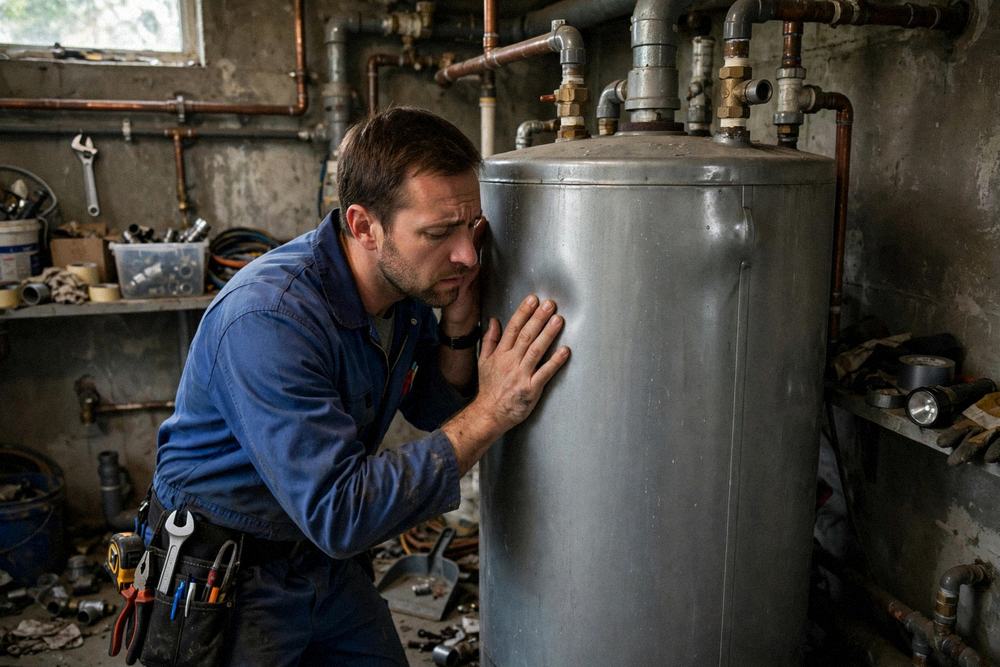
A water heater making popping noises almost always has sediment built up on the bottom of the tank. When the burner fires or the element heats up, water trapped under that sediment layer flashes to steam and bursts through it, and that burst is the pop you hear. It is the most common water heater noise there is, and it is also the earliest warning that scale is building up inside your tank. This guide explains what the sound means, why it happens faster in Nampa, what it costs you if you ignore it, and how to fix it.
What Makes the Popping Sound?
Inside a tank water heater, the burner sits under the bottom of the tank on a gas unit, and the heating elements sit inside the tank on an electric unit. Water is supposed to touch the hot steel directly and carry the heat away. Sediment breaks that contact.
As water heats up, minerals in it, mostly calcium and magnesium, come out of the water and settle on the bottom of the tank as a layer of sediment. That layer grows thicker every year the tank is not flushed. Water gets trapped in and under the sediment. When the burner fires, the trapped water heats past boiling and flashes to steam. The steam bubble bursts through the sediment with a pop. Do that hundreds of times a day and you get the steady popping and crackling that sounds like a coffee maker working hard.
Plumbers call this kettling, because it sounds like a kettle coming to a boil. A. O. Smith describes it in its mineral buildup bulletin as "a popping of water trapped under lime deposits." The sound is not random. It starts when the layer gets thick enough to matter, usually after years without a flush in a hard water area, and it gets louder as the layer grows.
Rumbling is the same problem at a larger scale. Thick, hardened scale traps bigger pockets of water against the tank bottom. When the burner fires, those pockets flash to steam hard enough to shake the tank, and you hear a low rumble or a deep growl on startup. If your heater pops, it needs a flush. If it rumbles, it needed a flush a while ago.
Why Sediment Builds Up Faster in Nampa
Every tank in the country builds up some sediment, but Nampa water makes it happen faster. The City of Nampa 2024 Consumer Confidence Report puts hardness at none to 7.08 grains per gallon, and the water comes from city wells in the Snake River Plain Aquifer. Water at 7 grains per gallon is classed as hard, and hard water drops more mineral out of every gallon heated than soft water does.
That means a Nampa tank that has never been flushed builds a thicker sediment layer in the same years than a tank in a soft water town. A tank in a new subdivision in North Nampa or East Nampa can start popping within a few years. A tank in an older home near downtown may have been popping for a decade without anyone flushing it.
The fix is the same everywhere, but the schedule is not. In a soft water town, a flush every two years may be enough. In Nampa, a yearly flush is the schedule that keeps a tank quiet. The US Department of Energy says to drain a quarter of the tank every few months to remove sediment, and to flush the full tank once a year in hard water areas. Our water heater flushing in Nampa page covers the full flush schedule and what it costs.
Kuna, just southeast of Nampa, averages 8.05 grains per gallon (City of Kuna Consumer Confidence Report), harder still.
Popping, Rumbling, and the Other Sounds
Not every noise is sediment. Here is how to tell them apart by ear.
| Sound | What it usually means | How urgent |
|---|---|---|
| Popping or crackling, like a coffee maker | Sediment on the tank bottom, water flashing to steam | Soon: schedule a flush |
| Rumbling or a low growl on startup | Thick hardened scale, large steam pockets | Soon: flush, and have the tank checked |
| Ticking or tapping as the tank heats and cools | Metal expanding and contracting, or heat traps in the pipes | Normal, unless it is loud and constant |
| Banging when a tap shuts off | Water hammer, pressure spike in the pipes | Soon: check pressure and arrestors |
| Hissing or sizzling near the burner | Condensation dripping on the burner, or a leak | Soon: check for water under the tank |
| Whistling or a high pitched scream | Partly closed valve, or a relief valve venting pressure | Now: check the relief valve |
| Popping from the relief valve | Pressure buildup from thermal expansion | Now: do not cap it, call a plumber |
Ticking is the sound most people mistake for a problem. A tank ticks as the steel warms and cools, and pipes tick as they expand in their brackets. That is normal, and it stops on its own. Banging is different. A loud bang the instant a faucet shuts off is water hammer, a pressure wave in the pipes, and it stresses the tank and the joints every time it happens.
Hissing needs a look. A little sizzling on a gas burner can be condensation dripping down during heat up, which is normal. A steady hiss with water under the tank is a leak, and that is a different problem. Our leaking water heater in Nampa page covers what to do when water shows up under the tank.
A pop from the relief valve is also different from sediment popping, and it matters more. The temperature and pressure relief valve sits on the side or top of the tank, and it opens at 150 psi or 210 degrees Fahrenheit to vent pressure. If it pops or drains, pressure is building up, often from thermal expansion in a closed system with no expansion tank. Never cap, plug, or restrict a relief valve or its discharge pipe. That valve is the one safety device standing between a tank and a rupture.
What Happens If You Ignore It
Popping is not just a noise. It is a warning that the tank is working harder than it should, and the longer you leave it, the more it costs you.
First, your bills go up. Sediment acts like insulation between the heat source and the water. The burner has to run longer and hotter to heat the same amount of water, and the elements have to stay on longer. Water heating is about 18 percent of a typical home energy use (US Department of Energy), so a heater working against a thick sediment layer shows up on the gas or electric bill month after month.
Second, the tank wears out sooner. The bottom of the tank overheats where the sediment traps the heat. Steel that runs hotter than it was built for weakens, and the glass lining inside the tank cracks. Once the lining cracks, water reaches the steel, and the steel starts to rust. A tank that should last 8 to 12 years can fail years early this way. Our blog on water heater replacement warning signs covers the seven signs that say a tank is done.
Third, you get less hot water. Sediment takes up space in the tank. A 50 gallon tank with several inches of sediment on the bottom holds less hot water than it did when it was new, and it heats what is left more slowly. Showers run out fast, and the dishwasher finishes before the water is hot.
Fourth, the tank can start leaking. Overheating weakens the bottom, and rust eats through it. A tank body leak cannot be repaired. Once water is coming through the steel itself, the only fix is a new tank, and the water on the floor is already doing damage. The Insurance Information Institute puts the average water damage claim at about 15,400 dollars, and one in 60 insured homes files one each year.
> The US Department of Energy says to drain a quarter of the tank every few months to remove sediment, and to flush the full tank once a year in hard water areas. A yearly flush is the cheapest maintenance a water heater ever gets.
How to Fix It: Flushing the Tank
A flush drains the tank and washes the sediment out. On a tank under about 8 years old that has been flushed before, it is routine maintenance. On a tank over 10 years old that has never been flushed, have a plumber look at it first, because a flush can reveal a leak the sediment was plugging.
A tank flush runs 75 to 250 dollars nationally (HomeGuide, 2026). The plumber shuts off the power or gas, closes the cold water supply valve, attaches a hose to the drain valve at the bottom of the tank, and runs the water out to a floor drain or outside. Then the cold water is opened briefly to stir up the sediment and wash it out. The tank is refilled, the air is bled out through a hot tap, and the heater is turned back on.
After a flush, the popping should stop right away. If it does not, the sediment has hardened into scale that a flush cannot move, and the tank may need a descale or a replacement. If the tank is over 10 years old and the noise comes back within weeks, that is a sign the tank is near the end of its life, not a sign the flush failed.
The schedule matters more than the fix. In Nampa, flush once a year. A tank flushed every year stays quiet, holds its full capacity, and reaches the top end of its 8 to 12 year life. A tank never flushed pops, runs out fast, and dies early. Our water heater flushing in Nampa page covers the full flush schedule, and our water heater maintenance in Nampa page covers the yearly tune up that goes with it.
Popping on a Tankless Unit
A tankless unit has no tank and no sediment layer on the bottom, but it can still pop, and the cause is the same mineral in a different place. Hard water leaves scale inside the heat exchanger, the coiled pipes where the water heats as it passes through. Scale narrows the passages, and water trapped behind it flashes to steam and pops, just like sediment in a tank.
A tankless unit that pops usually shows an error code too. Overheating is Rinnai 14 and Navien E016, plus the Navien 400 series including E407. If the display shows one of those codes and the unit pops, scale is the first suspect. The fix is a descale, which runs 75 to 300 dollars nationally (HomeGuide, 2026). A descale pumps a cleaning solution through the heat exchanger to dissolve the scale, and it takes about an hour.
In Nampa hard water, a tankless unit needs a descale every year. Skip it for three years and the scale hardens, the unit overheats, and the heat exchanger itself can fail. A heat exchanger replacement runs 600 to 1,300 dollars nationally (HomeGuide, 2026), and at that point the 50 percent rule starts to point at a new unit. Our tankless water heater repair in Nampa page covers error codes and descaling in full.
When to Call a Plumber
Popping by itself is not an emergency. It is a maintenance call, and it can wait a few days for a scheduled visit. Call sooner if any of these apply.
A typical repair runs 150 to 750 dollars nationally, averaging about 450 dollars (Fixr, updated August 29, 2025). A tank replacement runs 600 to 3,100 dollars installed (HomeGuide, January 2026). Those are national ranges, not Nampa prices. A yearly flush costs far less than either, and it is the one job that keeps a heater quiet.
Questions About Popping Noises
Is a popping water heater dangerous?
Popping by itself is not dangerous. It means sediment is built up and the tank is working too hard. It becomes a problem when the tank overheats, the relief valve starts discharging, or the tank starts leaking. If you hear popping and see water under the tank, call a plumber the same day.
Will flushing stop the popping?
Yes, if the sediment is still loose. A flush washes the layer out and the popping stops right away. If the sediment has hardened into scale over many years, a flush may not move it, and the noise will come back. On a tank over 10 years old, a flush that does not stop the noise is a sign the tank is near the end of its life.
How often should I flush my water heater in Nampa?
Once a year. Nampa water runs hard at none to 7.08 grains per gallon, and that hardness builds sediment fast. A yearly flush keeps the tank quiet, holds its full capacity, and helps it reach the top end of its 8 to 12 year life.
Why does my water heater pop more at night?
It does not pop more at night. You notice it more at night because the house is quiet, and the heater often reheats after evening showers and dishwasher cycles. The popping was there during the day too, under the noise of the house.
Call Nampa HeatPros When Your Heater Starts Popping
A popping heater is telling you it needs a flush. Call Nampa HeatPros and we will flush the tank, check the anode rod, and tell you straight whether the tank has years left or is near the end. Water heaters are all we do.
Our Service Area
We serve Nampa and the towns around it. Pick your area to see water heater repair there.