
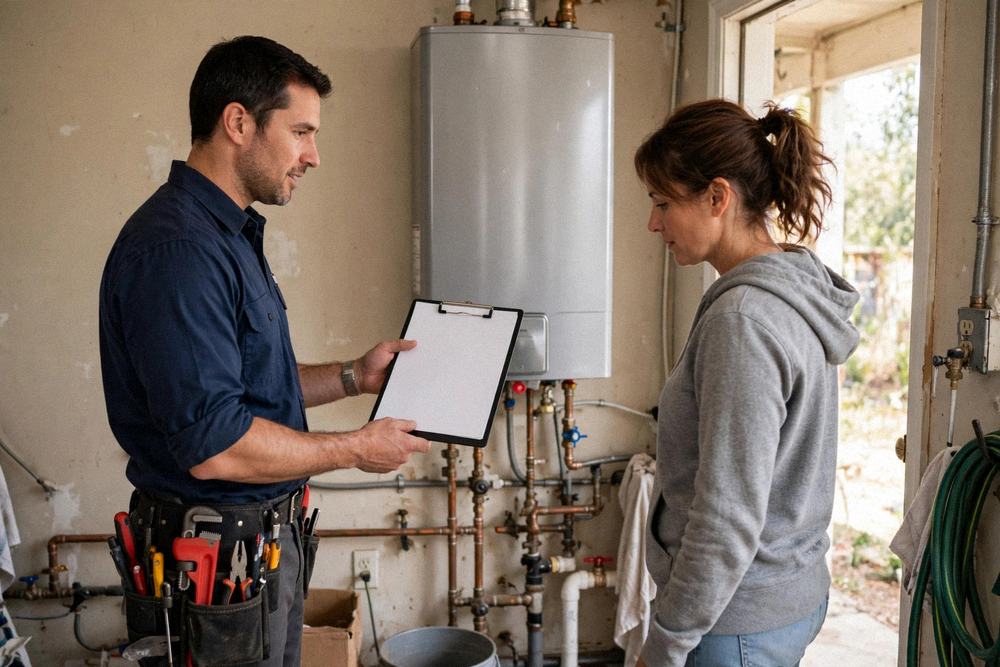
A tankless water heater costs $1,400 to $5,600 installed nationally (HomeGuide, 2026). Most homeowners pay $2,500 to $5,500 for a complete job, with an average near $3,800. The unit itself is only 30 to 50 percent of that total. The rest is labor, venting, gas or electrical upgrades, permits and disposal of the old heater. That is why two quotes for the same house can sit $2,000 apart.
The Short Answer: Cost by Scenario
Three scenarios cover nearly every tankless job, and knowing yours narrows the price more than anything else.
| Your scenario | Typical installed cost, national | What is involved |
|---|---|---|
| Direct swap, tankless replacing tankless | $1,200 to $2,800 | The gas line, venting and mounting are already there and get reused |
| Conversion from a tank, same fuel | $2,000 to $4,500 | Wall mounting, new venting, gas line sizing check, condensate routing, tank removal |
| Full conversion, fuel change or gas line upsize or panel work | $2,500 to $7,000 or more | Everything above plus new gas piping, a rerouted vent path or a service upgrade |
Sources: Region Home Services (2026) for the scenario ranges. HomeAdvisor (updated June 2026) puts the average tankless install at $2,641, typically $1,406 to $3,902. Fixr (January 2026) puts the range at $1,000 to $4,000. BuildCost (2026) puts a gas tankless conversion at $3,100 to $5,450 and an electric tankless at $2,200 to $4,150, including the conversion work.
The pattern is simple: the more of the old system you can reuse, the less you pay. A swap reuses the gas line, the vent and the mounting. A conversion builds those from scratch, so it costs more. Our tank to tankless conversion blog walks through every change a conversion makes in your home.
What the Unit Itself Costs
The unit is the smallest part of the mystery, because the price is printed on the box. What changes it is fuel type, size and brand.
| Tankless type | Unit cost, national | Installation labor, national | Total installed, national |
|---|---|---|---|
| Gas, natural gas, whole house | $800 to $2,000 | $1,500 to $3,000 | $3,000 to $5,500 |
| Gas, propane, whole house | $900 to $2,200 | $1,500 to $3,200 | $3,200 to $5,800 |
| Electric, whole house | $500 to $1,200 | $800 to $2,000 | $1,500 to $3,500 |
| Electric, point of use | $100 to $400 | $150 to $500 | $250 to $900 |
Source: Plumbing Price Guide (March 2026). These are national ranges. A point of use unit heats one tap, usually a single sink, and it is not a whole house heater. Do not let anyone sell you a point of use unit as a whole house solution. It will not keep up.
Size matters more than brand. A tankless unit is sized by flow rate, in gallons per minute, not by gallons. A whole house gas unit delivering 8 to 10 GPM, enough for two showers and a dishwasher running together, is the sweet spot for most families and lands in the $2,500 to $4,500 installed range before any gas or electrical upgrades (ABS Pipes, 2026). A smaller unit costs less but goes lukewarm when two showers run at once. The brands Nampa homes have are Rheem, Bradford White, A.O. Smith, Navien, Rinnai, Noritz and State. The price gap between them is smaller than the price gap between a good install and a cheap one.
What Labor and Materials Add
A complete tankless quote has seven or eight cost lines. Here they are, with 2026 national ranges, so you can read any quote line by line.
| Line item | Typical 2026 range, national | Notes |
|---|---|---|
| The unit | $500 to $2,800 | Electric at the bottom, condensing gas at the top |
| Installation labor | $500 to $3,000 | Higher on conversions than on swaps |
| Venting | $400 to $1,800 | A new sealed combustion vent run; more through a roof than a side wall |
| Gas line upsize | $500 to $1,500 | A tankless burner fires four to five times harder than a tank |
| Electrical work | $200 to $1,200 | A 120 volt outlet for a gas unit; much more for a large electric unit |
| Permit | $50 to $200 | National range; the Nampa rule is unverified, confirm with the City |
| Removal of the old heater | $75 to $500 | Drain, disconnect, haul away |
| Condensate drain | $100 to $400 | Only on high efficiency condensing units |
Sources: Region Home Services (2026) for the line items; HomeGuide (2026) for permit and removal; NR Tech Studio (2026) for venting and gas line ranges.
If a quote has only one number and no lines, ask for the lines. A single number hides where the money goes, and it hides what is missing. The most common missing line is the condensate drain on a condensing unit, followed by the gas line upsize. Both show up later as a second bill if they are not in the first quote.
Why One Quote Is $2,500 and Another Is $6,000
Three things move a tankless quote more than anything else, and none of them is the brand on the box.
A fourth factor is the house itself. A unit mounted on an outside wall with short water runs costs less to install than one buried in the middle of a basement with long pipe runs. Access matters. A tight closet with no room to work costs more in labor than an open garage wall.
Running Cost After Install
The install price is only half the money. A tankless unit costs less to run than a tank, but it also costs money every year to keep running well.
On energy, the US Department of Energy says a tankless unit is 24 to 34 percent more energy efficient than a tank model in homes that use 41 gallons or less of hot water a day. ENERGY STAR puts the saving for a family of four at about $95 a year compared with a standard gas tank. In homes that use about 86 gallons a day, the efficiency advantage drops to 8 to 14 percent, because the burner runs so much of the time anyway.
On upkeep, a tankless unit needs a descale every year in Nampa hard water. The City of Nampa 2024 Consumer Confidence Report puts hardness at none to 7.08 grains per gallon, and scale builds up fast at that level. A tankless descale runs $75 to $300 nationally (HomeGuide, 2026). Skip it and the unit throws error codes, runs lukewarm, and can fail years early. A tank needs a flush every year too, at $75 to $250 nationally, so the upkeep cost is about the same either way.
On repairs, a tankless repair runs $300 to $1,300 nationally, against $150 to $700 for a tank (HomeGuide, 2026). The heat exchanger is the expensive part, $600 to $1,300. But a tankless unit lasts 15 to 20 years against 8 to 12 for a tank, so you buy one tankless unit in the time you would buy two tanks. Our tankless water heater repair in Nampa page lists the error codes we see most and what each one costs to fix.
Total Cost Over 20 Years
The honest way to compare a tank and a tankless unit is over 20 years, not on day one. The table below uses national ranges and the DOE efficiency figures. Your numbers will differ, but the shape of the answer will not.
| Over 20 years, national | Tank water heater | Tankless water heater |
|---|---|---|
| Units bought | 2 (8 to 12 year life each) | 1 (15 to 20 year life) |
| Install cost, total | $1,200 to $6,200 | $1,400 to $5,600 |
| Energy saving vs the other | Baseline | About $95 a year for a family of four (ENERGY STAR) |
| Yearly upkeep | Flush $75 to $250 a year | Descale $75 to $300 a year |
| Typical repair | $150 to $700 per job | $300 to $1,300 per job |
A tankless unit costs more on day one and less over 20 years, if you keep it descaled and stay in the home long enough to use the longer life. If you move in three years, the tank wins. If you stay for fifteen, the tankless unit wins. That is why a tank vs tankless water heater comparison has to run past the install price.
> A tankless water heater is not a purchase. It is a 20 year plan. The install price is the first payment, the yearly descale is the upkeep, and the energy saving is the return. Judge it over 20 years, not over one quote.
Rebates and Tax Credits in 2026
There is no federal tax credit for a tankless water heater installed in 2026. The Energy Efficient Home Improvement Credit under Section 25C ended for equipment placed in service after December 31, 2025. A unit installed in 2026 gets $0 in federal credit, even if you signed the contract in 2025, because eligibility follows the placed in service date.
Idaho Power offers a $300 rebate for a heat pump water heater (form CRR 211), but that is a heat pump unit, not a tankless unit. Do not let anyone sell you a tankless install on a rebate meant for a different product. Before you sign, ask the installer to name the rebate in writing, with the form number and the amount. If they cannot name it, it does not exist.
How to Get a Fair Quote
Three written quotes, each one line by line. That is the whole method, and it works because it forces every installer to show the same lines.
FAQs
What is the average cost of a tankless water heater?
About $3,800 installed nationally for a complete job, with most homeowners paying $2,500 to $5,500 (Plumbing Price Guide, 2026). HomeAdvisor puts the average at $2,641. The range is wide because a direct swap and a full conversion are very different jobs.
Why does a tankless water heater cost more than a tank?
The unit costs more, and the install costs more. A tankless unit needs a bigger gas line, a new vent run, a condensate drain on high efficiency models, and an outlet for the controls. A tank reuses the gas line, the flue and the water lines that are already there. The gap is the work around the unit, not the unit itself.
Does a tankless water heater save money?
It saves about $95 a year on energy for a family of four (ENERGY STAR), and it lasts 15 to 20 years against 8 to 12 for a tank, so you buy one unit instead of two. It does not save enough on energy alone to pay back the install gap. The payback comes from the longer life.
Is there a tax credit for a tankless water heater in 2026?
No. The federal 25C credit ended for equipment placed in service after December 31, 2025. A tankless unit installed in 2026 gets $0 in federal credit. Check Idaho Power's current offers before counting on any rebate money, and get any rebate named in writing on the quote.
Book Your Tankless Water Heater Installation in Nampa Today
A tankless water heater costs $1,400 to $5,600 installed nationally, and the honest price for your home depends on your gas line, your vent path and your panel. Tell us what your current heater is and we will check all three, then give you a written quote, line by line, before we start. Water heaters are all we do.
Our Service Area
We serve Nampa and the towns around it. Pick your area to see water heater repair there.