
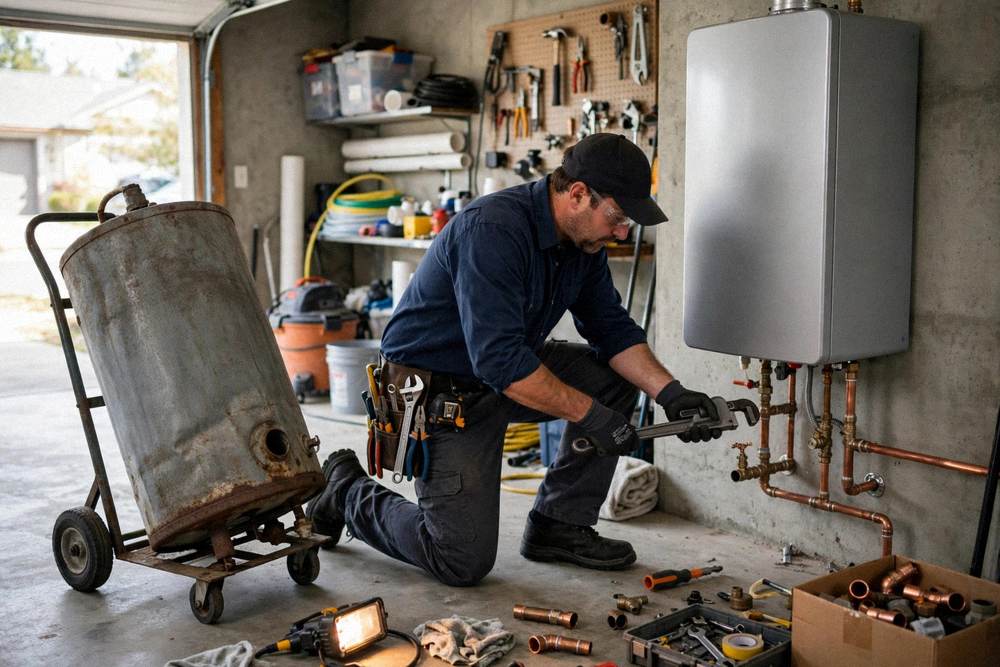
A tank to tankless conversion is not a swap. It is a small rebuild of the corner your old tank sat in. The gas line gets bigger, the venting changes completely, the water lines move to a wall mounted unit, and the new unit needs power and a drain for condensate. A straight tank swap takes 3 to 5 hours. A conversion takes most of a day.
A Conversion Is Not a Swap
When a tank water heater fails and you replace it with another tank, the installer disconnects the old one, sets the new one in the same spot, and reconnects the same gas line, the same flue, the same water lines and the same relief drain. Everything fits because the new tank is built to fit where the old tank sat.
A tank to tankless conversion breaks every one of those assumptions. A whole house gas tankless heater burns fuel at four to five times the rate of the tank it replaces, so the gas pipe is often too small. It vents differently, so the old flue usually cannot be reused. It needs electricity even when it burns gas. And because it hangs on a wall, the water connections move too.
That is why the price of a conversion is mostly labor and materials around the unit, not the unit itself. A gas tankless unit replacing a tank commonly runs $3,000 to $6,500 installed nationally, against $1,500 to $3,000 to replace a gas tank with another tank (The Honest Reviewers, 2026). The gap is almost entirely the gas line, the venting and the labor to rebuild them.
What Changes: The Gas Line
This is the biggest change, and the one that surprises most homeowners. A standard tank burns about 30,000 to 50,000 BTU an hour. A whole house gas tankless unit fires at up to 199,000 BTU an hour, four to five times as much gas at full fire.
Most tank water heaters run on a 1/2 inch gas line. A tankless unit usually needs a 3/4 inch or 1 inch line. If the main supply line from the meter is big enough, the plumber only has to upgrade the branch line from the main to the water heater. That runs $300 to $800 nationally, depending on the distance and whether the pipe runs through open or finished space (Amazing Flash, 2026).
If the main line from the meter is too small, or the meter itself cannot keep up, the work gets bigger and the price climbs with it. A home with a gas furnace, a gas range and a gas dryer already uses a large share of the meter capacity. Add a 199,000 BTU tankless unit and the meter may need an upgrade too. Get the gas line checked before you buy the unit, not after.
What Changes: The Venting
A tank water heater vents through a metal flue, usually a B vent that runs up through the roof. Hot exhaust rises on its own, and the flue carries it out. A tankless unit cannot use that flue. Gas tankless heaters are fan driven and vent under positive pressure, and manufacturers do not allow them on the B vent or chimney a tank used.
A standard efficiency tankless unit needs Category III stainless steel venting, a different and more expensive material than the old B vent. A high efficiency condensing unit can use PVC venting, which costs less, but it still needs a new vent run. Either way, the vent is new.
Most tankless units vent horizontally through a side wall rather than vertically through the roof, which often makes the job simpler. A typical side wall vent run adds $200 to $600 nationally. If the unit has to vent through the roof, the cost rises to $400 to $1,000 (Amazing Flash, 2026).
One more venting problem shows up in homes where the tank shared a chimney flue with the furnace. When the tank goes away, the furnace is left alone in a flue that is now too big for it. That is called an orphaned flue, and it can cause the furnace exhaust to condense inside the chimney. A good installer checks for it and fixes it with a liner or a new vent path.
What Changes: Water Lines, Power and the Condensate Drain
The water lines move. A tank sits on the floor with water connections at the top. A tankless unit hangs on the wall, so the hot and cold lines move to the new position, usually with isolation valves on both lines. Those valves are how a plumber descales the unit later without taking it off the wall. Make sure your quote includes them. A conversion without isolation valves saves a little money on day one and costs you every year after.
The unit also needs power. A gas tankless unit needs a 120 volt outlet for the control board, the ignition system and the vent fan. Most gas tanks need no power at all, so there is often no outlet near the heater. An electric tankless unit is a different story: a unit sized for a 3 bathroom home typically needs 100 to 150 amps across two to four dedicated 40 to 60 amp circuits (Amazing Flash, 2026). That can mean a panel upgrade, and that is why electric tankless conversions cost more in labor than most homeowners expect.
A high efficiency condensing tankless unit also needs a condensate drain. The unit pulls so much heat out of the exhaust that water condenses inside it, and that water has to go somewhere, usually to a floor drain or a pump that sends it outside. A standard efficiency unit does not need one. If your quote is for a condensing unit and there is no drain line in it, ask where the condensate goes.
What Happens to the Old Tank and the Space It Leaves
The old tank gets drained, disconnected and carried out. Removal runs $75 to $500 nationally (HomeGuide, 2026), and most conversion quotes include it. Ask before you sign, because a tank full of sediment is heavy and nobody wants it sitting in the garage for a week.
The space it leaves is yours. A tank takes up about as much floor space as a washing machine. A tankless unit mounts on the wall, so the floor is free. In a small Nampa garage or a tight utility closet, that space matters. Either way, the floor space is the most visible change on the day the work is done.
The old flue stays or goes depending on the house. If the flue ran through the roof and nothing else uses it, it gets capped or removed. If the furnace still uses it, it stays, and the installer checks the orphaned flue problem above.
How Long Does a Conversion Take?
A simple conversion with a short gas run and an easy outside wall usually takes one full day. The old heater comes out fast. The new exhaust run and the gas connection take most of the time. A long gas run, roof venting, a condensate pump or an orphaned furnace flue can push it to two days (The Honest Reviewers, 2026).
Hot water is usually back the same day the work starts. The water is off while the lines are moved, then back on once the new unit is tested. A good tankless water heater installer in Nampa tests hot water at every tap before leaving: the shower, the kitchen and the laundry. If a tap runs cold, the job is not done.
What a Conversion Costs
The table below uses national ranges. Nampa prices are unverified, so treat these as planning numbers and get a written quote for your home.
| Conversion scenario | Typical installed cost, national | What is involved |
|---|---|---|
| Direct swap, tankless replacing tankless | $1,200 to $2,800 | Existing gas line, venting and mounting are reused |
| Conversion from a tank, same fuel | $2,000 to $4,500 | Wall mounting, new venting, gas line sizing check, condensate routing, tank removal |
| Full conversion, fuel change or gas line upsize or panel work | $2,500 to $7,000 or more | Everything above plus new gas piping, a rerouted vent path or a service upgrade |
Sources: Region Home Services (2026) for the scenario ranges; HomeGuide (2026) for the tankless installed range of $1,400 to $5,600. A gas tankless unit alone runs $800 to $2,500, installation labor $500 to $1,500, and materials and upgrades $200 to $1,000 (Amazing Flash, 2026).
The two adders that surprise people most are venting and gas line upsizing. A new sealed combustion vent run adds $400 to $1,800 nationally, and a gas line upsize adds $500 to $1,500 (NR Tech Studio, 2026). A full retrofit with both upgrades can approach $8,850.
> The price on the box tells you almost nothing about the final bill. The unit is 30 to 50 percent of a conversion. Labor, venting, gas or electrical upgrades, permits and disposal of the old tank make up the rest. Get the quote in writing, line by line, before work starts.
The federal 25C credit ended for equipment placed in service after December 31, 2025. A tankless unit installed in 2026 gets no federal credit. Do not let anyone sell you a conversion on a rebate that no longer exists. Check the tankless water heater cost in Nampa page for the full breakdown of what goes into the price.
When a Conversion Is the Wrong Call
A tankless unit is not right for every home. Say no, or at least wait, when any of these fit your house.
The Nampa Hard Water Step Most Conversions Skip
Here is the step that separates a good conversion from a cheap one: the descaling setup. Nampa hard water leaves scale inside a tankless heat exchanger. The unit needs a descale every year, and the descale needs isolation valves and a drain point. Without them, the plumber has to disconnect water lines to flush the unit, which costs more every single time.
When you get a conversion quote, check for three things: isolation valves on the hot and cold lines, a service valve set that lets a pump push descaling solution through the heat exchanger, and a drain or a hose connection nearby. If the quote does not list them, ask for them. They add little to the install cost and save real money every year after. Our tankless water heater repair in Nampa page explains what happens when scale is left alone: error codes, lukewarm water, and a unit that shuts down in the middle of a shower.
The same hard water rule applies to the tank you are replacing. If your old tank died early from sediment, the new tankless unit will scale up fast too unless the yearly descale happens. A water softener is the other option, and it protects every fixture in the home, not just the heater. Ask about it when you get your quote.
FAQs
How long does a tank to tankless conversion take?
One full day for a simple conversion with a short gas run and an easy outside wall. A long gas run, roof venting, a condensate pump or an orphaned furnace flue can push it to two days. Hot water is usually back the same day.
Do I need a bigger gas line for a tankless water heater?
Usually, yes. A whole house gas tankless unit fires at up to 199,000 BTU, four to five times a tank. The gas line usually has to be upsized to 3/4 inch or larger.
Can a tankless water heater use my old vent?
No. A tankless unit cannot use the B vent or chimney flue a tank used. It needs its own vent run, usually through a side wall. High efficiency condensing units can use PVC venting. Standard efficiency units need stainless steel venting.
Is a tank to tankless conversion worth it?
It is worth it if you stay in the home for ten years or more, your gas line can be upsized without major work, and you will descale the unit every year. If any of those three is not true, a new tank is the better spend.
Book Your Tankless Water Heater Installation in Nampa Today
A tank to tankless conversion changes your gas line, your venting, your water lines and your power supply. Done right, it gives you endless hot water and a unit that lasts 15 to 20 years. Done cheap, it gives you error codes and a second bill. Tell us about your current tank and we will check the gas line, the vent path and the meter, then give you a written price before we start. Water heaters are all we do.
Our Service Area
We serve Nampa and the towns around it. Pick your area to see water heater repair there.