
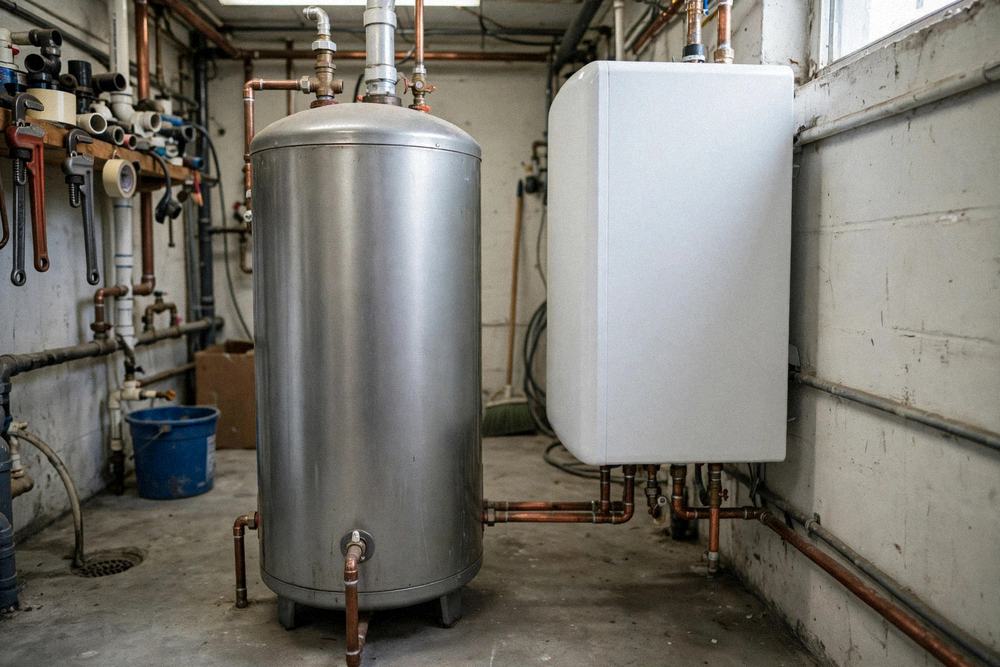
A tank water heater costs less on day one. A tankless water heater costs less to run and lasts about twice as long. For most Nampa homes the right choice comes down to three things: how many people shower at once, what your gas line and venting can handle, and whether you will descale a tankless unit every year.
How a Tank Water Heater Works
A tank water heater is a big insulated cylinder, usually 40 or 50 gallons, that holds hot water all day. A gas burner or two electric heating elements keep the whole tank hot, around the clock, whether anyone is using water or not. When you open a tap, hot water flows out of the top of the tank and cold water flows in at the bottom to take its place.
The parts are simple: a thermostat, one or two heating elements on electric models, a gas valve and burner on gas models, an anode rod that protects the tank from rust, and a temperature and pressure relief valve. A 40 gallon tank suits 1 to 3 people. A 50 gallon tank suits 3 to 5 people, or a family of 4. The tank sits on the floor, usually in a garage or a utility closet.
The weak point is the tank itself. Water sits in it all day, and in Nampa that water is hard. Minerals settle at the bottom as sediment. The anode rod slowly dissolves to protect the steel. Once the rod is gone, the tank starts to rust from the inside. That is why a tank lasts 8 to 12 years (US Department of Energy) and why a flush every year matters here.
How a Tankless Water Heater Works
A tankless water heater has no tank. It is a box about the size of a suitcase that mounts on a wall. When you open a hot tap, cold water flows through a heat exchanger inside the box, a gas burner or electric elements fire up, and the water comes out hot seconds later. When you close the tap, the unit shuts off. Nothing is kept hot all day.
Because there is no stored water, there is no standby heat loss. The US Department of Energy says a tankless unit is 24 to 34 percent more energy efficient than a tank model in homes that use 41 gallons or less of hot water a day. In homes that use about 86 gallons a day, the advantage drops to 8 to 14 percent, because the burner runs so much of the time anyway.
A tankless unit is rated by flow, not by gallons. The number that matters is GPM, gallons per minute: 3.5 GPM covers 1 to 2 fixtures at once, 5 GPM covers 2 to 3, and 7 GPM or more covers 3 to 4. A whole house gas unit fires at up to 199,000 BTU, four to five times the burner on a tank.
Tank vs Tankless Water Heater: The Side by Side Numbers
| Tank water heater | Tankless water heater | |
|---|---|---|
| Installed cost, national | $600 to $3,100 (HomeGuide, 2026) | $1,400 to $5,600 (HomeGuide, 2026) |
| Unit alone, national | $400 to $2,100 | $600 to $2,600 |
| Energy efficiency | Loses heat keeping stored water hot all day | 24 to 34% more efficient at 41 gallons a day or less (DOE) |
| Lifespan | 8 to 12 years (DOE) | 15 to 20 years (DOE), about 20 years (ENERGY STAR) |
| Hot water supply | Limited to the tank, then it runs out | Endless, up to the flow rate of the unit |
| Floor space | A full tank on the floor | A wall mounted box |
| Yearly upkeep in Nampa | Flush the tank, check the anode rod | Descale the heat exchanger every year |
| Typical repair cost, national | $150 to $700 (HomeGuide, 2026) | $300 to $1,300 (HomeGuide, 2026) |
All prices above are national ranges, not Nampa prices.
Upfront Cost: What You Pay on Day One
A tank is the cheaper buy. A standard 50 gallon gas or electric tank runs $600 to $3,100 installed nationally (HomeGuide, 2026), and a straight swap usually takes 3 to 5 hours because the new unit connects to the same gas line, the same flue and the same water lines.
A tankless unit costs two to three times more installed. The unit alone runs $600 to $2,600, and the installed price runs $1,400 to $5,600 nationally (HomeGuide, 2026). The gap is not the box. It is the work around the box: a bigger gas line, a new vent run, a condensate drain on high efficiency models, and an outlet for the controls. A full conversion from a tank can add $800 to $1,500 in conversion work on top of the unit price (ABS Pipes, 2026).
First, can your home take a tankless unit without major work? If your gas line is already 3/4 inch or larger and the unit can vent through a nearby outside wall, the conversion stays near the low end. If the gas line has to be upsized from the meter and the vent has to run through the roof, the price climbs fast. Our tankless water heater installation in Nampa page walks through what changes in your home.
Running Cost: What You Pay Every Month
A tank keeps 40 or 50 gallons of water hot all day and all night. That is standby heat loss, and it is the tank's biggest running cost. A tankless unit only fires when a tap opens, so it skips that loss entirely.
ENERGY STAR says a certified gas tankless water heater saves a family of four about $95 a year compared with a standard gas tank. That will not pay back a $2,000 to $3,000 price gap on its own. The payback comes from the longer life: a tankless unit lasts 15 to 20 years against 8 to 12 for a tank, so you buy one tankless unit in the time you would buy two tanks.
Water heating is about 18 percent of a typical home's energy use (DOE), so the fuel matters too. Natural gas usually costs less per unit of heat than electricity, which is why a gas tankless unit saves more than an electric one in most homes. In Idaho the gap is smaller than the national average because Idaho electricity is cheap: the statewide residential average was about 12.35 cents per kWh in May 2026 (US Energy Information Administration), among the lowest in the country. That does not flip the answer, but it does narrow it, and it is one reason an electric tank stays a fair choice in Nampa.
Hot Water Supply: How Much, How Fast
A tank gives you what it holds. A 50 gallon tank gives you about 35 to 40 gallons of usable hot water before the temperature drops, because cold water mixes in as you draw. That covers a couple of showers back to back, then the tank needs time to recover. A family of 5 that showers in the morning will run a 50 gallon tank dry.
A tankless unit gives you endless hot water, but only up to its flow rate. A unit rated at 7 GPM can run two showers and a dishwasher at once. Push it past its rating and the water comes out lukewarm, because the burner cannot keep up. The fix is sizing: count the fixtures that run at the same time, add up their flow, and buy a unit that covers that number with room to spare. A unit that is too small is the number one reason people are unhappy with tankless.
> A plumber's rule of thumb: size a tankless unit for the busiest hour in your home, not the average hour. Two showers plus the dishwasher on a winter morning is the test. If the unit cannot pass that test, it is too small.
Lifespan and Repairs
A tank lasts 8 to 12 years. The tank itself is the part that fails: once the anode rod is gone and the steel starts to rust, the tank leaks, and a leaking tank cannot be fixed. The parts around the tank are cheap to fix: a thermostat runs $100 to $350, a heating element $100 to $350, a thermocouple $100 to $325, an anode rod $150 to $350, all national ranges (HomeGuide, 2026).
A tankless unit lasts 15 to 20 years, and its parts can be replaced one at a time: a flow sensor, an igniter, a heat exchanger. The heat exchanger is the expensive one, $600 to $1,300 nationally (HomeGuide, 2026). Skip the yearly descaling and scale builds up inside the heat exchanger until the unit throws error codes and shuts down. Our tankless water heater repair in Nampa page lists the error codes we see most, and scale is behind most of them.
The 50 percent rule helps you decide on any repair: if the repair quote is more than half the cost of a replacement and the heater is past half its expected life, replace it. A $400 repair on a 10 year old tank is money you will not get back. The same $400 on a 5 year old tankless unit is a fair fix.
Nampa Hard Water: The Factor Most Comparisons Skip
Most tank vs tankless guides never mention water hardness. In Nampa, it is the factor that decides how long either unit lives. The City of Nampa 2024 Consumer Confidence Report puts hardness at none to 7.08 grains per gallon. That is hard water, and hard water leaves scale.
On a tank, scale settles at the bottom as sediment. The burner fires under it, the tank pops and rumbles, and the bottom overheats. A flush every year keeps it in check. On a tankless unit, scale coats the inside of the heat exchanger and trips the overheat sensor. A descale every year keeps it in check. The cost is about the same either way: a tank flush runs $75 to $250 nationally and a tankless descale runs $75 to $300 (HomeGuide, 2026).
The difference is what happens when you skip it. Skip a tank flush and the tank dies a few years early. Skip a tankless descale and the unit starts throwing error codes within a year or two. If you will book a yearly visit, tankless is the better buy. If you know you will forget, a tank is more forgiving.
Cold Water in Winter: Why Tankless Sizing Matters in Nampa
Nampa winters are cold. NOAA 1991 to 2020 normals show 132 nights a year at or below freezing, with a January average low of 23 degrees Fahrenheit. Cold ground means cold incoming water, and a tankless unit has to heat that water further to reach your shower temperature. A unit rated at 9 GPM in warm water may only deliver 6 GPM when the incoming water is near freezing.
That is why a tankless unit in Nampa should be sized for January, not for July. A unit sized from the summer water temperature will go lukewarm in the first cold snap. A tank does not have this problem: it stores hot water, so a cold morning only means a slower recovery, not a cold shower.
Which One Fits Your Home?
Use this as a starting point, then get a written quote for your home.
If your current tank is leaking or past 10 years old, the choice is urgent. Our water heater replacement in Nampa page covers the signs that say replace, not repair, and the water heater repair cost in Nampa page has the national ranges for every common job, labelled as national.
FAQs
Is a tankless water heater worth it in Nampa?
It is worth it if you stay in the home long enough to use the longer life and you descale it every year. If you will skip the yearly visit, a tank is the safer buy.
How long does a tankless water heater last?
15 to 20 years with yearly descaling (DOE), about 20 years per ENERGY STAR. A tank lasts 8 to 12 years. The tankless unit lasts about twice as long, which is where most of the value sits.
Can a tankless water heater run out of hot water?
It cannot run out the way a tank can, but it can fall behind if too many fixtures run at once. A unit rated at 5 GPM will go lukewarm if you run two showers and a dishwasher at the same time. Size it for your busiest hour.
Does a tankless water heater need a bigger gas line?
Often, yes. A whole house gas tankless unit fires at up to 199,000 BTU, four to five times a tank. The gas line usually has to be upsized to 3/4 inch or larger, and the unit needs its own vent run to an outside wall.
Book Your Water Heater Replacement in Nampa Today
Tank or tankless, the right answer is the one that fits your home, your household and your budget. Tell us what your heater is doing now and how many people shower in the morning, and we will size it and price it in writing before we start. Water heaters are all we do.
Our Service Area
We serve Nampa and the towns around it. Pick your area to see water heater repair there.