
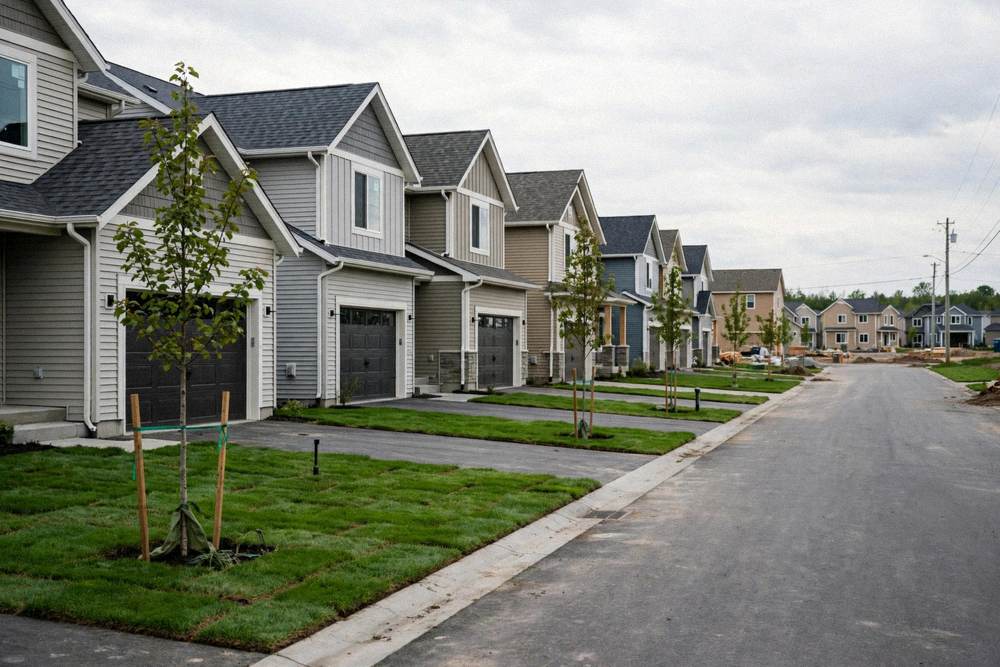
Nampa grew from 100,200 people in the 2020 census to 120,384 in the Census July 2025 estimate, and most of that growth landed in new subdivisions in Nampa along Ustick Road and Ten Mile Road. Every one of those new homes came with a water heater, and most came with the cheapest one that met code.
How Fast Nampa Is Growing
Nampa added about 20,000 people in five years. That growth did not spread evenly across the city. It went into new subdivisions on the edges: Ustick Road and Ten Mile Road on the east side, Karcher Road and the areas around Lake Lowell on the south side, and the corridors out toward Star and Middleton. Whole phases went up together, street after street, with the same floor plans, the same pipes, and the same water heaters.
The median Nampa home was built in 2000, and about 26 percent of homes were built before 1980. The new subdivisions are the newest part of that picture, and they are also the part where the water heater story is most predictable. When a subdivision goes up fast, the water heater is one of the first places a builder cuts cost. The units that landed in most new Nampa garages were the cheapest models that met code, not the ones a homeowner would pick for themselves.
That matters now, because the subdivisions built in the mid 2010s are reaching year 10. Their heaters were never made to last much longer than that. If your subdivision went up around 2015 and your heater is original, the first replacement wave is here, and it is hitting your street at the same time it hits your neighbours.
What the Builder Put in Your Garage
The typical new subdivision water heater in Nampa is a 40 gallon or 50 gallon tank, gas or electric, from Rheem, Bradford White, A.O. Smith, or State. It is a builder grade unit. That means it was chosen for price, not for life. It usually ships with a thin glass lining and a short 6 year warranty. It meets code and it makes hot water on day one. It was never built to outlive the neighbourhood.
Builders also sell upgrade lines. Rheem makes a builder series hybrid heat pump unit in 40, 50, 65, and 80 gallon sizes, with a Uniform Energy Factor of 3.50, built to help a new home earn a better energy rating. A.O. Smith makes builder guides around first hour rating and energy ratings too, because a better heater can earn a new home several points on its HERS Index score, the national system that rates how energy efficient a home is. If your builder offered a heat pump or tankless upgrade, ask for the paperwork. The upgrade may already be in your garage, and it changes the replacement math.
The key question for any new build is not the brand on the label. It is the first hour rating. The first hour rating tells you how much hot water the unit can deliver in a busy hour, and it is the number that predicts whether the last person in the morning gets a warm shower. A 40 gallon tank with a strong burner can beat a 50 gallon tank with a weak one, because recovery rate matters as much as storage. The A.O. Smith builder guide puts it plainly: 2 people need 45 to 55 gallons of first hour rating, 3 people need 55 to 65, 4 people need 65 to 75, and 7 or more people need 100 or more. Check the EnergyGuide label on your unit. If the number is below your household, the heater was undersized from day one.
Why Builder Grade Heaters Fail Around Year 10
A builder grade tank fails around year 10 for three reasons that stack on top of each other. First, the thin glass lining. A cheap tank has less protection on the steel inside, so rust starts earlier. Second, the short warranty. A 6 year warranty is the maker telling you how long the unit was built to last without trouble. Third, Nampa hard water. Water runs from none to 7.08 grains per gallon of hardness, based on the City of Nampa 2024 Consumer Confidence Report, and scale builds fastest in a tank that was never flushed.
The signs show up in the same order on every street. Rusty hot water in the morning. Popping or rumbling noises, which are steam bubbles escaping from under the sediment layer. Pooling water at the base of the tank. Hot water that runs out faster than it used to. A tank that shows any of those signs at year 10 is telling you the end is near. A tank lasts 8 to 12 years, based on the US Department of Energy, and a builder grade tank in hard water tends toward the low end of that range.
Whole phases fail together. When a subdivision goes up in one year, every heater on the street is the same age, the same model, and fed by the same hard water. When one house replaces a heater at year 10, the neighbours usually follow within a year or two. That is not bad luck. It is a schedule. If your neighbours are replacing heaters, get yours checked before yours leaks. A planned replacement lets you pick the size and the type. An emergency replacement gives you whatever is on the truck that day.
Sizing: 40 Gallon or 50 Gallon in a New Home
Most new Nampa homes got a 40 gallon or 50 gallon tank. The rule is simple: a 40 gallon tank suits 1 to 3 people, and a 50 gallon tank suits 3 to 5 people, whichever fuel you pick. But gallons on the label are the wrong number to shop by. The first hour rating is the number that matters, because it combines storage and recovery into one figure.
Here is the sizing table from the A.O. Smith builder guide, which builders themselves use.
| Household | First hour rating needed |
|---|---|
| 2 people | 45 to 55 gallons |
| 3 people | 55 to 65 gallons |
| 4 people | 65 to 75 gallons |
| 7 or more people | 100 gallons or more |
If your household has grown since you moved in, or if guests stay over often, the heater that was right on move in day may be too small now. A family of five taking back to back morning showers will empty a 50 gallon electric tank and wait an hour for it to catch up, because an electric tank recovers in 60 to 90 minutes. A gas tank of the same size recovers in about 30 to 40 minutes. If your showers run short every morning, the answer may be a bigger tank, not a new heater of the same size. Our what size water heater guide walks through the full sizing question.
A tankless unit changes the math completely, because it has no tank to empty. It heats water as it flows, so the limit is flow rate, not storage. For a large household in a new subdivision, a tankless unit sized for winter inlet water can end the morning shower queue for good. A tankless install runs $1,400 to $5,600 installed, national, HomeGuide 2026, against $600 to $3,100 for a tank swap, national, HomeGuide 2026.
New Build or Resale: What to Check
Whether your home is a new build or a resale in a new subdivision, run through this list before you spend money on a water heater.
First, read the rating plate on the side of the tank. The first four digits of the serial number often give the month and year the unit was built. A builder grade tank at year 10 is a replacement to plan for, even if it still makes hot water today. Check the warranty papers too. A 6 year warranty on a 10 year old unit means the maker stopped standing behind it four years ago.
Second, ask what the builder upgraded and what it did not. Did the house get a tankless unit, a heat pump unit, or a standard tank? Is the gas line sized for a tankless unit, or would a switch need a gas line upsize? Is there a condensate drain for a tankless or heat pump unit? Is there an expansion tank? These questions decide what a replacement will cost, and they are much cheaper to answer before the old unit leaks.
Third, check the safety parts. The temperature and pressure relief valve opens at 150 psi or 210 degrees Fahrenheit, and it must have a discharge pipe that ends within 6 inches of the floor, with no valve, cap, or smaller pipe in the line. A gas unit in a garage must sit 18 inches above the floor. The venting must carry exhaust gas out of the house with a steady slope, no sag, gap, or rust hole. Our new home water heater in Nampa guide covers the full inspection list for a new build.
Tankless or Heat Pump Upgrade in a New Home
A replacement in a new subdivision is the best time to upgrade, because the house is new, the pipes are new, and the job is simple. Two upgrades make sense in Nampa, and one of them needs a careful look at where the unit will sit.
A tankless unit gives you endless hot water and a 15 to 20 year life, based on the US Department of Energy. It needs a gas line sized for it, venting, and a condensate drain. In Nampa hard water it needs descaling once a year, which runs $75 to $300, national, HomeGuide 2026. Our tankless water heater installation in Nampa page walks through the job step by step.
A heat pump unit gives you the lowest running cost of any tank, about $200 to $300 a year, national. It needs a warm space with room to breathe, a condensate drain, and a 240 volt circuit. It does not work well in an unheated garage in a Nampa winter, when the city sees 132 freezing nights a year. Idaho Power offers a $300 rebate on qualifying heat pump units, form CRR 211, and it applies to heat pump units only. The federal 25C credit that many guides still list ended December 31, 2025, so do not count on it. Our heat pump vs tankless guide runs both totals side by side for a Nampa home.
Either upgrade beats a like for like swap on a builder grade tank, if you plan to stay in the home. If you plan to sell in a year or two, a standard tank swap is the cheaper move, and the next owner can choose the upgrade.
The First Replacement Wave Is Here
Subdivisions built in the mid 2010s are now about 10 years old, and their builder grade heaters are reaching the end together. That wave will roll through Nampa subdivision by subdivision over the next few years, following the build dates. Ustick Road and Ten Mile Road went up first in the current growth wave, so they feel it first. Karcher Road and the newer phases follow.
A repair averages $450, national, Fixr, updated August 29, 2025, with a range of $150 to $750. The 50 percent rule is the guide: if the repair quote is more than half the cost of a replacement, and the heater is past half its expected life, replace it. A thermocouple at $100 to $325, national, HomeGuide 2026, on a 5 year old tank is a fair fix. A gas control valve at $150 to $550, national, HomeGuide 2026, on a 10 year old builder grade tank is money you will not get back.
A permit, if one is needed, runs $50 to $200, national, HomeGuide 2026. We check with the City of Nampa before we start. Plan the replacement in the fall, before the cold season opens on November 19, and your new heater faces its first winter clean, flushed, and ready.
Frequently Asked Questions
How long does a builder grade water heater last in Nampa?
A builder grade tank usually ships with a thin glass lining and a short 6 year warranty, and in Nampa hard water a new subdivision water heater tends toward the low end of the 8 to 12 year tank life, based on the US Department of Energy. Most fail around year 10. A tank that gets flushed once a year lasts longer than one that never gets touched.
Is a 40 gallon or 50 gallon tank right for my new Nampa home?
A 40 gallon tank suits 1 to 3 people and a 50 gallon tank suits 3 to 5 people. But check the first hour rating, not just the gallons. Two people need 45 to 55 gallons of first hour rating, 3 people need 55 to 65, 4 people need 65 to 75, and 7 or more people need 100 or more. If your household has grown since move in day, the heater may be too small now.
Should I upgrade to tankless or heat pump when my builder grade tank fails?
If you plan to stay, yes. A tankless unit gives endless hot water and lasts 15 to 20 years. A heat pump unit gives the lowest running cost, about $200 to $300 a year, national, and Idaho Power offers a $300 rebate on qualifying heat pump units only. A tankless unit needs a gas line sized for it, and a heat pump unit needs a warm space. We price both for your house.
Why are all the heaters on my street failing at the same time?
Because your subdivision went up in one phase with the same builder grade heaters, the same age, and the same hard water. When one house replaces a heater at year 10, the neighbours usually follow within a year or two. Get yours checked when the first neighbour replaces theirs, before yours leaks.
Call Nampa HeatPros for Your New Subdivision Heater
Tell us your street and the year your home was built. We will read the rating plate, check the size against your household, and give you a written price for a like for like swap and for both upgrades, before we start. If your heater is original to a subdivision built in the mid 2010s, do not wait for the leak. Water heaters are all we do, and we do them in Nampa.
Our Service Area
We serve Nampa and the towns around it. Pick your area to see water heater repair there.