
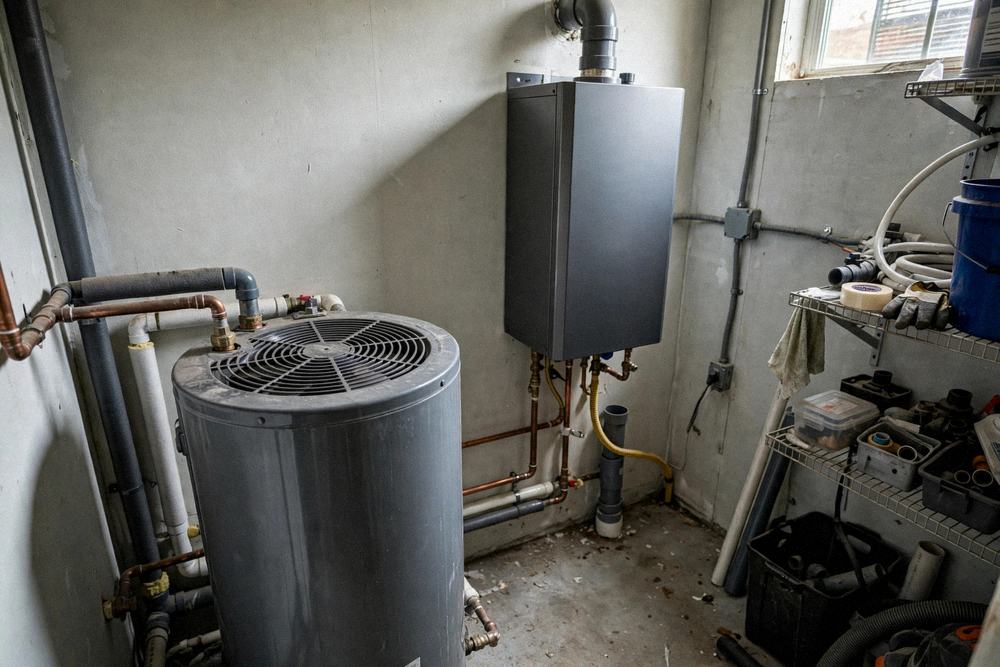
A heat pump water heater usually wins on running cost. A tankless water heater usually wins on endless hot water and long life. In a Nampa home the answer depends on three things: where the unit sits, how much hot water your family uses at once, and whether you have a gas line.
How Each One Heats Water
A heat pump water heater does not make heat the way a normal tank does. It moves heat from the air around it into the water in the tank. Think of a fridge running in reverse. Because it moves heat instead of making it, it uses about a third of the electricity of a standard electric tank for the same hot water. ENERGY STAR certifies heat pump models with a Uniform Energy Factor of 2.0 or higher, which means they put out at least twice as much heat as the electricity they take in.
A tankless water heater has no tank at all. Water flows through a heat exchanger, a burner or an element heats it on the spot, and hot water comes out the tap. When you close the tap, it stops. Gas tankless units are 24 to 34 percent more efficient than a standard tank for homes that use 41 gallons of hot water a day or less, based on the US Department of Energy. For homes that use about 86 gallons a day, the edge drops to 8 to 14 percent.
Both beat a standard tank by a wide margin. The heat pump vs tankless question is really a question about your house, not about which machine is better in a lab.
What Each One Costs to Install
A hybrid heat pump water heater runs $2,000 to $4,600 installed, national, HomeGuide 2026. A tankless water heater runs $1,400 to $5,600 installed, national, HomeGuide 2026. Those are wide ranges because the job around the unit matters as much as the unit itself.
A heat pump unit needs floor space, air to move, and a place for the condensate drain. It needs a 240 volt circuit. It usually needs no gas line and no vent, which keeps the install simple in a home that already has the electric capacity. It does need room to breathe. A tight closet with no air flow is a poor spot, and we will tell you so before we start.
A gas tankless unit needs a gas line sized for it, venting that carries exhaust out of the house, and a condensate drain. A gas line upsize can add real money to the job. An electric tankless unit may need a panel upgrade, which can cost as much as the unit itself. That is why two quotes for the same house can sit far apart. Always ask what is included in the price: the unit, the gas or electric work, the venting, the drain, the removal of the old heater, and the permit if one is needed.
Idaho Power offers a $300 rebate on qualifying heat pump water heaters, form CRR 211, and it applies to heat pump units only. It does not apply to a tankless unit. Many guides online still list a federal 30 percent credit for heat pump water heaters. That credit was the 25C credit, and it ended December 31, 2025. Do not count on it when you run your numbers. A permit, if one is needed, runs $50 to $200, national, HomeGuide 2026. We check with the City of Nampa before we start.
What Each One Costs to Run Each Year
A heat pump water heater costs about $200 to $300 a year to run, national. A gas tankless unit costs about $200 to $400 a year for a typical family, national. Those are the running costs only, not the install price, and your own bill depends on your rates and how much hot water you use.
Idaho residential electricity runs about 12.35 cents per kWh and residential natural gas runs about $1.08 per therm, based on the US Energy Information Administration, May 2026, Idaho state averages. Cheap electricity helps a heat pump, and cheap gas helps a gas tankless. Neither rate is a Nampa rate, so your own bill may differ.
The tankless saving depends on how much water you use. At 41 gallons a day or less, a tankless unit is 24 to 34 percent more efficient than a standard tank. At about 86 gallons a day, the edge falls to 8 to 14 percent. A big family that uses a lot of hot water gets less of the tankless advantage, because the burner runs most of the day anyway. A heat pump keeps its advantage at any volume, because it uses two to three times less electricity than a standard electric tank for the same hot water.
Over 10 years, the heat pump usually saves more on fuel. But fuel is only one part of the total. Install price, rebates, yearly care, and how long the unit lasts all change the answer. That is why this guide shows the whole total, not just the energy bill.
The Nampa Winter Question
This is the part most national guides skip, and it matters more in Nampa than anywhere else in the comparison. A heat pump pulls heat from the air around it. In a Nampa garage in January, that air is cold. Nampa sees 132 freezing nights a year, with a January average low of 23 degrees Fahrenheit, based on NOAA data for 1991 to 2020. The cold season runs November 19 to February 18.
A heat pump in a cold garage works harder to pull heat from cold air. In deep cold it may switch to its backup electric elements, and at that point it heats water like a standard electric tank. The savings shrink. That does not make a heat pump a poor choice in Nampa. It makes the location a poor choice. A heat pump belongs in a warm space with room to breathe: a heated garage, a large utility room, or a basement that stays above freezing. If your only spot is an unheated garage, we will tell you honestly that a tankless unit is the better fit for your house.
A gas tankless unit has its own winter problem. Cold inlet water in January means longer burner runs to reach the same set temperature of 120 degrees Fahrenheit. That is normal and it is built into the running cost above. The bigger winter risk is freezing. Most tankless units have built in freeze protection, but it needs power. In a power cut, an outside unit or a garage unit can freeze, and a frozen heat exchanger can crack. If your tankless unit sits in an unheated space, ask us about freeze protection and what to do if the power goes out.
Endless Hot Water or a Full Tank
A tankless unit gives you endless hot water, limited only by flow. Two showers and a washing machine at once need a unit sized for that flow, measured in gallons per minute. An undersized tankless unit does not run out of hot water. It runs lukewarm, which feels worse.
A heat pump unit stores 50 to 80 gallons and heats it slowly. Recovery is slow, so the first hour rating matters more than the tank size. The first hour rating tells you how much hot water the unit can deliver in a busy hour. A family of four needs a first hour rating of about 65 to 75 gallons. If the tank runs out, you wait for it to catch up.
For a small household, the stored tank is plenty. For a large family showering in the same hour, or a home with a soaking tub, the tankless unit wins, because no tank holds enough hot water for a full tub plus a shower after it.
How Long Each One Lasts
A tankless water heater lasts 15 to 20 years, based on the US Department of Energy. A heat pump water heater lasts 10 to 15 years. A standard tank lasts 8 to 12 years. That life gap is part of the heat pump vs tankless savings math. Over 20 years you may buy one tankless unit or two heat pump units, and that changes the total even if the heat pump costs less to run each year.
Yearly care matters for both. A tankless unit in Nampa needs descaling once a year. Nampa water runs from none to 7.08 grains per gallon of hardness, based on the City of Nampa 2024 Consumer Confidence Report, and scale coats the narrow passages of a heat exchanger fast. A tankless descale runs $75 to $300, national, HomeGuide 2026. Skip it and the unit throws error codes, overheats, and shuts down.
A heat pump unit needs a tank flush once a year, which runs $75 to $250, national, HomeGuide 2026. The anode rod needs a check every 3 to 4 years, and the temperature and pressure relief valve needs a check every 6 months, based on US Department of Energy guidance. The relief valve opens at 150 psi or 210 degrees Fahrenheit, and it must never be capped. Scale settles as sediment at the bottom of the tank, and a flush while it is still loose keeps it from hardening into a crust.
Hard Water Treats Them Differently
Heat is what turns Nampa hard water into scale, and both units heat water. They just collect the damage in different places. A tankless unit collects it inside the heat exchanger, where the passages are narrow and the water is hottest. That is why a tankless unit in Nampa needs a descale every year, not every few years. A heat pump unit collects it as sediment at the bottom of the tank, where it insulates the water from the heat source and forces longer run times.
A water softener helps both by taking the hardness out before it reaches the heater. We do not quote softener prices here, because they vary too much by house. If you buy a tankless unit in Nampa, put the yearly descale in your budget from day one. If you buy a heat pump unit, put the yearly flush in your budget from day one.
Which One Saves More for Your Home
There is no single winner. Here is how the choice usually falls in a Nampa home.
| Your house | The better pick | Why |
|---|---|---|
| Small household, warm space, no gas line | Heat pump | Lowest running cost, simple install |
| Large family, gas line already in place | Tankless gas | Endless hot water, 15 to 20 year life |
| Tight closet, no floor space | Tankless | Wall mounted, no tank to fit |
| Only spot is a cold garage | Tankless gas | A heat pump would lose its edge in the cold |
| Plan to stay 10 years or more | Either, run both totals | Fuel saving vs long life, do the math |
Run the 10 year total for your own house before you decide. The ranges overlap, so the winner depends on your install job, your household size, and where the unit sits. A written price for your house beats any national table, and that is what we give before we start.
What We Install in Nampa
We install hybrid heat pump units and tankless units in Nampa homes. When your old tank is done, we price the heat pump vs tankless choice for your house, look at where the unit will sit, whether you have a gas line, and how many people use hot water at once. Then we give you a written price before we start.
If your old tank is leaking or has no hot water left in it, read our water heater replacement in Nampa page first. If you already know you want tankless, our tankless water heater installation in Nampa page walks through the job step by step. If your tankless unit is throwing error codes, our tankless water heater repair in Nampa page lists the codes we see most. For the wider tank vs tankless choice, our tank vs tankless water heater guide covers the standard tank side too, and our gas vs electric water heater cost guide covers the fuel question in detail.
Frequently Asked Questions
Which one saves more money per year, a heat pump or a tankless water heater?
On running cost, the heat pump vs tankless winner is usually the heat pump, about $200 to $300 a year against about $200 to $400 a year for a gas tankless unit, both national. But the heat pump lasts 10 to 15 years against 15 to 20 for a tankless unit, so the full 10 year total can go either way. Run both totals for your house before you decide.
Will a heat pump water heater work in my Nampa garage in winter?
It depends on how cold the garage gets. A heat pump pulls heat from the air around it, and in deep cold it works harder and may switch to backup electric elements. Nampa sees 132 freezing nights a year. A heated garage or a large utility room is a good spot. An unheated garage is a poor spot, and a tankless unit is usually the better fit there.
How long does each one last?
A tankless water heater lasts 15 to 20 years and a heat pump water heater lasts 10 to 15 years, based on the US Department of Energy. A standard tank lasts 8 to 12 years. Yearly care matters for both: a tankless unit needs a descale every year in Nampa hard water, and a heat pump unit needs a tank flush every year.
Can I get the Idaho Power $300 rebate on a tankless water heater?
No. The $300 Idaho Power rebate, form CRR 211, applies to heat pump water heaters only. The federal 25C credit that many guides still list ended December 31, 2025, so do not count on it either. Ask us what rebates are live when you get your written price.
Call Nampa HeatPros for a Straight Answer on Heat Pump vs Tankless
Tell us what you have now, where the unit sits, and how many people use hot water at once. We will price both options for your house, show you the 10 year totals side by side, and tell you plainly which one saves more. Water heaters are all we do, and we do them in Nampa.
Our Service Area
We serve Nampa and the towns around it. Pick your area to see water heater repair there.