
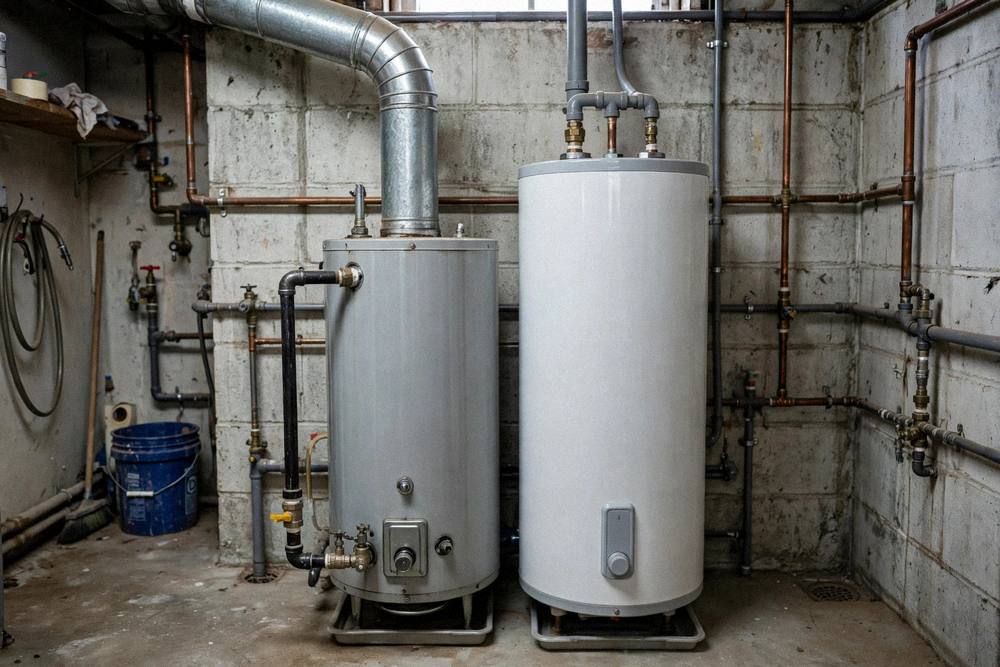
Gas usually costs less to run. At 2026 national average rates, a family of four pays about $300 to $480 a year to run a gas water heater and about $600 to $840 a year to run an electric one. But the gap is smaller in Nampa, because Idaho electricity is among the cheapest in the United States. The real answer depends on whether you already have a gas line, how much hot water your household uses, and how long you plan to stay.
How Each One Heats Water
A gas water heater burns natural gas under the tank. A burner fires, heats the water from below, and exhausts through a flue. A pilot light or an electronic igniter starts the burner.
An electric water heater has no flame and no flue. Two heating elements sit inside the tank, one near the top and one near the bottom. When the thermostat calls for heat, the elements draw current and heat the water directly.
The efficiency numbers look backwards at first. Electric tanks are 90 to 95 percent efficient, and gas tanks are about 60 to 70 percent efficient, because a share of the heat goes up the flue. But electricity costs about three times as much per unit of heat as natural gas nationally, so the efficiency edge loses. What matters is what the fuel costs in your town. And in Nampa, electricity is cheap.
Upfront Cost: Electric Wins on Day One
An electric water heater is cheaper to buy and cheaper to install. There is no gas line to run, no flue to vent, and no combustion safety checks. A gas unit needs a gas connection and a vent. That work costs money.
| Electric water heater | Gas water heater | |
|---|---|---|
| Installed cost, national | $900 to $1,600 (ABS Pipes, 2026) | $1,100 to $1,900 (ABS Pipes, 2026) |
| Venting | None | Flue or power vent required |
| Gas line | None | Required, must be sized for the burner |
| Install time | 3 to 5 hours | 3 to 5 hours, longer if a new gas line is needed |
Source: ABS Pipes (October 2026). All prices are national ranges, not Nampa prices.
The install gap is usually $200 to $300 in favor of electric. If your home already has a gas line and a flue, a gas swap costs about the same as an electric swap. If your home has no gas at all, adding a gas line can add $500 to $1,500 or more, and electric wins the day one price by a wide margin.
Running Cost: Gas Wins Most Months
Running cost is where gas pulls ahead. At 2026 national average rates, roughly 17 cents per kWh for electricity and $1.40 per therm for natural gas, heating water for a family of four costs about $55 to $65 a month on electric and about $28 to $38 a month on gas (ABS Pipes, 2026). Over a year, that is $600 to $840 for electric against $300 to $480 for gas. Over 10 years, gas saves $2,000 to $3,500 in energy costs versus electric.
Another guide puts it in yearly terms: about $300 a year for gas versus $475 a year for electric (Bright Side Kit, 2026). The electric unit starts $300 cheaper to install, but the fuel gap wipes that out in the first two years.
Water heating is about 18 percent of a typical home's energy use (DOE), so the fuel choice shows up on the bill every month. A household of 5 with daily showers and laundry will feel the gap more than a household of 2 that uses little hot water.
The Idaho Angle: Cheap Electricity Narrows the Gap
Here is where Nampa is different. Idaho electricity is among the cheapest in the United States, because most of it comes from hydroelectric dams. The US Energy Information Administration put the Idaho residential average at 12.35 cents per kWh in May 2026, well below the national average of about 17 cents. Idaho Power's 2026 residential rates run 9.93 cents per kWh in the first tier in the non summer months, 10.43 cents in the second tier, and 11.01 cents in the third tier, with a $15 monthly service charge. Summer rates are higher, at 12.12, 13.30 and 14.62 cents per kWh by tier.
Natural gas in Idaho is also cheap. The EIA put the Idaho residential natural gas average at about $10.82 per Mcf in May 2026, which works out to roughly $1.08 per therm. Nationally, the average is closer to $1.40 per therm.
So in Idaho, the fuel price ratio is still about 3 to 1 in gas's favor, even after the hydroelectric discount. At Idaho's rates, a family of four can expect roughly $350 to $500 a year for electric and roughly $250 to $400 a year for gas. The gap is closer to $100 to $150 a year, not $300 a year.
None of these are Nampa prices. They are Idaho state averages and national ranges, and your own bill depends on your tier and your usage. But the direction is clear: gas is still cheaper to run in Nampa, just by less than the national guides suggest.
Total Cost Over 10 Years
The install saving on electric and the fuel saving on gas pull in opposite directions. The only fair way to compare them is to add up the whole cost of ownership over the heater's life.
| Electric water heater | Gas water heater | |
|---|---|---|
| Install, national | $900 to $1,600 | $1,100 to $1,900 |
| Fuel per year, national | $600 to $840 | $300 to $480 |
| Fuel per year, Idaho | $350 to $500 | $250 to $400 |
| Repair cost over life, national | Lower | Higher |
| Life | 8 to 12 years | 8 to 12 years |
| Total over 10 years, national | $7,200 to $10,000 | $4,100 to $6,700 |
| Total over 10 years, Idaho | $4,400 to $6,600 | $3,600 to $5,900 |
Sources: ABS Pipes (October 2026), Bright Side Kit (2026), DOE life figures, EIA Idaho rates (May 2026). All prices are national ranges and Idaho state averages, not Nampa prices.
Gas wins the 10 year total in both columns, but the Idaho column is close enough that a small change in fuel prices or usage can flip it. If you plan to stay for only five years, the electric unit's lower install cost matters more. If you plan to stay for 15 years, gas wins by a wider margin.
Recovery Speed and Hot Water Supply
Gas heats water faster. A gas burner puts 30,000 to 50,000 BTU an hour into the tank. An electric tank usually has two 4,500 watt elements, and only one runs at a time. A gas tank recovers in about 30 to 40 minutes. An electric tank takes 60 to 90 minutes.
That matters in a big household. A family of five taking back to back morning showers will empty a 50 gallon electric tank and wait an hour for it to catch up. A gas tank of the same size catches up in half the time. A 40 gallon tank suits 1 to 3 people, and a 50 gallon tank suits 3 to 5 people, whichever fuel you pick.
Repairs and Lifespan
Electric water heaters are simpler machines, and simpler machines break less. The parts that fail are the heating elements and the thermostats. A heating element costs $100 to $350 to replace (HomeGuide, 2026), and a thermostat costs $100 to $350. Both are quick jobs with no combustion safety test needed.
Gas water heaters have more parts that can fail: the thermocouple, the gas control valve, the burner, and the pilot assembly. A thermocouple costs $100 to $325 to replace (HomeGuide, 2026), and a gas control valve costs $150 to $550. The pilot light repair runs $75 to $175 (Fixr, August 29, 2025). A gas repair often needs a combustion and venting check that an electric repair does not.
A gas tank lasts 8 to 12 years (DOE), and an electric tank lasts 8 to 12 years too. Electric tanks have no flame, no flue and no combustion byproducts wearing on the tank.
The 50 percent rule applies to both. If a repair quote is more than half the cost of a new heater, and the heater is past half its expected life, replace it. On an 8 year old gas tank with a bad gas valve quoted at $550, that rule says replace. On a 6 year old electric tank with a bad element quoted at $200, that rule says repair. Our gas water heater repair in Nampa page and our electric water heater repair in Nampa page walk through the same decision for each type.
The Third Option: A Heat Pump Water Heater
There is a third choice, and it beats both of them on running cost. A heat pump water heater, also called a hybrid, pulls heat out of the surrounding air and puts it into the water, instead of making heat from fuel or from a resistance element. It uses about one third of the electricity of a standard electric tank, and it costs about $200 to $300 a year to run. The install runs $2,000 to $4,600 nationally (HomeGuide, 2026).
It also fits Nampa well. It works best in a warm space like a garage or a utility room, and it dehumidifies the air as it runs. Idaho Power offers a $300 rebate on qualifying heat pump water heaters (form CRR 211). That rebate is for heat pump units only, not for standard electric tanks and not for gas.
The catch is the install price and the space it needs. A hybrid needs room to breathe, and it cools the room it sits in, which is fine in summer and less welcome in a cold garage in January. If you are replacing a tank and you have the space, it is worth pricing. If you are on a tight budget, a standard electric tank at Idaho's cheap rates is the next best thing.
Which One Fits Your Nampa Home?
Use this guide, not a rule. The right answer depends on what is already in the house.
Choose gas if:
Choose electric if:
Consider a heat pump if:
If you are switching from one fuel to the other, read our tank vs tankless water heater guide and our tankless water heater cost guide first. A fuel switch is a bigger job than a like for like swap, because the venting, the gas line and the electrical panel all change.
Frequently Asked Questions
Is gas or electric cheaper to run in Nampa?
Gas is cheaper to run, but by less than the national guides suggest. At Idaho's rates, about 12.35 cents per kWh for electricity and about $1.08 per therm for natural gas (EIA, May 2026), a family of four pays roughly $250 to $400 a year for gas and $350 to $500 a year for electric.
Is it worth switching from electric to gas?
Usually not, unless you already have a gas line. Adding a gas line can cost $500 to $1,500 or more, and it takes 4 to 10 years of fuel savings to pay that back. If the gas line is already in the house, a gas swap costs about the same as an electric swap.
Which one lasts longer, gas or electric?
Neither lasts longer on paper. A gas tank lasts 8 to 12 years, and an electric tank lasts 8 to 12 years too (DOE).
What about a heat pump water heater in Nampa?
It is the cheapest to run of all three, about $200 to $300 a year, and it uses about one third of the electricity of a standard electric tank. The install runs $2,000 to $4,600 nationally (HomeGuide, 2026). Idaho Power offers a $300 rebate on qualifying heat pump units (form CRR 211). It needs a warm space with room to breathe.
Call Nampa HeatPros for a Straight Answer on Gas or Electric
The right heater for your home depends on what is already in the house, how much hot water you use, and how long you plan to stay. Tell us what you have now, and we will tell you what the switch would cost, what it would save, and whether it is worth doing. Water heaters are all we do, and we do them in Nampa.
Our Service Area
We serve Nampa and the towns around it. Pick your area to see water heater repair there.