
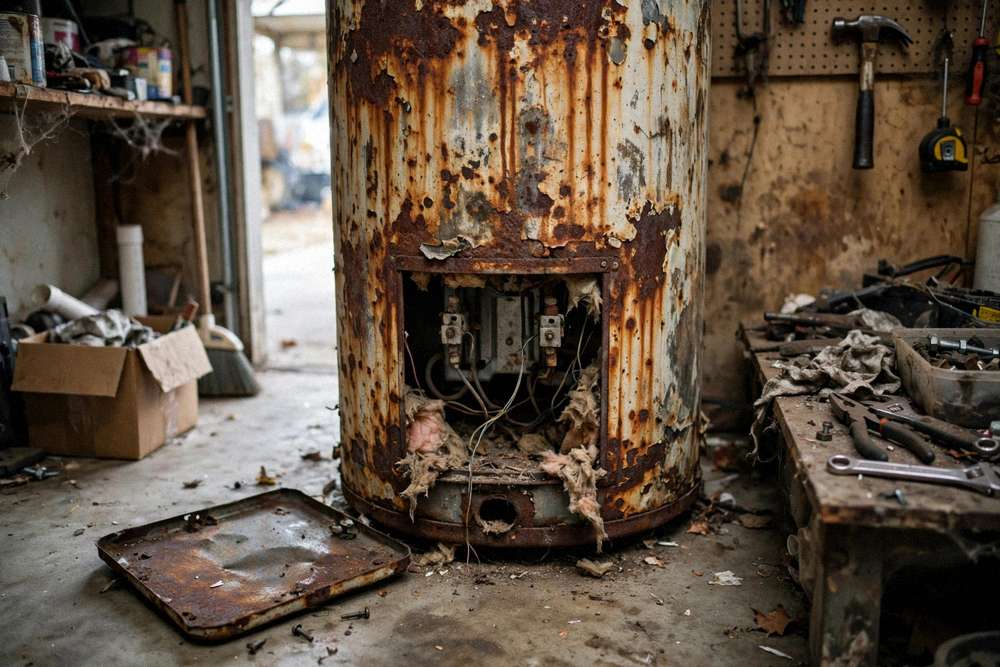
Most water heaters fail for one of six reasons: rust inside the tank, sediment from hard water, worn out heating parts, a bad thermostat, pressure with nowhere to go, or plain age. A tank lasts 8 to 12 years and a tankless unit lasts 15 to 20 years, based on the US Department of Energy.
In Nampa, hard water and cold winters push heaters toward the short end of that range.
The 6 Reasons Water Heaters Fail Most Often
Here is the short list. Each cause below gets its own section with the warning signs to watch for and what to do next.
| Cause | What it does | First warning sign |
|---|---|---|
| Corrosion and rust | Eats the steel tank from the inside | Rusty water or a damp spot at the base |
| Sediment buildup | Coats the tank floor and traps heat | Popping or rumbling noises |
| Heating parts wear out | Element or burner stops heating | Lukewarm water or no hot water |
| Thermostat failure | Water runs too hot, too cold, or swings | Temperature changes during a shower |
| Pressure problems | Stresses the tank, pipes, and valves | T and P valve dripping or leaking |
| Age and poor install | Every part reaches the end at once | Small repairs that keep coming back |
The International Association of Certified Home Inspectors reports that about 75 percent of water heater failures come from a tank that rusts through from the inside. That one number tells you where to look first. The tank is the part you cannot see.
1. Corrosion and Rust Eat the Tank From the Inside
A tank water heater is a steel tank full of hot water. Steel plus water plus oxygen means rust. The glass lining inside the tank slows rust down, but every tank has weak spots. Once water reaches bare steel, rust starts, and it does not stop.
The anode rod is the part that stands between your tank and rust. It is a magnesium or aluminum rod that hangs inside the tank. It corrodes on purpose so the tank does not. The US Department of Energy says to inspect the anode rod every 3 to 4 years. In Nampa, where the water runs from none to 7.08 GPG in hardness, based on the City of Nampa 2024 Consumer Confidence Report, we check the rod during the yearly flush. Hard water eats rods faster.
When the rod is gone, the tank is next. Rust shows up as brown or rusty water at the hot tap, a metallic taste, or a damp ring at the base of the tank. Rust at a pipe fitting can be fixed. Rust on the tank itself cannot. A tank that leaks from the body needs a new tank. There is no repair that holds.
What to do: ask us to check the anode rod when we flush the tank. A new anode rod runs 150 to 350 dollars nationally, based on HomeGuide 2026, plus labor. A new tank runs 600 to 3,100 dollars installed nationally, based on HomeGuide 2026. The rod is the cheap fix that protects the big purchase. Our anode rod replacement in Nampa page explains what the rod does and when to change it.
2. Sediment Buildup in Nampa Hard Water
Nampa water comes from city wells in the Snake River Plain Aquifer, and it carries calcium and magnesium. The City of Nampa 2024 Consumer Confidence Report lists hardness from none to 7.08 GPG across the city system. When hard water heats up, the minerals drop out and settle at the bottom of the tank as sediment. Year by year the layer gets thicker.
Sediment does two kinds of damage. First, it acts like a blanket between the burner or heating element and the water. Heat has to push through the layer, so the heater runs longer and burns more gas or power to make the same hot water. Second, water trapped under the sediment boils in small bursts, and that is the popping or rumbling noise many Nampa homeowners hear.
Tankless units have their own version of the same problem. Scale coats the heat exchanger, narrows the water path, and can throw error codes or shut the unit down. A tankless descale runs 75 to 300 dollars nationally, based on HomeGuide 2026. A tank flush runs 75 to 250 dollars nationally, based on HomeGuide 2026.
What to do: flush a tank once a year and descale a tankless unit once a year. In Nampa, once a year is the right pace because the top of the city hardness range sits at 7.08 GPG. Homes with a softener can stretch the interval, but only if the softener is filled with salt and serviced. Our water heater flushing in Nampa page walks through what a flush covers.
3. Heating Elements and Burners Wear Out
In an electric tank, two heating elements do the work. The lower element does most of the heating, and the upper element tops the water off. In a gas tank, the burner under the tank does the work, with the pilot light and thermocouple keeping the flame lit. Both kinds of parts wear out with use, and sediment makes them wear out faster.
A failing element shows up as lukewarm water, hot water that runs out fast, or no hot water at all. When the lower element fails, the upper element heats only the top of the tank, so you get a short burst of hot water and then cold.
A heating element runs 100 to 350 dollars nationally, based on HomeGuide 2026. A thermocouple runs 100 to 325 dollars nationally, based on HomeGuide 2026. A gas control valve runs 150 to 550 dollars nationally, based on HomeGuide 2026. These are part costs, and labor is on top. Labor runs 75 to 150 dollars an hour nationally, based on Fixr, updated Aug 29, 2025.
Use the 50 percent rule. If the repair quote is more than half the cost of a new heater and the heater is past half its expected life, replace it. A 200 dollar element on a 5 year old tank is a fair fix. A 550 dollar gas valve on a 10 year old tank is money you will not get back.
4. Thermostat and Controls Fail
The thermostat tells the heater when to fire and when to stop. A tank has one or two thermostats. A tankless unit has sensors and a control board. When a thermostat sticks, the water runs too hot, too cold, or swings between the two during a shower. When a thermostat fails open, the heater never fires at all.
A thermostat that sticks closed is the one to take seriously. The heater keeps heating past the set point, the water gets very hot, and the T and P valve may start to drip. That drip is the safety valve doing its job. Never cap a dripping T and P valve to stop the drip. The drip is a symptom, and the fix is the thermostat or the pressure problem behind it. Our T and P valve safety post explains what the valve does and why it must stay open.
A thermostat runs 100 to 350 dollars nationally, based on HomeGuide 2026. The repair is quick when the tank is sound. The test is simple too. Set the thermostat to 120 degrees F, based on US Department of Energy guidance, and watch what happens. If the water at the tap reads far above 120 or swings by a wide margin, the thermostat is suspect. A good thermometer at the tap and a steady hand tell you most of what you need to know.
What to do: check the setting with a thermometer at the tap. Set the dial to 120 degrees F and wait a day. If the tap reads far above 120 or swings by a wide margin, the thermostat is suspect.
5. Pressure Builds With Nowhere to Go
Water expands as it heats. In a closed plumbing system, that extra volume has nowhere to go unless the system has room for it. Pressure climbs, and the tank, the pipes, and the valves feel it first. High pressure stresses fittings, shortens the life of the tank, and can make the T and P valve drip.
The T and P valve opens at 150 psi or 210 degrees F. That is its job. It is the last line of defense that lets water out before pressure or temperature can damage the tank. A valve that drips now and then may be doing its job against thermal expansion. A valve that drips all the time points to high house pressure, a failed expansion tank, or a bad thermostat.
An expansion tank gives the extra water a place to go. It is a small tank with air inside that compresses as water expands. When the expansion tank fails, pressure spikes return. An expansion tank runs 150 to 350 dollars installed nationally, based on HomeGuide 2026. A T and P valve runs 50 to 300 dollars nationally, based on HomeGuide 2026.
What to do: if the T and P valve drips, put a bucket under the discharge pipe and watch it. A steady drip or a stream is not normal. Call us and we will check the house pressure, the expansion tank, and the thermostat in one visit. Our expansion tank installation in Nampa page explains how the tank protects the heater.
6. Age and Poor Installation Catch Up
Every water heater has a clock. A tank lasts 8 to 12 years. A tankless unit lasts 15 to 20 years. A heat pump unit lasts 10 to 15 years. Those figures come from the US Department of Energy. After that range, parts fail together. You fix the element, then the thermostat goes. You fix the thermostat, then the tank starts to leak. Small repairs that keep coming back are the heater telling you it is done.
Poor installation shortens the clock. A gas unit in a garage must sit 18 inches above the floor. A vent that sags or has gaps lets exhaust gas back into the house. A tankless unit with a gas line that is too small starves the burner. A discharge pipe that runs uphill or ends too high above the floor breaks the safety rules. A heater that was never flushed from day one builds sediment from the first year.
Nampa adds its own wear. The cold season runs Nov 19 to Feb 18, with 132 freezing nights a year, based on NOAA 1991 to 2020 data. Cold inlet water in winter makes the heater work harder to reach the same set point. Hard water at up to 7.08 GPG lays sediment down faster than soft water does.
What to do: find the age of your heater from the serial number on the rating plate. The first four digits often give the month and year it was built. If the tank is past 10 years old and needs a repair over 200 dollars, run the 50 percent rule before you spend it. If the tank is past 12 years old, plan a replacement on your schedule, not on the tank's schedule. A planned swap takes 3 to 5 hours and you pick the day.
Repair or Replace: The 50 Percent Rule
When a heater fails, the question is always the same: fix it or replace it. Use the 50 percent rule. If the repair quote is more than half the cost of a replacement and the heater is past half its expected life, replace it. A tank that is 5 years old with a 200 dollar element is a repair. A tank that is 10 years old with a 550 dollar gas valve is a replacement.
Fixr reports the average water heater repair at 450 dollars, with a range of 150 to 750 dollars, updated Aug 29, 2025. A tank replacement runs 600 to 3,100 dollars installed nationally, based on HomeGuide 2026. A tankless replacement runs 1,400 to 5,600 dollars installed nationally, based on HomeGuide 2026. Those are national figures, not Nampa prices. We give you a written price before we start, so you can run the rule on real numbers.
Three signs point straight to replacement. The tank leaks from the body. The water runs rusty even after a flush. The heater is past 12 years old and needs a second repair in the same year. Three signs point to repair. The tank is sound and under 8 years old. The fault is one part, like a thermostat or an element. The repair costs less than half of a new unit. Our yearly water heater maintenance in Nampa visit catches most of these signs before they turn into a failure.
Frequently Asked Questions
Why do water heaters fail in Nampa more than in soft water cities?
Hard water is the difference. Nampa water runs from none to 7.08 GPG in hardness, based on the City of Nampa 2024 Consumer Confidence Report. Minerals settle as sediment, scale coats heat exchangers, and anode rods wear faster. A yearly flush keeps the damage in check.
How do I know if my water heater is about to fail?
Watch for the early signs. Rusty water, popping noises, lukewarm water, hot water that runs out fast, a damp spot at the base, or a T and P valve that keeps dripping. One sign means book a visit soon. Two signs together mean book it this week. A tank that leaks from the body is past repair.
Can I fix a failing water heater myself?
You can do the safe checks. Look for leaks, listen for noises, read the serial number for the age, and check the breaker once. Leave gas, venting, electrical parts, and the T and P valve to us. A wrong move on a gas valve can hurt you.
Is it worth repairing a 10 year old water heater?
It depends on the repair and the tank. A 200 dollar thermostat on a sound 10 year old tank can be fair. A 550 dollar gas valve on the same tank is not. Use the 50 percent rule and ask us for a written price before you decide.
Call Nampa HeatPros Before a Small Failure Turns Into a Flood
Water heaters rarely fail without warning. The signs are there weeks before the tank leaks or the hot water stops. If you hear popping, see rusty water, or notice the hot water running out faster than it used to, tell us now. We will test the heater, give you a written price, and tell you straight whether a repair or a replacement makes sense.
Our Service Area
We serve Nampa and the towns around it. Pick your area to see water heater repair there.