
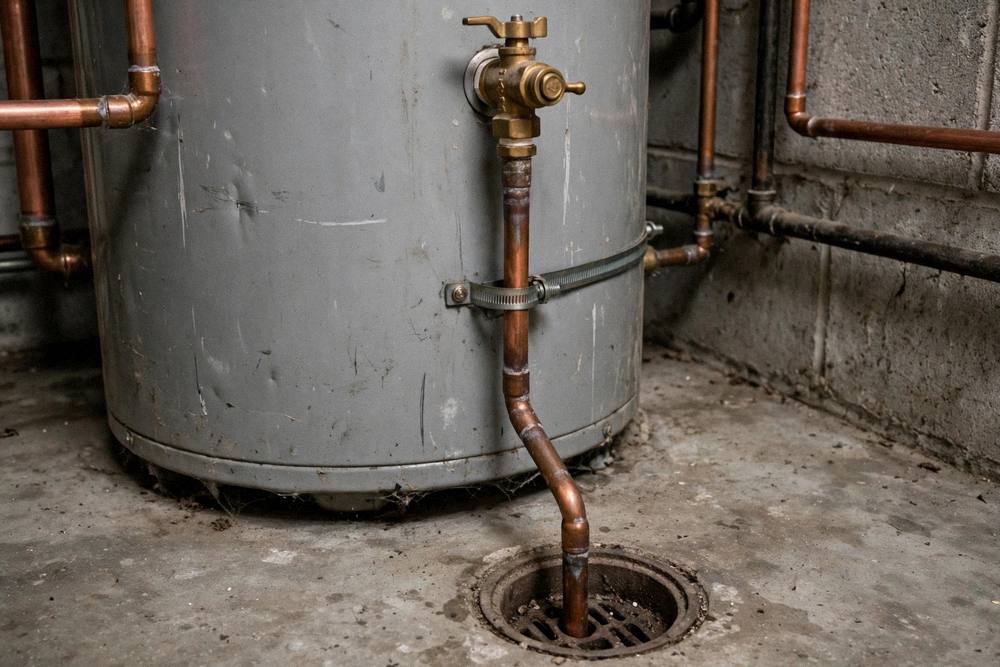
The T and P valve is the safety valve on the tank, and it is the one part you must never cap, plug, or block. It opens at 150 psi or 210 degrees F to let water out before pressure or temperature can damage the tank. T&P valve safety starts with one rule: the valve and its pipe stay open.
A tank with no working relief valve can build pressure until it fails, and a failed tank can flood a home or hurt someone badly.
What the T and P Valve Does
T and P stands for temperature and pressure. The valve sits on the side or the top of the tank, with a short pipe running down from it. Inside the valve, a spring holds a seal shut. When the water in the tank gets too hot or the pressure climbs too high, the spring gives way, the seal lifts, and water flows out through the pipe. When the pressure drops back to a safe level, the spring pushes the seal shut again.
Two things make the valve open. The first is heat. If the thermostat fails and the heater keeps heating, the water climbs past the set point toward 210 degrees F. The valve opens and dumps hot water out before the tank can boil. The second is pressure. Water expands as it heats. In a closed plumbing system, that expansion has nowhere to go, so pressure climbs. The valve opens at 150 psi and lets the extra water out.
The valve is the last line of defense. It is not the part that controls the heater. The thermostat controls the heater. The valve is there for the day the thermostat fails. Every tank water heater must have one, and the valve must sit in the opening made for it on the tank. The manuals from A.O. Smith and other makers say the same thing in plain words: the valve must not be removed from its opening, and it must not be plugged.
Why People Cap It, and Why That Is Dangerous
Most capped valves start with a drip. The valve drips, the drip annoys the homeowner, and someone puts a cap on the end of the pipe to stop it. That cap turns a safety valve into a plugged pipe. T&P valve safety comes down to this: the valve must always be free to open. The valve can no longer let water out, so the next time pressure or temperature climbs, the tank has no relief at all.
A tank with no relief is a pressure vessel with no escape. Water heated past boiling in a sealed tank builds pressure fast. The tank can split, burst, or launch upward with enough force to break through a floor. The manuals warn of this in the strongest terms they have: failure to follow the warning can result in excessive tank pressure, serious injury, or death. That is not sales talk. It is the reason the valve exists.
A dripping valve is a symptom, not the problem. The cause is usually one of three things. High house pressure pushes water out of the valve. A failed expansion tank leaves expanding water with nowhere to go. A bad thermostat overheats the water. Fix the cause and the drip stops. Cap the pipe and you hide the warning while the danger grows.
If your valve is dripping, put a bucket under the discharge pipe and watch it. A few drips after a long heating cycle can be normal expansion. A steady drip or a stream is not. Call us and we will check the house pressure, the expansion tank, and the thermostat in one visit. Our T and P valve replacement in Nampa page walks through what a new valve costs and how the job works.
The Discharge Pipe Rules
The pipe attached to the valve matters as much as the valve itself. It routes scalding water to a safe place. The rules for that pipe are the same in every manual and in the plumbing code, and they are simple.
First, the pipe must not be smaller than the valve outlet, and it must run full size to the end. No reducing coupling, no smaller pipe, no kink that chokes the flow. Second, it must flow downhill by gravity, with no low spots where water sits and no uphill runs. Third, it must have no valve, no tee fitting, and no threaded end. A threaded end lets someone screw a cap on, so the code forbids it. Fourth, it must not connect straight into a drain without an air gap. Fifth, it must end where the water can go safely and where you can see it. At a floor drain, it must stop no more than 6 inches above the floor. The pipe must be made of a material rated for hot water, which rules out ordinary plastic drain pipe.
The most common violations are easy to spot. A pipe that stops a foot above the floor. A pipe that runs up and over a joist. A pipe that shrinks in size halfway down. A flexible plastic hose instead of rigid pipe. A cap screwed on the end. Any one of these fails inspection, and any one of them can turn a working valve into a useless one.
In Nampa, one more rule matters. The discharge pipe must not run where it can freeze. A pipe that ends outside the house can freeze shut in a cold snap, and a frozen pipe is a blocked pipe. Nampa winters bring 132 freezing nights a year, based on NOAA 1991 to 2020 data, and the cold season starts Nov 19. If your discharge pipe runs outside, tell us, and we will route it to a drain inside the house instead.
How to Test the Valve Safely
The US Department of Energy says to check the T and P valve every 6 months. The makers say to work the valve by hand at least once a year. A valve that has never been tested can seize shut, and a seized valve protects nothing.
Here is the safe way to test it. Put a bucket under the end of the discharge pipe. Lift the lever on the valve briefly and let it snap back. A burst of hot water should flow out and stop when you let go. If water flows and stops, the valve works. If no water comes out, the valve may be seized. If the valve keeps dripping after the test, the seal is worn and the valve needs a new one.
Three warnings go with this test. First, the water that comes out is scalding hot, so keep your hands and your face clear of the pipe end. Second, never test a valve that looks corroded, rusted, or stuck. If the lever will not move, stop and call us. Forcing it can break the valve open and flood the floor. Third, never test the valve by capping the pipe first to see if it holds. The pipe must stay open during the test and after it.
If the valve fails the test, we replace it. A T and P valve runs 50 to 300 dollars nationally, based on HomeGuide 2026, plus labor. Labor runs 75 to 150 dollars an hour nationally, based on Fixr, updated Aug 29, 2025. The job is quick when the tank is sound, and it is one of the cheapest safety jobs in the house. That yearly test is the simplest T&P valve safety habit there is. We test the valve on every water heater maintenance in Nampa visit, so you never have to remember the schedule yourself.
When the Valve Needs a New One
A T and P valve wears out like any other part. The spring weakens, the seal hardens, and mineral scale from hard water can coat the seat so it will not close. Nampa water runs from none to 7.08 GPG in hardness, based on the City of Nampa 2024 Consumer Confidence Report, and that mineral load works on the valve seat year by year.
Four signs say the valve needs a new one. It drips all the time, even when the heater is idle. It keeps dripping after you test it. No water comes out when you lift the lever. Or you see rust, corrosion, or mineral crust on the valve body. A valve that is past 5 years old and has never been tested is suspect even if it looks fine from the outside.
A new valve must match the tank. The relief pressure on the new valve must not exceed the working pressure of the tank, which is printed on the rating plate. Only a new valve should go in. Never reuse an old valve from another heater, because it may be damaged or rated wrong for the tank. The valve must sit in the opening made for it on the tank, with no valve or other block between the relief valve and the tank.
What to do: if the valve is dripping, do not tighten it, do not cap it, and do not put a bucket under it and forget about it. The drip is the heater telling you something is wrong. Book a visit and we will find the cause. Most drips end with a pressure check, a new expansion tank, or a new valve. None of those ends with a cap.
The Expansion Tank: The Part That Stops the Dripping
Many dripping valves are not valve problems at all. They are expansion problems. When water heats, it expands. In an older open plumbing system, the extra water pushed back into the city main. In a modern closed system with a check valve or a pressure regulator, the extra water has nowhere to go, so pressure climbs every time the heater runs a full cycle.
The expansion tank gives the extra water a place to go. It is a small tank with air inside that squeezes as water expands. When the tank is sound, pressure stays steady and the T and P valve stays shut. When the tank fails, usually because the air charge leaks out or the bladder inside breaks, pressure spikes return and the valve starts to drip.
An expansion tank runs 150 to 350 dollars installed nationally, based on HomeGuide 2026. We check the air charge in the tank on our yearly visit, and we replace the tank when it will not hold pressure. If your valve drips after every long heating cycle, ask us to check the expansion tank first. It is the most common cause, and it is a cheaper fix than a valve that keeps getting blamed for a problem it did not cause. Our expansion tank installation in Nampa page explains how the tank protects the heater.
What to Do If the Valve Opens All the Way
A valve that opens fully and dumps a large amount of water is doing its job in an emergency. Stay calm and follow these steps. First, shut off the power or gas to the heater. For an electric unit, switch the breaker off. For a gas unit, turn the gas control to off. Second, shut off the cold water supply to the heater. Third, let the tank cool. Do not touch the valve or the discharge pipe while hot water is flowing. Fourth, call us.
Do not relight the pilot or switch the breaker back on until we have found the cause. A thermostat that stuck closed will stick again. A heater that overheated once will overheat again until the faulty part is changed. If the tank is over 8 years old and the thermostat failed, use the 50 percent rule. If the repair quote is more than half the cost of a new heater and the heater is past half its expected life, replace it. A tank lasts 8 to 12 years and a tankless unit lasts 15 to 20 years, based on the US Department of Energy.
Frequently Asked Questions
Can I cap the discharge pipe to stop the dripping?
Never. T&P valve safety starts here: the discharge pipe is the relief path, and it must stay open, unvalved, and routed to a safe place. Capping it removes the tank's pressure relief entirely. If the valve drips, the cause is high pressure, a failed expansion tank, or a bad thermostat. Fix the cause and the drip stops.
How often should I test the T and P valve?
The US Department of Energy says to check it every 6 months, and the makers say to work it by hand yearly. Put a bucket under the discharge pipe, lift the lever briefly, and let it snap back. Hot water should flow out and stop. If no water comes out, or the valve keeps dripping, call us.
Why does my T and P valve drip only sometimes?
A valve that drips after a long heating cycle is usually fighting thermal expansion. The water heats, expands, and has nowhere to go, so the valve lets a little out. A valve that drips all the time points to high house pressure or a failed expansion tank. We check the pressure, the expansion tank, and the thermostat.
Does a tankless water heater have a T and P valve?
Tankless units have pressure relief too, but the setup is different. A tankless unit holds no stored water, so it has no tank to protect. It still has a relief valve on the hot water line, and the same rule applies: never cap it, never block it, and test it on the schedule in the manual.
Call Nampa HeatPros if Your Relief Valve Drips or Fails a Test
A dripping relief valve is a warning, and a valve that fails its test is a safety job, not a wait and see job. We will check the valve, the house pressure, the expansion tank, and the thermostat, and we will tell you straight what needs doing. Water heaters are all we do, and we do them in Nampa.
Our Service Area
We serve Nampa and the towns around it. Pick your area to see water heater repair there.