
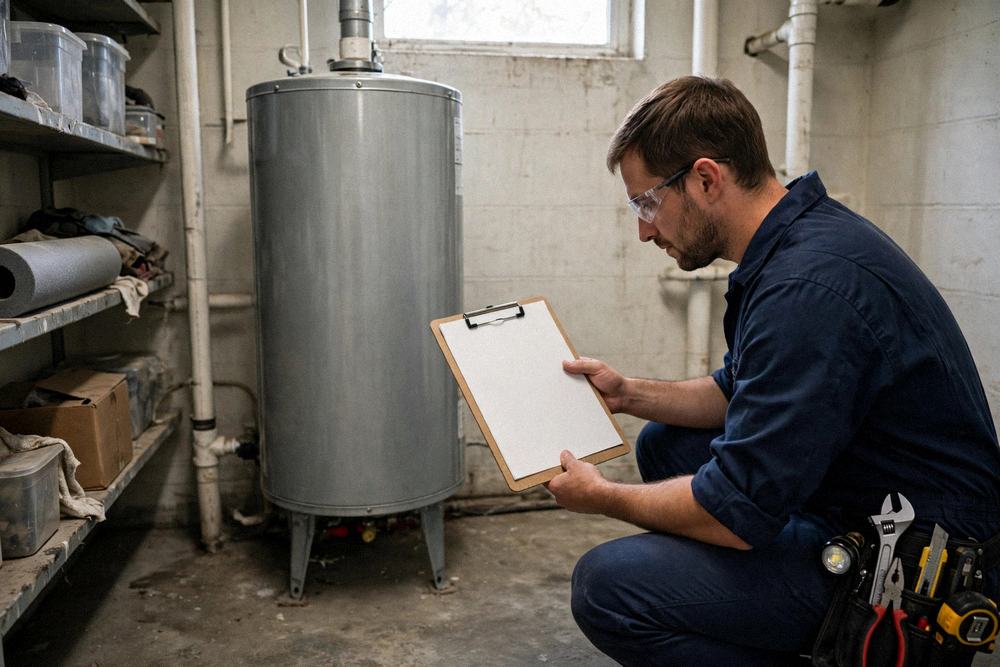
A water heater lasts 8 to 12 years with yearly care, and it often fails years early without it. The yearly care is simple. Flush the tank, check the anode rod, test the T and P valve, and look the unit over. That is the whole water heater maintenance checklist, and it takes one visit a year.
In Nampa, where hard water runs up to 7.08 GPG and winters bring 132 freezing nights a year, that one visit is what stands between a heater that lasts and a heater that floods a garage.
The Yearly Checklist at a Glance
Here is the full checklist. Each job below gets its own section with what it does, how often, and who should do it.
| Job | How often | Who does it |
|---|---|---|
| Flush the tank | Once a year | Us, or you with care |
| Descale a tankless unit | Once a year | Us |
| Inspect the anode rod | Every 3 to 4 years | Us |
| Test the T and P valve | Every 6 months | You, or us on the visit |
| Check the temperature setting | Once a year | You |
| Look for leaks and rust | Every few months | You |
| Check the vent and gas line | Once a year | Us |
| Check the expansion tank | Once a year | Us |
The US Department of Energy says to inspect the anode rod every 3 to 4 years and to check the T and P valve every 6 months. Those two intervals are the backbone of the checklist. Everything else fits around them.
1. Flush the Tank Once a Year
Flushing means draining the tank to wash sediment out. Nampa water carries calcium and magnesium, and the City of Nampa 2024 Consumer Confidence Report lists hardness from none to 7.08 GPG across the city system. When that water heats up, minerals settle at the bottom of the tank. The layer grows thicker every year the tank is not flushed.
Sediment is the quiet killer of tanks. It blankets the bottom, so heat from the burner or the lower element has to push through the layer to reach the water. The heater runs longer, burns more fuel, and the bottom of the tank overheats. Water trapped under the sediment boils in bursts, and that is the popping or rumbling noise you hear. Left alone, sediment shortens the life of the tank by years and can bury the lower element in an electric unit until it burns out.
A tank flush runs 75 to 250 dollars nationally, based on HomeGuide 2026. The job is simple in outline. We shut the heater off, let the water cool, hook a hose to the drain valve, and drain the tank until the water runs clear. If the drain valve is old plastic, we treat it with care. Old valves can break if forced, and a broken valve on a full tank is a mess.
Can you flush it yourself? Some homeowners do. If you try it, let the water cool first, keep the hose end where hot water can drain safely, and never open the drain valve on a full hot tank. Our water heater flushing in Nampa page walks through the job step by step.
2. Descale a Tankless Unit Once a Year
Tankless units do not hold water, so they do not collect sediment the same way. They collect scale instead. Hard water leaves mineral scale on the heat exchanger, the part that heats the water as it flows through. Scale narrows the water path, makes the burner work harder, and can throw error codes or shut the unit down.
A tankless descale runs 75 to 300 dollars nationally, based on HomeGuide 2026. The job uses the service valves and a small pump to run a cleaning solution through the heat exchanger. It takes under an hour. The manual for your model gives the interval, and in Nampa the right pace is once a year, because the top of the city hardness range sits at 7.08 GPG. Homes with a softener that is filled with salt and serviced can run longer between descales.
Do not skip the descale because the unit still makes hot water. Scale builds silently. By the time the water runs lukewarm or the unit throws an overheat code, the scale is already thick. Yearly descaling is the cheapest tankless job there is, and it protects the most expensive part in the unit. A heat exchanger runs 600 to 1,300 dollars nationally, based on HomeGuide 2026. Compare that with a 75 to 300 dollar descale and the choice is plain.
3. Inspect the Anode Rod Every 3 to 4 Years
The anode rod is a magnesium or aluminum rod that hangs inside the tank. It corrodes on purpose so the steel tank does not. The US Department of Energy says to inspect it every 3 to 4 years. We check it during the yearly flush in Nampa, because hard water eats rods faster than soft water does.
When we pull the rod, we look at how much metal is left. A rod that is down to a thin wire, or one that has more than 6 inches of core wire showing, needs a new rod. A new anode rod runs 150 to 350 dollars nationally, based on HomeGuide 2026. That is the cheapest insurance a tank has. Once the rod is gone, the tank itself starts to rust, and a rusted tank cannot be fixed. A new tank runs 600 to 3,100 dollars installed nationally, based on HomeGuide 2026.
One thing to know: a water softener speeds up anode wear. Softened water is more aggressive on the rod. If your home has a softener, tell us, and we will check the rod every year instead of every 3 to 4 years. Homes on private wells should do the same, because well water in the Nampa area can run harder than city water. Test your own water to know your own number. Our anode rod replacement in Nampa page explains what the rod does and when to change it.
4. Test the T and P Valve Every 6 Months
The T and P valve is the safety valve on the tank. It opens at 150 psi or 210 degrees F, and it lets water out before pressure or temperature can damage the tank. The US Department of Energy says to check it every 6 months. A valve that has never been tested can seize shut, and a seized valve protects nothing.
To test it, put a bucket under the discharge pipe and lift the lever briefly. A burst of hot water should come out and stop when you let go. If no water comes out, or the valve keeps dripping after the test, it needs a new valve. A T and P valve runs 50 to 300 dollars nationally, based on HomeGuide 2026.
Never cap, plug, or valve off the T and P valve or its discharge pipe. The discharge pipe must end within 6 inches of the floor, with no valve, no cap, and no smaller pipe in the line. If the valve drips all the time, the drip is a symptom, not the problem. The cause is usually high house pressure, a failed expansion tank, or a bad thermostat. Fix the cause and the drip stops. Our T and P valve safety post explains the valve in plain language and why it must stay open.
5. Check the Temperature Setting Once a Year
Set the thermostat to 120 degrees F, based on US Department of Energy guidance. That setting is hot enough for showers, dishes, and laundry, and cool enough to cut scald risk and save fuel. Many units leave the factory set near 140 degrees F, and some Nampa homeowners turn the dial up when the water runs lukewarm. Both habits waste fuel.
Lowering the setting from 140 to 120 degrees F can cut water heating costs by roughly 4 to 22 percent, based on US Department of Energy and Energy Star figures. The range is wide because it depends on how much hot water the home uses. A home that uses a lot of hot water saves more. The saving comes from less standby heat loss, because the tank loses less heat to the air around it when the water inside is cooler.
Check the setting with a thermometer at the tap. If the tap reads far above or below the dial, the thermostat may be failing, and that is a job for us.
6. Look for Leaks and Rust Every Few Months
This is the job you do yourself, and it takes two minutes. Walk to the heater and look at the floor, the tank base, and the pipe fittings. Look for damp spots, rust stains, or white mineral crust where water has dried. Listen for hissing or dripping. Put your hand near the base and feel for dampness.
Rust at a pipe fitting can be fixed. Rust on the tank itself cannot. A damp spot at the base that keeps coming back is the early sign of a tank leaking from the inside. Catch it early and you plan a replacement on your schedule. Catch it late and you come home to a flooded garage. Tanks fail from the inside out, and the outside often looks fine until the last weeks.
Check the area around the heater too. Keep the space clear. Boxes, paint cans, and laundry piled against a gas heater block airflow and can be a fire risk. A gas unit in a garage must sit 18 inches above the floor, and nothing should sit against the vent.
7. Check the Vent, Gas Line, and Expansion Tank Once a Year
These three checks belong on our yearly visit, because they need a trained eye. The vent carries exhaust gas out of the house. It must run up with a steady slope, with no sag, no gap, and no rust hole. A vent that sags or leaks can let carbon monoxide, a gas with no smell, back into the house. If the vent looks rusted or the joints look loose, tell us before the heating season starts.
The gas line and gas valve get a look too. We check for the smell of gas, for rust on the line, and for a shutoff valve that turns freely. If you ever smell gas near the heater, leave the house and call the gas company first, then call us. Do not flip switches or light anything on the way out.
The expansion tank gives expanding water a place to go. It is a small tank with air inside that compresses as water heats and expands. When it fails, pressure spikes come back, and the T and P valve starts to drip. An expansion tank runs 150 to 350 dollars installed nationally, based on HomeGuide 2026. We check the air charge in the tank on the yearly visit, and we replace the tank when it will not hold pressure.
What Yearly Care Costs, and What Skipping It Costs
A yearly visit that covers a flush, an anode rod check, a T and P valve test, and a look over the vent and fittings costs far less than one emergency call. A tank flush runs 75 to 250 dollars nationally, based on HomeGuide 2026. A tankless descale runs 75 to 300 dollars nationally, based on HomeGuide 2026. An anode rod runs 150 to 350 dollars nationally, based on HomeGuide 2026. A T and P valve runs 50 to 300 dollars nationally, based on HomeGuide 2026. Fixr reports the average water heater repair at 450 dollars, with a range of 150 to 750 dollars, updated Aug 29, 2025.
Skipping care costs more. A tank that is never flushed can fail in as little as 5 years, while the same tank with yearly care often reaches 10 to 12 years. A new tank runs 600 to 3,100 dollars installed nationally, based on HomeGuide 2026. A tankless unit that is never descaled can lose its heat exchanger, which runs 600 to 1,300 dollars nationally, based on HomeGuide 2026.
Book the visit in the fall, before the first freeze. Nampa winters bring 132 freezing nights a year, based on NOAA 1991 to 2020 data, and the cold season starts Nov 19. Cold inlet water makes the heater work harder all winter. A flushed tank with a sound anode rod and a working relief valve goes into winter ready. A neglected one goes in already tired.
Frequently Asked Questions
How often should I flush my water heater in Nampa?
Once a year. Nampa water runs from none to 7.08 GPG in hardness, based on the City of Nampa 2024 Consumer Confidence Report, and that is hard enough to lay sediment down fast. Homes with very hard well water may need a flush every 6 months.
Do tankless water heaters need the same checklist?
Most of it, with one change. A tankless unit has no tank to flush and no anode rod, but it needs a descale once a year, a T and P valve test where one is fitted, and an inlet filter clean. The manual for your model gives the exact intervals.
Can I test the T and P valve myself?
Yes, with care. Put a bucket under the discharge pipe, lift the lever briefly, and let it snap back. Hot water should flow out and stop. If no water comes out, or the valve keeps dripping, call us. Never cap the valve or the pipe, and never test a valve that looks corroded or stuck.
What happens if I skip maintenance for a few years?
The heater keeps working until it does not. Sediment thickens, the anode rod wears out, and the tank starts to rust from the inside. By the time you see rusty water or hear popping noises, the damage is well along. Yearly care is cheaper than one emergency swap.
Book Your Yearly Water Heater Check With Nampa HeatPros
One visit a year covers the flush, the anode rod, the T and P valve, and a full look over the unit. We will tell you what we found in plain words, give you a written price for anything that needs doing, and leave the heater ready for winter. Book your water heater maintenance in Nampa visit with Nampa HeatPros today.
Our Service Area
We serve Nampa and the towns around it. Pick your area to see water heater repair there.