
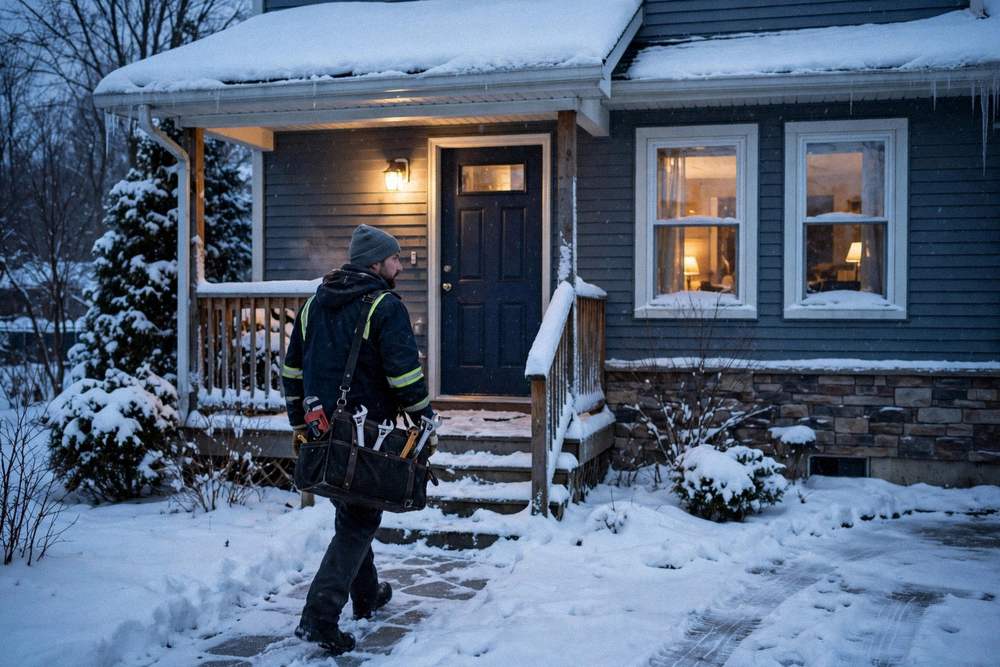
Nampa sees 132 freezing nights a year, with a January average low of 23 degrees Fahrenheit. That is more than a third of the year below freezing. Cold inlet water, frozen pipes, dead pilot lights, and tanks that work overtime all show up between November and February. This guide shows what breaks first.
What 132 Freezing Nights a Year Mean for Hot Water
The number comes from NOAA data for 1991 to 2020, measured at the Nampa Sugar Factory station. Nampa averages 132 nights a year at or below freezing, and the cold season runs November 19 to February 18. January is the coldest month, with an average low of 23 degrees Fahrenheit. December is close behind, with an average low near 23 degrees as well.
That matters because a water heater fights the cold every day. In July, the water coming into your house is warm, and the heater only has to lift it a short way to reach 120 degrees Fahrenheit. In January, the same water arrives far colder, and the heater has to work much longer to reach the same temperature. Any weak part shows itself in the coldest week of the year.
Most Nampa homes feel winter at the water heater first. The shower runs short. The water turns lukewarm halfway through. The tank makes popping noises it never made in summer. None of that means the heater is broken. It means the heater is working against 132 freezing nights, and it needs care before the cold season starts.
Cold Inlet Water: Why Winter Showers Run Short
The single biggest winter effect is cold inlet water. The water in the ground is colder in January than in July, so the water entering your house is colder too. Your heater has to raise it further to reach 120 degrees Fahrenheit, and that takes more time and more energy.
A tank heater feels this as shorter showers. A 40 gallon tank holds the same 40 gallons in January as in July, but the burner needs longer to bring the next tankful up to temperature after the first one is used. A family of four that showers back to back in the morning will run out faster in January than in July, even though nothing is wrong with the unit.
A tankless unit feels this as a lower flow rate. A tankless heater can only lift the water temperature by a set amount at a given flow. When the inlet water is colder, the same unit delivers fewer gallons per minute at full temperature. A unit sized for summer flow may run lukewarm in January if two taps open at once. This is a sizing question, not a fault, and it is why we size a tankless unit for winter inlet water, not summer inlet water.
Space showers out by a few minutes in January. If the water still runs short every morning, the heater may be undersized, or sediment may be stealing capacity. A tank flush runs $75 to $250, national, HomeGuide 2026, and it is the cheapest winter fix there is.
Frozen Pipes and Frozen Heaters: What Breaks First
Water freezes at 32 degrees Fahrenheit. When water freezes inside a pipe or a tank, it expands, and that expansion can crack metal, split plastic, and burst joints. The damage often stays hidden until the ice thaws, then shows up as a leak.
Pipes break first, before the tank does. The pipes most at risk are the ones in unheated spaces: the garage, a crawl space, an outside wall, or a utility closet with a draft. The inlet and outlet pipes at the water heater are a common freeze point, because they run through cold air to reach the unit. A frozen inlet pipe means no water reaches the heater at all, so the hot tap gives you nothing or a thin trickle.
The tank itself is the next risk. A tank full of hot water holds its heat for a long time, so it rarely freezes while it is running. It freezes when the power goes out, when the gas is off, or when the house sits empty with the heat turned down. Once the water inside cools to freezing and stays there, ice can crack the tank from the inside. A cracked tank cannot be fixed. It has to be replaced, and a tank replacement runs $600 to $3,100 installed, national, HomeGuide 2026.
The signs of a freeze are easy to spot: no hot water at all, a trickle from the hot tap while the cold tap runs fine, frost or ice on pipes near the heater, or a room that feels as cold as outside. If you see any of those, do not run the heater. Turn off the power at the breaker for an electric unit, or turn off the gas for a gas unit, shut off the cold water supply to the heater, and open a hot tap to take pressure off the pipes. Then call a plumber. Running a frozen heater can burn out elements, crack the tank, or start a fire.
Tankless Units Freeze Faster
A tankless water heater is more exposed to freezing than a tank, and Nampa winters punish that difference. A tank stores 40 or 50 gallons of hot water that holds heat for hours. A tankless unit holds only a small amount of water in narrow passages, and those passages freeze fast. Makers warn that a tankless unit can freeze even near 30 to 32 degrees Fahrenheit if it is not protected.
Most tankless units have built in freeze protection, usually a small heater inside the unit that switches on when the temperature drops. That protection needs power. In a power cut, the protection stops, and the water inside the unit can freeze quickly, even if the night is only just below freezing. This is the winter failure most Nampa tankless owners never see coming, because the unit worked fine all through the last cold snap while the power stayed on.
If your tankless unit sits outside or in an unheated garage, ask us about freeze protection before the cold season. For a power cut, know how to drain the unit: shut off the water, open the taps, and drain it so no water is left inside to freeze. Our tankless water heater repair in Nampa page lists the error codes that show up after a freeze, and our tankless water heater error codes guide explains what each code means.
The Garage Problem in Nampa Homes
Most Nampa water heaters sit in the garage, and the garage is the coldest room in the house. A gas unit in a garage must sit 18 inches above the floor, which puts it right in the path of cold air coming under the garage door. An electric unit in a garage loses heat through the tank walls to the cold air around it. Both work harder in a garage than they would in a heated utility room.
The garage problem has three parts. First, drafts. A gap under the garage door or a crack in the wall lets freezing air straight onto the heater and its pipes. Second, insulation. Many Nampa garages have no insulation on the walls or the ceiling, so the room tracks the outside temperature overnight. Third, power and gas. A garage heater that loses power in a January storm has no backup heat, and the water inside starts cooling at once.
Seal the drafts around the garage door and any wall gaps. Insulate the hot and cold pipes at the heater. Keep the garage door closed on freezing nights. Do not turn the heater off in freezing weather while you are living in the home, because keeping it on is what keeps the water inside from freezing. If you leave the house empty for the winter, drain the tank first.
The Nampa Winter Water Heater Checkup Before the First Freeze
The best time to deal with Nampa winters is before they start. A fall checkup in October, before the cold season opens on November 19, catches the problems that become emergencies in January.
In October, flush the tank. Nampa water runs from none to 7.08 grains per gallon of hardness, based on the City of Nampa 2024 Consumer Confidence Report, and sediment builds up all summer. A flush while the sediment is still loose takes it out before it hardens into a crust. Check the anode rod at the same time. The US Department of Energy says to check it every 3 to 4 years. Check the temperature and pressure relief valve too. It opens at 150 psi or 210 degrees Fahrenheit, and it must never be capped.
In November, insulate the pipes at the heater and any exposed pipe in the garage or crawl space. Set the thermostat to 120 degrees Fahrenheit, based on US Department of Energy guidance. Check that the garage door seals. If you have a tankless unit, test the freeze protection and clear the condensate drain.
From December to February, watch for the signs. Short showers, lukewarm water, popping noises from sediment, a pilot light that will not stay lit in a draft, or rusty water in the morning. A pilot light repair runs $75 to $175, national, Fixr, updated August 29, 2025. A thermocouple runs $100 to $325, national, HomeGuide 2026.
In March, watch for thaw leaks. Freeze damage hides all winter and shows up when the ice melts. Check the base of the tank, the pipe joints, and the relief valve discharge pipe for drips in the first warm week.
What to Do When the Hot Water Stops on a Freezing Night
First, check the obvious. Is the power on? Is the breaker tripped? Is the pilot light lit on a gas unit? A winter draft can blow out a pilot light, especially if the venting is not sealed well. If the pilot will not stay lit, the thermocouple is the most common cause, and our pilot light will not stay lit guide walks through it.
Second, check whether the cold tap runs. If the cold tap runs fine but the hot tap gives nothing, the freeze is on the hot side, usually the inlet or outlet pipe at the heater. If neither tap runs, the freeze is further back in the supply, and the problem is bigger than the heater.
Third, do not force it. Do not turn the heater up, do not run a frozen unit, and do not use an open flame on a frozen pipe. Turn off the power or gas, shut off the water supply to the heater, open a hot tap to relieve pressure, and call for help. Our emergency water heater repair in Nampa page covers what counts as an emergency and what to do before we arrive. Our no hot water in Nampa page covers the full list of causes when the hot water stops for any reason.
Winter Proofing That Pays for Itself
Winter care for a Nampa water heater is not expensive, and it pays back in two ways: fewer emergency calls and a longer life for the unit. A tank lasts 8 to 12 years and a tankless unit lasts 15 to 20 years, based on the US Department of Energy, but only with yearly care. A tank that never gets flushed in Nampa hard water will not reach the top of that range.
The short list is this. Flush the tank once a year, and descale a tankless unit once a year. A tank flush runs $75 to $250 and a tankless descale runs $75 to $300, both national, HomeGuide 2026. Insulate the pipes at the heater. Seal the garage drafts. Keep the thermostat at 120 degrees Fahrenheit. Check the anode rod every 3 to 4 years and the relief valve every 6 months. Test the tankless freeze protection before the first freeze, and know how to drain the unit if the power goes out.
A repair averages $450, national, Fixr, updated August 29, 2025, with a range of $150 to $750. A replacement runs $600 to $3,100 for a tank and $1,400 to $5,600 for a tankless unit, both installed and national, HomeGuide 2026.
Frequently Asked Questions
How many freezing nights does Nampa get a year?
Nampa averages 132 freezing nights a year, based on NOAA data for 1991 to 2020, with a January average low of 23 degrees Fahrenheit. The cold season runs November 19 to February 18. That is more than a third of the year below freezing, which is why winter care matters so much for a Nampa water heater.
Why does my hot water run out faster in winter?
The water coming into your house is colder in January than in July, so the heater has to work longer to reach 120 degrees Fahrenheit. A tank runs out faster because the burner needs more time to reheat the next tankful. A tankless unit delivers fewer gallons per minute at full temperature for the same reason. Spacing out showers by a few minutes usually fixes it.
Can my water heater freeze in Nampa?
Yes, and the pipes freeze first. Pipes in unheated garages, crawl spaces, and outside walls are most at risk. A tankless unit freezes faster than a tank because it holds little water in narrow passages, and its freeze protection stops working in a power cut. Do not run a frozen heater. Turn off the power or gas, shut off the water, open a hot tap, and call a plumber.
What should I do before the first freeze each year?
Flush the tank, check the anode rod and the relief valve, insulate the pipes at the heater, seal the garage drafts, set the thermostat to 120 degrees Fahrenheit, and test the tankless freeze protection if you have one. Do it in October, before the cold season opens on November 19. Then watch for thaw leaks in March.
Call Nampa HeatPros Before the Cold Season Starts
Do not wait for the first freezing night to find out your water heater is not ready. Book a Nampa winter water heater check in October and we will flush the tank, check the anode rod and the relief valve, insulate the pipes, and test the freeze protection. If your hot water has already stopped on a freezing night, our emergency water heater repair in Nampa page tells you what to do right now. Water heaters are all we do, and we do them in Nampa.
Our Service Area
We serve Nampa and the towns around it. Pick your area to see water heater repair there.