
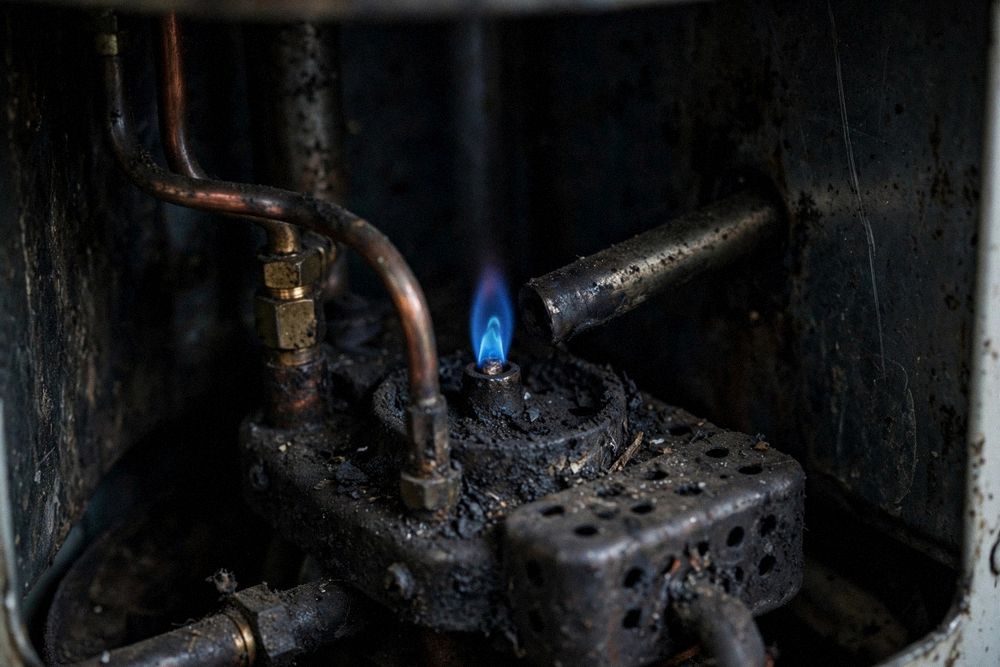
A pilot light that will not stay lit almost always points to the thermocouple, a small safety sensor that sits in the pilot flame. When it wears out, gets dirty, or slips out of position, it cannot tell the gas valve the flame is burning, so the valve shuts the gas off seconds after you let go of the button. A clogged pilot orifice, a draft, a blocked air screen, or a failing gas valve can do the same thing.
How the Pilot and Thermocouple Work Together
Most standard tank gas water heaters use a small, steady pilot flame to light the main burner whenever the tank calls for heat. Sitting in that pilot flame is a thin copper rod called a thermocouple. On some models it is a thicker thermopile, which does the same job. When the pilot flame heats the thermocouple, it makes a tiny electrical signal that tells the gas valve the pilot is lit and it is safe to keep gas flowing.
If the pilot goes out, the thermocouple cools within a minute or so and the gas valve shuts off the gas. That is a safety feature, not a defect. It keeps unburned gas from filling your garage or closet. So when a pilot light will not stay lit, the question is always one of two things: why is the flame going out, or why does the valve think it went out?
Newer heaters may use electronic ignition and a flame sensor instead of a standing pilot. If your heater has no pilot flame at all and lights with a spark or a hot surface igniter, this blog does not apply to it.
The Most Common Causes, Ranked
1. A dirty or failing thermocouple
This is the most common cause, and the first thing a plumber checks. Thermocouples live in a harsh spot: directly inside a flame, cycling between hot and cool every time the burner fires. Over years they wear out, oxidize, or get coated in soot. A weak one may hold the pilot for a few hours or days, then drop it. A dead one will not hold it at all.
The classic symptom is the pilot that lights while you hold the button, then dies within seconds of letting go. That pattern points straight at the thermocouple circuit. A relit pilot that dies within seconds almost always points to a worn or misaligned thermocouple (Legacy Plumbing and Drain, 2026).
The fix is cleaning first, then replacement. Cleaning sometimes helps if the tip is only coated in soot. Replacement is usually the right call, because the part is inexpensive and sealed, and a new one removes the doubt. A thermocouple replacement runs $100 to $325 nationally (HomeGuide, 2026), and the part itself costs $15 to $30.
2. A thermocouple out of position
Even a good thermocouple will not work if it is not fully in the pilot flame. The tip should sit at least 3/8 to 1/2 inch into the hottest part of the flame. If it has been bumped away, it will not heat enough to make the voltage the valve needs. Rheem's service bulletin says the flame should cover the top 3/8 inch to 1/2 inch of the tip, and the connection at the gas valve should be no more than one quarter turn beyond hand tight.
The fix is to bend it gently back into the flame path, with the pilot off, following the lighting instructions on the front of the unit. If the thermocouple is loose at the gas valve, finger tight plus one quarter turn is the right connection. More than that can damage the fitting.
3. A dirty pilot orifice
The pilot orifice is a tiny opening where gas flows to make the pilot flame. If dirt, dust or mineral deposits block it, gas flow becomes weak and irregular, and the flame struggles to stay lit. A clogged orifice makes a weak, yellow flame instead of a steady blue one. A weak flame cannot heat the thermocouple properly even if it is in the right position.
The whole pilot assembly collects grime over years: the gas tube, the ignition electrode and the thermocouple. Cleaning these parts often solves the problem without new parts. A pilot light repair runs $75 to $175 nationally (Fixr, 2025).
4. A clogged flame arrestor screen
Heaters built since the early 2000s have a sealed combustion chamber with a screen on the bottom that lets air in but keeps flames from getting out. That screen collects dust, dryer lint and pet hair fast, especially in a garage. When it clogs, the burner starves for air and the pilot can go out. This is one of the most missed causes, because the screen sits low on the unit where nobody looks.
The fix is to clean the screen and clear the air intake, with the gas off and the unit cool. The screen is easy to damage if it is forced.
5. Drafts and poor venting
A strong breeze from an open garage door, a fan pointed at the heater, or a blocked vent pipe can snuff out the pilot or pull exhaust back into the burner area. In Nampa, winter is when this shows up most: garage doors open and close in cold wind, and a heater in an unheated garage faces drafts a heater in a warm closet never sees. Check whether the pilot goes out when the garage door opens or a vent fan runs.
6. Gas supply problems
If other gas appliances in the home are also acting up, the problem may be the gas supply, not the water heater. Low or unsteady gas pressure, a partially closed gas valve, or a supply interruption will starve the pilot. Check the stove and the furnace. If they are fine, the fault is inside the heater.
7. A failing gas control valve
The gas control valve holds the thermostat, the main valve and the pilot valve in one unit. On an older heater, the valve itself can wear out and fail to hold open even with a good thermocouple. This is less common than a bad thermocouple, but it does happen, especially on units past 10 years old. A gas control valve replacement runs $150 to $550 nationally (HomeGuide, 2026). At that price, on an old tank, the 50 percent rule usually says replace the heater instead. Our gas water heater repair in Nampa page covers the full repair vs replace decision for gas units.
What You Can Safely Check Yourself
What You Should Not Do
Gas work carries real risk. If you smell gas near your water heater, do not try to relight it. Do not flip switches, do not use your phone in the room, and leave the house. Call the gas company from outside. A pilot that will not stay lit is an annoyance. A gas leak is an emergency.
Do not take the gas valve apart. Do not adjust the gas pressure. Do not bypass the thermocouple or wire the valve open to keep the pilot lit. The thermocouple is a safety device. Bypassing it means gas keeps flowing with no flame to burn it, and that is how a house fills with gas. American's own manual says not to tamper with the gas valve, the thermostat, the igniter or the thermocouple. Only qualified technicians should service these parts.
Do not keep relighting a pilot that goes out again and again. Each failed relight puts a little unburned gas into the room. Three tries is enough. If it will not hold after three careful tries, stop and call a plumber. Our pilot light will not stay lit in Nampa page has the same steps in short form.
What a Plumber Does on a Pilot Call
A pilot call follows the same steps. First, the plumber relights the pilot the right way, holding the button for a full minute, and watches what happens when it is released. If it dies at once, the thermocouple circuit is the suspect.
Second, the plumber tests the thermocouple. American's manual gives a multimeter test: disconnect the thermocouple from the gas valve, clip the meter leads to the copper body and the silver end, light the pilot, and watch the reading. After 45 seconds the meter should read 12 millivolts DC or more. Below that, the thermocouple is weak and gets replaced.
Third, the plumber cleans the pilot orifice and the flame arrestor screen, checks the thermocouple position, and checks the venting. Most pilot calls end here, with a clean or a new thermocouple and a pilot that holds. If the thermocouple tests fine and the pilot still will not hold, the gas valve is next, and that is the point where the age of the heater decides the repair. Our pilot light and thermocouple repair in Nampa page covers the same visit.
> Three careful relights is enough. If the pilot will not hold after three tries, stop. Each failed relight puts unburned gas into the room, and a pilot that keeps dying is telling you a part has failed, not that you are lighting it wrong.
When the Pilot Problem Means a New Heater
A pilot problem is usually a small fix. It becomes a replacement decision when the fix costs too much for the age of the tank.
The 50 percent rule is the guide: if the repair quote is more than half the cost of a replacement and the heater is past half its expected life, replace it. A gas control valve at $150 to $550 nationally, on a 12 year old tank with a life of 8 to 12 years, is money you will not get back. A thermocouple at $100 to $325, on a 5 year old tank, is a fair fix.
Other signs point the same way. Rust in the hot water, a tank that pops and rumbles from sediment, or a leak at the bottom of the tank all mean the tank is failing. A tank replacement runs $600 to $3,100 installed nationally (HomeGuide, 2026), and a straight swap takes 3 to 5 hours.
Nampa Winter Drafts and Garage Heaters
Nampa winters are cold. NOAA 1991 to 2020 normals show 132 nights a year at or below freezing, with a January average low of 23 degrees Fahrenheit. Most Nampa water heaters sit in a garage, and a garage in January is cold and drafty, with wind every time the door opens. That is when pilot problems show up most.
A heater in a cold garage faces two problems a heater in a warm closet does not. First, drafts. Cold wind through a garage door gap or a vent can snuff a weak pilot flame that held fine all summer. Second, cold air starves the burner. A clogged flame arrestor screen matters more in winter, because the burner needs full air flow to burn cleanly. If your pilot goes out every winter and holds all summer, check the screen and the drafts before you blame the thermocouple.
FAQs
Why does my pilot light go out as soon as I release the button?
That points at the thermocouple circuit. The thermocouple is a small rod in the pilot flame that makes a tiny voltage when hot, and that voltage holds the gas valve open. If it is dirty, worn out, or out of position, it does not make enough voltage, and the valve closes the moment you let go.
How long should I hold the pilot button down?
A full 30 to 60 seconds after the flame appears, before you slowly release. American's lighting steps say to keep holding for about one minute after the pilot is lit.
Is a pilot light that will not stay lit dangerous?
It can be. The thermocouple is a safety device, and a pilot that will not hold means the safety circuit is working, but it also means gas is flowing and not burning each time you relight it. If you smell gas, do not relight anything, leave the house, and call the gas company from outside.
How much does it cost to fix a pilot light that will not stay lit?
A pilot light repair runs $75 to $175 nationally (Fixr, 2025). A thermocouple replacement runs $100 to $325, and a gas control valve runs $150 to $550 (HomeGuide, 2026). Most pilot calls end with a clean or a new thermocouple.
Book Your Gas Water Heater Repair in Nampa Today
A pilot light that will not stay lit is usually a small fix: a thermocouple, a cleaning, or a repositioning. Tell us what your pilot is doing and we will test it, give you an upfront written price, and fix it the same day where we can.
Our Service Area
We serve Nampa and the towns around it. Pick your area to see water heater repair there.