A tankless water heater error codes display tells you why the hot water stopped, and it names the part that failed. The number on the screen is not random. It points at ignition, flame, heat, venting, water flow, scale, or a sensor. Read it, write it down, and reset once before you decide what to do next.
What a Code Is and Where to Read It
A tankless unit watches itself while it runs. It watches gas, air, flame, water flow, and temperature. When one reading moves outside the safe range, the control board shuts the burner off and shows a code. The code says what the board saw, not why it happened. Testing finds the cause.
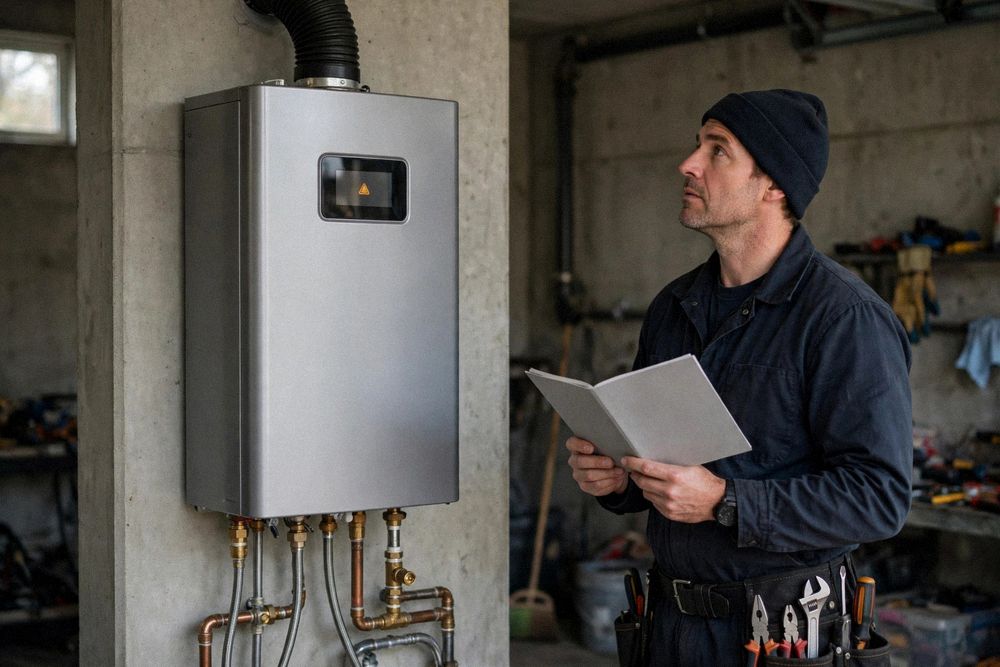
You read the code on the front panel display. On Rinnai it is a plain number such as 11. On Navien it starts with E, such as E003. On Takagi it is a three digit number such as 111. On Rheem it is a plain number such as 11 or 29.
Write the code down before you press anything. Take a photo with your phone. Codes vary by model, so always check the manual for your model number.
What Tankless Water Heater Error Codes Tell You First
Every code falls into one of six groups. Ignition means the burner did not light. Flame loss means the burner lit and then went out. Overheat means a temperature rose past a safe limit. Venting means air or exhaust could not move as it should. Flow means water did not move through the unit as it should. Sensor means a temperature sensor sent a reading that was out of range, or no reading at all.
Ignition and venting faults can involve gas and exhaust. Overheat faults can involve scale. Scale faults turn into overheat faults if you ignore them.
A code that comes back right after a reset is a real condition. Stop resetting at that point.
Common Codes by Brand
Find your brand, then your number. Codes vary by model, so check your manual if your number is not here.
| Fault | Rinnai | Navien | Takagi | Rheem |
|---|---|---|---|---|
| Flame loss | 12 | E012 | 121 | 12 |
| Overheat | 14 | E016 | See manual | 14 |
| Venting or air | 10 | E110 | 101 | 10 |
| Condensate drain | 25 | See manual | 291 | 29 |
| Scale or service due | LC | E760 | See manual | 1L |
| Hot water outlet sensor | See manual | E407 | See manual | See manual |
Code 11 means no ignition on Rinnai and on Rheem. Always match brand and model first.
No Ignition and Flame Loss
No ignition is the most common fault we see. Rinnai 11, Navien E003, Takagi 111, and Rheem 11 all mean the same thing. The unit sensed water flow, tried to light the burner, and never saw a flame. Rinnai 12, Navien E012, Takagi 121, and Rheem 12 mean the burner lit, then went out.
Check three safe things first. Make sure the gas valve to the heater is fully open. Make sure other gas appliances in the house work. If the stove or furnace also struggles, the gas supply to the house is the problem. Make sure the unit has power. A tripped breaker stops ignition cold. Check the air intake filter if you can reach it. Dust and lint clog it.
Do not open the gas valve inside the unit, clean the igniter, or adjust gas pressure. Those are tech jobs. If the code comes back after one reset, call for tankless water heater repair in Nampa.
Overheat Codes
Overheat codes mean a temperature rose past a safe limit and the board shut the burner off to protect the unit. Rinnai 14, Navien E016, and Rheem 14 are the numbers you will see most. Navien also uses the 400 series for sensor and overheat faults, including E407 for the hot water outlet sensor.
Low water flow is a common cause. When water moves too slow through the heat exchanger, heat has nowhere to go. A clogged cold water inlet filter slows flow. Scale inside the heat exchanger slows heat transfer into the water, so the metal runs hot even when flow looks fine. That is why overheat codes show up so often in hard water homes. Nampa water runs from none to 7.08 grains per gallon, per the City of Nampa 2024 Consumer Confidence Report.
If the code returns after the unit cools and you reset once, stop. A heat exchanger costs 600 to 1,300 dollars to replace, national figure from HomeGuide 2026. A full tankless repair runs 300 to 1,300 dollars, national figure from HomeGuide 2026.
Venting, Air, and Condensate
Venting codes mean the unit could not move air in or exhaust out as it should. Rinnai 10, Navien E110, Takagi 101, and Rheem 10 are the common numbers. In Nampa, check the outside vent first. Leaves, a bird nest, snow, and ice can block it. Nampa sees 132 freezing nights a year, with a January average low of 23 degrees Fahrenheit, per NOAA 1991 to 2020.
On condensing units, Rheem 29 means the condensate is not draining. Rinnai 25 means the same on many models. When the trap clogs or the line freezes, the unit shuts down. If you see water pooling under the unit, shut the water off at the heater and call.
Never run a gas tankless unit with the vent disconnected. If you smell gas, hear hissing, or see scorch marks on the unit or the vent, stop. Do not press reset. Do not flip switches. Leave the house and call for help from outside.
Scale and Service Codes
Scale codes are the most useful codes a tankless unit gives you, because they warn you before the unit fails. Rinnai LC, Navien E760, and Rheem 1L all mean lime scale has built up in the heat exchanger and the unit needs a flush. These are service codes, not failure codes. Do not ignore them. Scale coats the inside of the heat exchanger, blocks heat from moving into the water, and forces the burner to run hotter and longer.
Nampa hard water drives this. Water at up to 7.08 grains per gallon leaves mineral behind every time it is heated. In Nampa we descale tankless units yearly. Descaling every 12 to 18 months in hard water is the rule we follow, and it matches the guidance from PipeBeaver Nampa. A descale costs 75 to 300 dollars, national figure from HomeGuide 2026.
Our tankless descaling in Nampa page explains the visit step by step.
Flow and Sensor Codes
Flow codes mean the unit did not see enough water moving to fire, or flow stopped mid run. Most tankless units need about 0.4 to 0.5 gallons per minute to fire. Open a tap only a crack and the unit may not fire at all. That is normal. Open the tap wider. If it still will not fire, check the cold water inlet filter.
Sensor codes mean a temperature sensor sent a reading the board could not trust. Navien E407 means the hot water outlet sensor, called a thermistor, is open or shorted. The manual says to contact technical support for E407. A sensor code does not always mean the sensor failed. Loose wiring, moisture, corrosion, a scale coated probe, and a board fault can all give the same reading. Do not replace a sensor on a guess.
If the code comes back after a flush, the sensor itself may be bad.
The Reset Rule: Once, Twice at Most
Reset once. If the code clears and the hot water stays hot, watch it. If the code comes back, reset a second time only if the code is not a gas, vent, or overheat code. Then stop. Two resets is the limit. Rheem reserves a separate reset step for hard lockouts on some models, and that step starts with removing the front cover. That step is for a tech, not an owner.
How you reset depends on the brand. On Navien, press the Back button on the front panel for minor faults, per the NPE 2 user manual. On many other units, turn the power off at the unit or the breaker, wait 30 to 60 seconds, then turn it back on. Read your manual for your model. Do not cycle power five or six times hoping the code gives up. It will hide the pattern a tech needs to see, and it can wear the igniter and the gas valve.
Write down what happened after each reset. Did the code come back at once, or only when two taps ran at once?
Emergency Now or Can It Wait
Use this table to judge yours. When in doubt, call.
| Situation | Call now | Can wait a day |
|---|---|---|
| Water pooling under the unit | Yes | No |
| No hot water and the code keeps coming back | Yes | No |
| Overheat code that returns after cooling | Yes | No |
| Vent or condensate code in freezing weather | Yes | No |
| Scale or service code, hot water still works | No | Yes, book a flush |
| Code cleared after one reset and stayed clear | No | Yes, watch it |
| Low flow, tap opened only a crack | No | No fault, open the tap wider |
A unit with no hot water in January is urgent in Nampa. Nampa sees 132 freezing nights a year, per NOAA 1991 to 2020, In a power cut in freezing weather, the manuals for Rinnai, Navien, Noritz, and Takagi all say to drain the unit.
A scale code with hot water still working can wait a day or two, but book the flush.
When to Call a Plumber and What a Visit Looks Like
Call when the code comes back after one reset, when the code involves gas, venting, overheat, or a sensor, when water is pooling, or when you smell gas. Call also when the code is one you do not recognize.
A visit starts with the code you wrote down. We read the code history from the board, then check gas, venting, flow, and sensors. Gas first, then air, then water, then sensors.
Cost depends on the cause, not the code. A tankless repair runs 300 to 1,300 dollars, national figure from HomeGuide 2026. A full repair average is 450 dollars, with a range of 150 to 750 dollars, national figure from Fixr updated August 29, 2025. Those are national figures, not Nampa prices. The error codes problem page for Nampa covers what the display shows and what to do first.
How Descaling Prevents Most Codes
Descaling is a flush that strips mineral scale from the heat exchanger. A pump moves a descaling solution through the unit for about an hour, then clean water rinses it out. The burner stays off during the flush. After the flush, flow improves and the overheat sensor stops tripping.
Descale yearly in Nampa. A tankless unit lasts 15 to 20 years, per the US Department of Energy, but only if scale does not eat that life away.
We pair descaling with yearly water heater maintenance in Nampa.
What to Write Down Before You Call
Keep this list by the unit.
Bring that list to the call.
FAQs
Can I reset a tankless water heater code myself?
Yes, reset once. Turn the power off, wait 30 to 60 seconds, then turn it on again. If the code clears and the hot water stays hot, watch it. If it comes back, reset a second time at most, then stop and call. Repeated resets can hide a gas fault and wear the igniter.
What does Navien E003 mean?
E003 means ignition failure. The unit tried to light the burner and never saw a flame. Check that the gas valve is open and that other gas appliances work. Reset once. If E003 comes back, the cause may be low gas pressure, a failed igniter, a dirty flame sensor, or blocked venting, and that needs testing by a tech.
Why does my tankless unit keep showing an overheat code?
Overheat codes such as Rinnai 14 and Navien E016 often mean scale in the heat exchanger, low water flow, or a clogged inlet filter. Scale blocks heat from moving into the water, so the metal runs hot and trips the sensor. Clean the filter if your manual shows how, then book a flush. If the code returns, call.
Does hard water in Nampa cause tankless error codes?
Yes. Nampa water runs from none to 7.08 grains per gallon, per the City of Nampa 2024 Consumer Confidence Report. That mineral coats the heat exchanger, trips overheat codes, and triggers scale codes such as Rinnai LC, Navien E760, and Rheem 1L. Yearly descaling in Nampa prevents most of these codes and protects the heat exchanger.
Call Nampa HeatPros When a Code Comes Back
A tankless water heater error codes display is the unit telling you what it saw. Read it, write it down, reset once, and do the safe checks. If the code clears, watch it. If it comes back, if it involves gas, venting, or overheat, or if water is pooling or you smell gas, call us. We test in order: gas, air, water, then sensors. Tell us the code and we will tell you what happens next.
Our Service Area
We serve Nampa and the towns around it. Pick your area to see water heater repair there.