
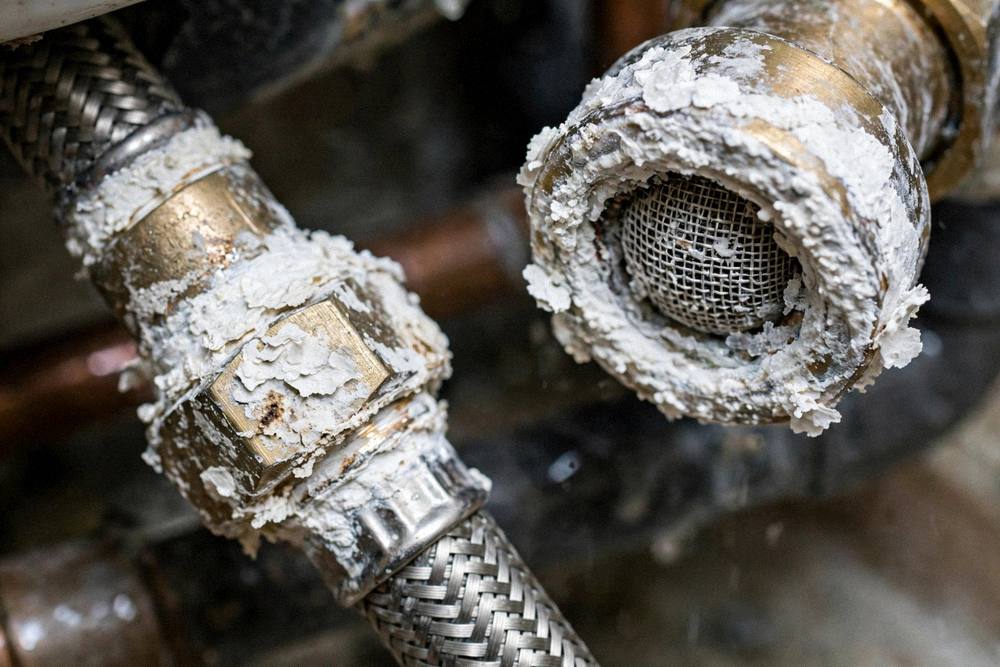
Nampa water carries calcium and magnesium, and your water heater turns those minerals into rock. The City of Nampa 2024 Consumer Confidence Report lists hardness from none to 7.08 grains per gallon, on the line where water counts as hard. This guide shows how hard water in Nampa works, what it does inside your heater, and what slows it.
What Hard Water Is
Hard water is water with dissolved calcium and magnesium in it. You cannot see the minerals, and they do not change how the water tastes much at the levels Nampa sees. They only show themselves when the water gets hot, or when it dries and leaves white crust on a tap or a shower head.
Hardness is measured in grains per gallon, short GPG. One grain per gallon equals 17.1 milligrams per liter. The US Geological Survey sorts water into four bands: soft at 0 to 60 milligrams per liter, moderately hard at 61 to 120, hard at 121 to 180, and very hard above 180. In grains per gallon, those lines sit near 3.5, 7.0, and 10.5.
Nampa water tops out at 7.08 grains per gallon. Multiply 7.08 by 17.1 and you get about 121 milligrams per liter, right on the line where moderately hard turns hard. That is the number that matters for your heater. Nampa water is not the hardest water in the country. It is hard enough to scale a heater, and that is all that matters.
How Hard Is Nampa Water, Really
The City of Nampa 2024 Consumer Confidence Report lists hardness from none to 7.08 grains per gallon across the city system. That range is the honest figure. Some parts of the city run softer. Some run at the top of the range. The water comes from city wells in the Snake River Plain Aquifer, and different wells carry different mineral loads, so your tap can differ from your neighbour's tap across town.
Kuna, just southeast of Nampa, averages 8.05 grains per gallon in the City of Kuna Consumer Confidence Report, higher than the top of the Nampa range. Homes on private wells can differ again, in either direction. The only way to know your own number is to test your own water. A test costs little, and it tells you whether your heater faces the soft end or the hard end of the Nampa range.
Hardness has no health based limit. The numbers in this guide describe scale, not drinking water quality. Your water can be perfectly safe to drink and still be hard enough to shorten the life of your heater. That is the point most homeowners miss. They hear the water is fine, and they assume the heater is fine too. The water is fine to drink. The heater still scales up.
Why Heat Turns Hard Water Into Scale
Most things dissolve better in hot water. Calcium carbonate does the opposite. Raise the temperature and it comes out of the water as a chalky solid. Your water heater is the hottest spot in the house, so that is where the hardness turns into rock.
It works like this. Cold hard water flows into the heater carrying dissolved calcium and magnesium. The burner or the element heats the water. As the water heats up, the minerals fall out of solution and stick to the hottest surfaces they touch: the bottom of a tank, the heating elements, the inside of a tankless heat exchanger. The hotter the surface, the faster the scale forms. A tank set well past 120 degrees Fahrenheit drops more scale than one set sensibly, which is one more reason to keep the thermostat at 120 degrees, based on US Department of Energy guidance.
Scale does not form overnight. It builds a thin layer at a time, month after month, year after year. You never see it happen. You only see what it does: the shower runs short, the tank starts popping, the tankless unit throws an error code. By the time you notice, the scale has been building for years.
What Scale Does Inside a Tank
Inside a tank, scale settles as sediment at the bottom and coats the heating elements. The sediment layer does two damaging things at once. First, it insulates the water from the heat source, so the burner or the element has to run longer and hotter to reach the same temperature. Second, it traps heat against the bottom of the tank, which speeds up rust where the tank is already weakest.
The signs show up in order. First, the tank takes longer to recover after a shower. Then you hear popping or rumbling noises, which are steam bubbles escaping from under the sediment layer. Then the hot water runs out faster, because sediment has taken the place of water inside the tank. Then the water turns rusty, because the anode rod is gone and the steel is rusting from the inside. A tank that reaches that stage is close to leaking, and a leaking tank cannot be fixed.
A tank lasts 8 to 12 years, based on the US Department of Energy. In hard water, a tank that never gets flushed tends toward the low end of that range. A tank that gets flushed once a year while the sediment is still loose tends toward the high end. The difference is not luck. It is care. A tank flush runs $75 to $250, national, HomeGuide 2026, and it is the cheapest way to buy years for a tank in Nampa.
What Scale Does Inside a Tankless Unit
A tankless unit suffers faster, because its passages are narrow and its water is hotter. Scale coats the inside of the heat exchanger, where the water flows through tight channels at high temperature. As the scale builds, flow drops, the unit works harder to reach temperature, and the heat exchanger overheats.
The first sign is usually an error code. Overheat codes and scale codes are the ones we see most in Nampa, and our tankless water heater error codes guide lists what each code means. The next sign is lukewarm water at full flow, because the unit cannot lift cold inlet water to temperature through a scaled exchanger. The last sign is a shutdown, where the unit stops heating at all to protect itself.
In Nampa hard water, a tankless unit needs descaling once a year. That is not a suggestion from a maker trying to sell service. It is the schedule the water forces on you. A tankless descale runs $75 to $300, national, HomeGuide 2026. Skip it for two or three years and the scale hardens into a crust that a descale may not remove. At that point the heat exchanger itself is the repair, and a heat exchanger runs $600 to $1,300, national, HomeGuide 2026.
The Signs Your Heater Is Already Scaling Up
Scale gives you warnings before it kills the unit. Here are the ones to watch for in a Nampa home.
Popping or rumbling noises from the tank. That is steam escaping from under the sediment layer. It means the sediment is thick enough to trap heat, and the tank is working harder than it should.
Hot water that runs out faster than it used to. Sediment takes up space inside the tank, so there is less hot water to use. A family that used to get four showers now gets three, and nothing else changed.
Water that is warm but not hot. On a tankless unit, this usually means scale in the heat exchanger. On a tank, it can mean a failing element or thermostat, but in Nampa hard water it often means sediment has buried the lower element.
Rusty or brown water in the morning. This can mean the anode rod is gone and the tank is rusting, or it can mean old galvanised pipes are corroding. Either way, it needs a look, because rusty water never gets better on its own.
Error codes on a tankless display. Scale codes and overheat codes point straight at the heat exchanger. Write the code down before you reset the unit, and read our tankless water heater repair in Nampa page for what each code means.
Higher energy bills with no change in use. Scale forces longer run times, and longer run times cost money. This guide gives no percentage for that loss, because no verified figure exists for a Nampa home. What is certain is the direction: scale only ever pushes the bill up, never down.
What Actually Helps
Four things help against hard water in Nampa. Everything else is noise.
First, flush the tank once a year and descale a tankless unit once a year. Do it while the sediment is still loose. A flush cannot remove sediment that has already hardened into a crust, so the schedule matters more than the method. Our water heater flushing in Nampa page walks through the tank flush, and our tankless water heater descaling in Nampa page walks through the descale.
Second, keep the thermostat at 120 degrees Fahrenheit. Hotter water drops more scale, wastes energy, and risks scalding. There is no benefit to running hotter than 120 in a Nampa home.
Third, check the anode rod every 3 to 4 years and the temperature and pressure relief valve every 6 months, based on US Department of Energy guidance. The anode rod protects the steel tank from rust, and the relief valve opens at 150 psi or 210 degrees Fahrenheit. An anode rod replacement runs $150 to $350, national, HomeGuide 2026. A relief valve replacement runs $50 to $300, national, HomeGuide 2026.
Fourth, consider a water softener. A softener takes the hardness out before it reaches the heater, which stops new scale from forming. It does not remove scale that is already there. A softener is a real investment, and we do not quote softener prices in this guide because they vary too much by house. Be careful with products sold as softeners that are not. A scale filter is not a softener. It may change how scale sticks, but it does not take the hardness out of the water, so keep the yearly flush if that is all you have.
What does not help is waiting. Scale never reverses itself. It only builds. The heater that gets yearly care in Nampa lasts. The heater that does not gets replaced early.
The Yearly Plan for a Nampa Home
Here is the schedule we give Nampa homeowners. It fits on a fridge and it covers the whole year.
| Job | How often | Why |
|---|---|---|
| Tank flush or tankless descale | Once a year | Removes sediment and scale while it is still loose |
| Anode rod check | Every 3 to 4 years | Protects the steel tank from rust |
| Relief valve check | Every 6 months | Makes sure the safety valve opens when it should |
| Water test | Once, then after any change | Tells you your own hardness number |
| Thermostat check | Once a year | Keeps the setting at 120 degrees Fahrenheit |
Do the flush in the fall, before the cold season opens on November 19. Nampa sees 132 freezing nights a year, and a heater full of sediment works hardest in the coldest weeks. A fall flush means the heater faces winter clean. Do the relief valve check in the spring, when you are already looking at the unit after the thaw. Our water heater maintenance in Nampa page puts the full yearly list in one place, with the same prices and the same schedule.
Frequently Asked Questions
How hard is Nampa water?
The City of Nampa 2024 Consumer Confidence Report lists hardness from none to 7.08 grains per gallon across the city system. That top number sits right on the line where water counts as hard. Kuna averages 8.05 grains per gallon, higher than Nampa. Test your own water to know your number, because it varies by area and by well.
How fast does scale build up in a Nampa water heater?
It builds a thin layer at a time, month after month, and you notice it after a year or two: shorter showers, popping noises, lukewarm water, or error codes on a tankless unit. In Nampa hard water a tankless unit needs descaling once a year and a tank needs flushing once a year. Skip the schedule for two or three years and the scale can harden into a crust that a flush may not remove.
Does a water softener stop scale completely?
A real softener takes the hardness out before it reaches the heater, so it stops new scale from forming. It does not remove scale that is already there. A scale filter is not a softener, so keep the yearly flush if that is all you have. We do not quote softener prices in this guide because they vary too much by house.
Will hard water shorten the life of my water heater?
Yes. A tank lasts 8 to 12 years, based on the US Department of Energy, and a tank that never gets flushed in hard water tends toward the low end of that range. A tankless unit lasts 15 to 20 years, but only with a yearly descale in Nampa water. Yearly care is the difference between the low end and the high end of those ranges.
Call Nampa HeatPros to Flush or Descale Your Heater
If your showers run short, your tank pops, or your tankless unit throws error codes, scale is the first suspect in a Nampa home. We flush tanks and descale tankless units across Nampa, and we give you a written price before we start. Book the yearly flush in the fall and your heater faces winter clean. Water heaters are all we do, and we do them in Nampa.
Our Service Area
We serve Nampa and the towns around it. Pick your area to see water heater repair there.