
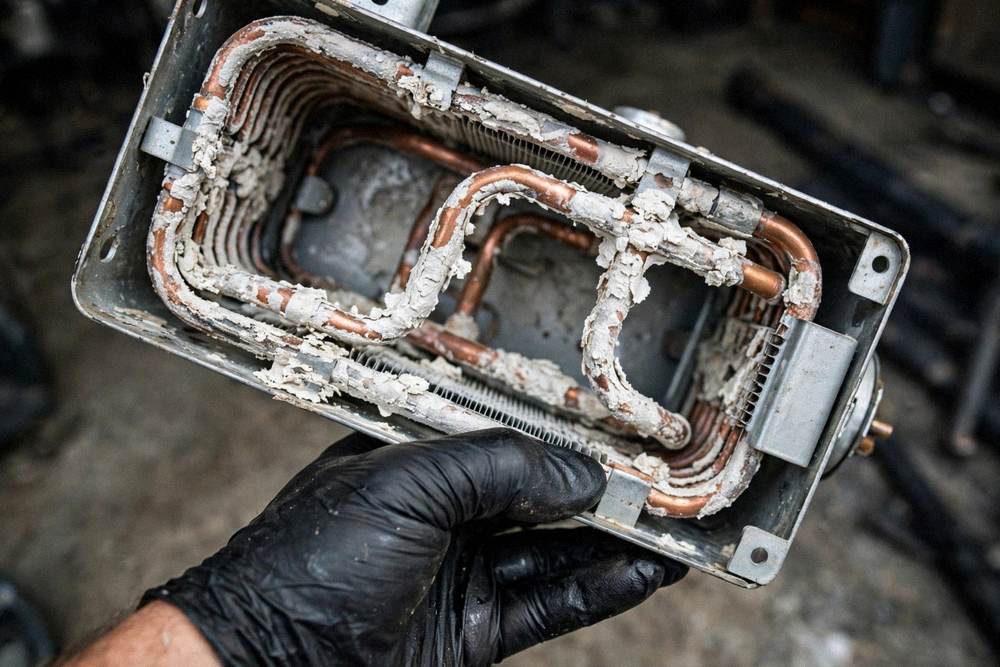
Tankless water heater scale hard water trouble starts quiet in Nampa. Hard water leaves calcium and magnesium inside the narrow heat exchanger, and that crust cuts flow, trips the overheat sensor, and pushes gas bills up. This post shows how it builds, the signs to watch, and what stops it.
What Scale Is and Where It Comes From
Scale is rock. It is calcium and magnesium that were dissolved in your water, then left behind as a hard white crust when the water got hot. You see the same stuff as white spots on a shower head and a ring in a kettle. Inside a water heater, it coats the hot metal, and it stays there.
Hardness measures how much calcium and magnesium sit in the water. Reports state it in grains per gallon, short GPG, or milligrams per liter, short mg/L. One grain per gallon equals 17.1 mg/L. The US Geological Survey sorts water into four bands: soft at 0 to 60 mg/L, moderately hard at 61 to 120, hard at 121 to 180, and very hard above 180. In grains per gallon, those lines sit near 3.5, 7.0, and 10.5.
Heat drives the change. Cold water can carry the minerals along with no trouble. Hot metal pulls them out of the water and pins them to the surface. The hotter the metal, the faster the crust grows.
How a Tankless Heat Exchanger Works
A tankless heater has no tank and no stored hot water. Cold water runs in, passes through a heat exchanger, and comes out hot at the tap. The exchanger is a tight coil of narrow passages made of copper or stainless steel, heated by a gas burner or an electric element.
The passages are narrow on purpose. Narrow passages put more water in contact with hot metal in a small box, and that is how a unit the size of a suitcase heats water on demand for a whole house. A 3.5 GPM unit serves 1 to 2 fixtures at once, a 5 GPM unit serves 2 to 3, and a 7 GPM unit or larger serves 3 to 4.
Narrow passages are also the weak point. A tank heater has a wide open tank, so minerals settle to the bottom as loose sediment and the water still has room to move. A tankless heater has no room to spare. Even a thin crust inside a narrow passage cuts the opening, slows the flow, and puts a coat between the hot metal and the water. The burner has to fire longer to get the same heat through that coat.
Nampa Hard Water in Numbers
Nampa water comes from city wells in the Snake River Plain Aquifer, and that ground water carries calcium and magnesium. The City of Nampa 2024 Consumer Confidence Report lists hardness from none to 7.08 GPG across the city system. That top number is the one that matters for your heater.
Put 7.08 GPG against the US Geological Survey bands and the picture is plain. Multiply 7.08 by 17.1 and you get about 121 mg/L, right on the line where moderately hard turns hard. A tankless heater does not need extreme water to scale. It needs hard water, heat, and time, and Nampa gives it all three.
Kuna, just southeast of Nampa, averages 8.05 GPG in the City of Kuna Consumer Confidence Report, higher than the top of the Nampa range. Homes on private wells can differ again, so test your own water to know your own number.
Winter adds load. Nampa sees 132 freezing nights a year, with a January average low of 23 degrees, from NOAA data for 1991 to 2020. Cold inlet water means the burner runs longer to lift the water to 120 degrees, and longer hot runs give minerals more time on hot metal.
How Tankless Scale Builds in Nampa Hard Water
Scale does not build at one fixed rate. It builds faster when the water is harder, when the set temperature is higher, and when the house uses more hot water.
The service interval that fits Nampa water is once a year. PipeBeaver Nampa puts the hard water interval at 12 to 18 months, and once a year sits inside that range. A home with a softener or a scale filter can run to the long end. A home with no treatment and heavy use should stay at the short end.
Soft water changes the pace. In soft water at 0 to 3.5 GPG, the descale interval can stretch out. In Nampa hard water at the top of the city range, it cannot. If you moved here from a soft water city and kept your old service habits, your heater is now on the wrong schedule.
Three habits set your pace:
5 Signs Scale Is Building in Your Tankless Heater
Catch two of these signs together and the heater needs a descale now.
1. Lukewarm water and temperature swings
The shower runs hot, then lukewarm, then hot again, or it never gets past warm. Scale coats the exchanger and blocks heat from reaching the water, so the water leaves cooler than the set temperature. If it keeps happening with one tap open, scale is high on the list.
2. Weak hot water flow
Hot water pressure drops while cold water pressure stays strong. That split points straight at the heater, because the cold side never passes through the exchanger. Scale narrows the passages, so less water gets through. Check the aerator and the inlet filter first, then look at scale.
3. Popping, rumbling, or kettling noise
The unit pops, rumbles, or makes a kettle like noise while it fires. Water gets trapped under the crust, flashes to steam, and breaks free with a pop. It means the metal under the crust is running hotter than it should. New noise from a unit that used to run quiet is a warning, not a quirk.
4. Error codes and shut downs
Modern units watch their own sensors and shut down to protect the exchanger. Overheat codes are the ones tied most often to scale, because the metal overheats where the crust blocks heat transfer. Codes vary by model, so check your own manual. The codes below are verified for the brands named.
Reset the unit once, twice at most. If the code comes back, stop resetting it and get the unit checked. Repeated resets will not clear scale. Our tankless water heater repair in Nampa page covers what a repair visit checks when a code keeps coming back.
5. Higher gas bills and a longer wait for hot water
The burner fires longer to push the same heat through the crust, so gas use climbs. Hot water also takes longer to reach the tap. A bill that creeps up with no change in habits, plus a slower shower, points at the exchanger.
What Scale Does If You Leave It
Left alone, scale moves from a nuisance to damage. Flow drops, temperature swings start, the overheat sensor trips, and the unit shuts down mid shower. Each shut down is the unit protecting itself, and each one tells you the metal is running hotter than it was built to run.
Hot spots form under thick crust. The metal on one side of a hot spot runs far hotter than the metal a few inches away, and that uneven heat stresses the exchanger. Over time that stress can warp or crack the exchanger, and a cracked exchanger leaks inside the unit. At that point the fix is a heat exchanger swap or a new unit.
The US Department of Energy puts tankless life at 15 to 20 years, and tankless efficiency 24 to 34 percent higher than a tank heater for homes using 41 gallons per day or less. Scale eats into both numbers. Read the service interval in your own manual and keep the service record.
Prevention That Works in Nampa
Prevention has three parts: descale on schedule, cut the minerals before they reach the heater, and keep the set temperature at 120 degrees. No single part does the whole job on Nampa water.
Descaling is the base. Tankless water heater descaling in Nampa once a year clears the crust before it gets thick enough to trip the sensor. Skip it for two or three years and the crust gets hard to clear, and the risk of damage climbs.
A water softener is the strongest fix. A salt based ion exchange softener swaps calcium and magnesium out before the water reaches the heater, so the minerals never get to the exchanger. It protects the whole home.
A salt free conditioner is the lighter option. It uses template assisted crystallization, short TAC, to change the mineral crystals so they stick less to hot metal. It does not remove the minerals, and the water still tests hard, but the crystals pass through instead of pinning to the exchanger.
A small inline scale filter on the cold line into the heater is the budget step. It treats only the water going to the heater, and the cartridge needs changing on schedule, but it cuts the load on the exchanger for little money.
Set the temperature to 120 degrees, as the US Department of Energy advises. Higher settings speed scale formation and raise scald risk. Check the inlet filter at the same time, because a dirty filter cuts flow on its own and can look like scale.
What a Descale Visit Looks Like
A descale visit is a flush, not a teardown. The tech shuts the unit down and lets it cool, then closes the isolation valves to cut the heater off from the house plumbing. A pump and two hoses hook to the service valves, and a bucket holds the descale solution. The pump circulates the solution through the heat exchanger, and the mild acid dissolves the calcium carbonate crust off the metal walls.
The solution runs until the crust is gone, then the tech flushes the unit with clean water to clear out the leftover solution and the dissolved minerals. The tech then opens the valves, fires the unit, checks the outlet temperature and the flow, and clears any error codes tied to the scale.
You do not need to drain the house or move the unit. You do need the service valves in place, and older installs that lack them need the valves fitted first. If your unit has no service valves, say so when you book.
Cost: Descale Now or Replace Later
Descaling is cheap next to the parts scale can kill. All prices below are national figures, labelled national, with source and date. Nampa prices will differ. For the full price picture, see our water heater repair cost in Nampa page.
Read those numbers as a ladder. A descale sits at the bottom at $75 to $300 national. A heat exchanger sits at $600 to $1,300 national, and a full install sits at $1,400 to $5,600 national. Three skipped years on hard water can turn a $75 to $300 national visit into a four figure repair.
Two notes on money. The federal 25C credit ended Dec 31, 2025, so do not count on it for a new unit. A new install is the time to fix the water, not just the heater, because a new exchanger on the same hard water starts scaling on day one. Our tankless water heater installation in Nampa page covers sizing and install steps for a new unit.
FAQs
How often should I descale a tankless heater in Nampa?
Descale once a year on Nampa city water. The City of Nampa 2024 report lists hardness up to 7.08 GPG, on the hard line, and PipeBeaver Nampa puts the hard water interval at 12 to 18 months. Once a year sits inside that range. Homes with a softener can run longer. Heavy use homes should stay at a year.
Does a water softener stop scale in a tankless heater?
Yes, a salt based softener stops it at the source by removing calcium and magnesium before they reach the heater. A salt free conditioner does not remove the minerals, but it changes the crystals so they stick less to hot metal. Both help, and both still pair with a yearly descale on Nampa water for full cover.
Can I descale my own tankless water heater?
You can, if your unit has service valves and you follow the maker manual for your model. The job needs a pump, hoses, a bucket, and a descale solution, plus a water flush after. Gas and vent work stays with a pro. If the unit shows an overheat code or the scale is years old, book a visit instead.
Will scale void my tankless warranty?
Read your own manual, because terms vary by brand and model. Makers list a descale interval for hard water areas, and they ask for service records when a heat exchanger fails. Keep the date, the invoice, and the hardness note from each visit, so you can show the unit was kept to the interval the maker sets.
Get the Scale Out Before It Costs You a Heat Exchanger
Tankless scale in Nampa hard water is a slow problem with a cheap fix, and the fix only works on schedule. Check the signs above and look at the last descale date on your unit. Book the visit if a year has passed or if two signs show together. A descale now keeps the flow strong and the temperature steady.
Our Service Area
We serve Nampa and the towns around it. Pick your area to see water heater repair there.