
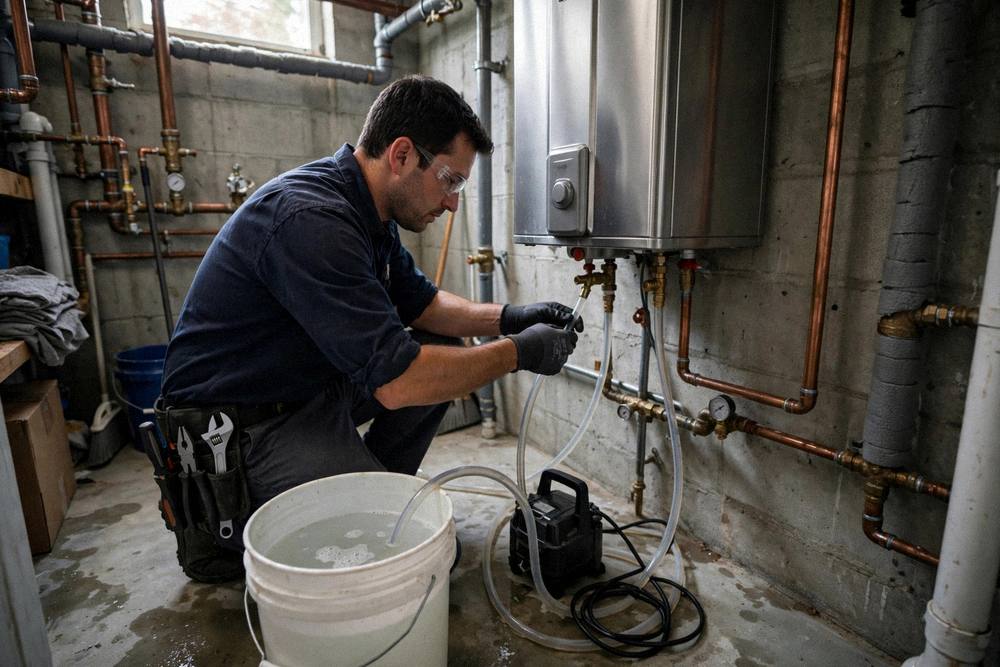
Tankless water heater maintenance descaling means a full flush once a year in Nampa. Our water runs from none to 7.08 grains per gallon, hard enough to coat the heat exchanger with scale in 12 months. A yearly flush, a clean inlet filter, and a vent check keep hot water strong and stop overheat codes.
What Nampa Water Does to a Tankless Unit
A tankless unit heats water as it passes through a narrow heat exchanger. There is no tank, so every drop touches hot metal on its way to the tap. When Nampa water is heated, the calcium and magnesium in it drop out and stick to that hot metal as scale.
The City of Nampa 2024 Consumer Confidence Report puts Nampa hardness at none to 7.08 grains per gallon. The low end is soft water and the high end is hard water, so the safe plan is to care for the unit as a hard water unit.
Scale acts like a blanket on the heat exchanger. Heat has to push through it, so the burner runs longer and the flow drops. Over time the sensor trips and the unit shuts off mid shower.
The US Department of Energy says a tankless unit should last 15 to 20 years, and that a tankless unit is 24 to 34 percent more efficient than a tank unit for homes that use 41 gallons of hot water a day or less. Those numbers assume the unit is cared for. Nampa winters add strain too. NOAA data for 1991 to 2020 gives Nampa 132 freezing nights a year, with a January average low of 23 degrees Fahrenheit.
Tankless Water Heater Maintenance Descaling: How Often by Hardness
The schedule starts with your hardness, measured in grains per gallon, shortened to GPG. Use the table with your own water in mind, not with a guess.
| Water hardness | What it means | Flush every |
|---|---|---|
| 0 to 3.5 GPG | Soft water | Every 2 years |
| 3.5 to 7 GPG | Moderately hard water | Once a year |
| 7 to 10.5 GPG | Hard water | Once a year |
| Over 10.5 GPG | Very hard water | Every 6 months |
| Softener on the line | Minerals removed before the unit | Every 2 years |
Nampa tops out at 7.08 GPG, so Nampa homes belong on the yearly plan. PipeBeaver Nampa puts descaling at every 12 to 18 months in hard water, and we say once a year, because a year is easy to remember. With a working water softener, kept filled with salt and serviced, you can move to every 2 years. A scale filter is not a softener, so keep the yearly flush if that is all you have.
The manual for your model is the last word. Navien, Rinnai, Noritz, Rheem, Bradford White, A.O. Smith, and State all publish a flush interval in the manual, so follow it when it calls for a shorter interval. Many models also have a descaling reminder you can set to 6, 12, or 24 months. Set it to 12 in Nampa.
The Full Yearly Care List, Not Just the Flush
A flush is the main job, but a tankless unit has six care jobs, and each one protects a different part. Do them together once a year.
Flush the heat exchanger
This is the descale. A pump moves a mild acid solution through the heat exchanger, the acid dissolves the scale, and clean water rinses it out. White vinegar works for light scale and a purpose made descaler works faster on heavy scale. The job takes 45 to 60 minutes, plus rinse time, and it needs service valves.
Clean the cold water inlet filter
The inlet filter sits where cold water enters the unit and catches sand, rust, and grit. When it clogs, flow drops and the unit may not fire at a low tap flow. Pull it out, rinse it, and check the screen for tears. Clean it at every flush.
Check the vent and the air intake
The vent carries exhaust gas out and the intake brings fresh air in. Birds nest in the vent cap, leaves block the intake, and ice can close a low vent in a Nampa freeze. Look at both terminals once a year, before winter. A vent fault can trip Rinnai 10. Gas vent work is plumber work, so call a plumber if you see damage or smell gas.
Clear the condensate drain
A high efficiency condensing unit makes condensate water as it runs, and that water drains through a small line. The line clogs with grit, and a blocked drain trips the condensate code, Rheem 29, and the unit stops. Check the line once a year and make sure it runs downhill with water in the trap. Media change in a neutralizer is plumber work.
Check the igniter and the flame sensor
The igniter lights the gas and the flame sensor proves the flame is lit. Soot coats both parts over time, and a dirty flame sensor drops the flame signal. That shows up as flame loss, Rinnai 12, Navien E012, or Takagi 121, while no ignition shows as Rinnai 11, Navien E003, or Takagi 111. A plumber cleans both parts and tests the flame signal. Do not bend these parts yourself.
Check the water pressure and the temperature
High pressure strains the unit and low pressure starves it at high flow. A plumber checks the static pressure at a hose bib and checks the pressure relief valve for a drip or a stuck lever. The US Department of Energy also says to set the water temperature to 120 degrees Fahrenheit, which cuts scald risk, scale rate, and gas use.
What a Descale Visit Looks Like Step by Step
A professional descale visit takes 60 to 90 minutes from arrival to hot water back on. Here is the order we follow.
- Turn the unit off and let it cool, then close the hot and cold service valves.
- Hook up the pump kit to the service valves, with a 5 gallon bucket under the pump. Use 3 to 4 gallons of undiluted white vinegar or a maker approved descaler.
- Circulate the solution for 45 to 60 minutes, or 90 minutes if the unit has gone years without a flush.
- Drain the solution and rinse with clean water for 5 to 10 minutes, until the water runs clear.
- Clean the inlet filter and the air intake filter while the flush runs.
- Check the vent, the condensate drain, and the pressure relief valve.
- Open the valves, turn the gas or power back on, and purge air at a hot tap.
- Fire the unit, run a hot tap, check the temperature, and watch the display for codes.
Write the next flush date on the unit when the visit ends.
DIY or Call a Plumber
Some of this work is safe for a homeowner and some of it is not. The line is simple. If the job touches gas, venting, or the inside of the burner, it is plumber work. If the job is outside the unit, and the unit is off and cool, you can do it.
You can clean the inlet filter and the air intake filter, clear leaves from the vent terminal, check the condensate drain, and set the temperature to 120 degrees. You can also descale the unit yourself, if it has service valves and you have a pump kit, hoses, a bucket, and the right solution. Read your manual first, because a wrong solution can damage seals.
Call a plumber if the unit has no service valves, and for the igniter, the flame sensor, the gas valve, the vent pipe, and the condensate neutralizer media. Call a plumber if a code comes back after one reset. Reset once, twice at most, then stop and call. Call a plumber if you smell gas, if the vent is damaged, or if the unit leaks.
What Skipping Care Costs You
Skipping a flush feels free, but it is not. The cost shows up as codes, then as parts, then as a short life.
| Code | Brand | What it means |
|---|---|---|
| 14 | Rinnai | Overheat, often scale in the heat exchanger |
| E016, E407 | Navien | Overheat, flush is one of the fixes listed |
| 11 | Rinnai | No ignition |
| E003 | Navien | No ignition |
| 111 | Takagi | No ignition |
| 12 | Rinnai | Flame loss |
| E012 | Navien | Flame loss |
| 121 | Takagi | Flame loss |
| 10 | Rinnai | Venting fault |
| 29 | Rheem | Condensate fault |
Codes vary by model, so check your manual. An overheat code points most to scale. The heat exchanger is coated, the metal runs hot, and the unit shuts down to protect itself. A flush fixes it if the scale is still thin.
HomeGuide 2026 puts a tankless descale at 75 to 300 dollars, national, a tankless repair at 300 to 1,300 dollars, national, and a heat exchanger alone at 600 to 1,300 dollars, national. One yearly descale costs less than one repair call.
The other cost is life. The US Department of Energy puts tankless life at 15 to 20 years. A unit flushed on schedule can reach that range, while a unit that is never flushed will fail years early. Scale damage is treated as a care fault, not a maker fault, so a heat exchanger claim can be refused if the manual called for a yearly flush and no flush was done. Keep your flush receipts.
Your Yearly Calendar and Checklist
A schedule only works if it has a date. Pick one month and keep it every year. Spring is a good pick in Nampa, when a flush clears the winter scale before summer use.
| Month | Job |
|---|---|
| March or April | Full descale flush, clean the filters, check the vent and the condensate drain, and plumber check of the igniter, flame sensor, pressure, and relief valve |
| September | Look at the vent terminal outside, clear leaves, check the condensate line before winter |
| October | Check the vent and freeze protection before the first freeze, test the unit at a hot tap |
| Every month | Glance at the display for a code, listen for a new noise, note any change in hot water flow |
Nampa has 132 freezing nights a year, NOAA 1991 to 2020, so the October check earns its place. A vent blocked by ice or a condensate line that freezes will stop a unit on a cold night. Clear the terminal, make sure the condensate line runs downhill, and run a hot tap to prove the unit fires.
What Care Costs in Nampa
There is no Nampa price in this post, because no Nampa price has been verified. The figures below are national, labelled as national, with source and date.
A tankless descale runs 75 to 300 dollars, national, HomeGuide 2026. A tankless repair runs 300 to 1,300 dollars, national, HomeGuide 2026, and a tankless install runs 1,400 to 5,600 dollars, national. Fixr, updated August 29, 2025, puts a water heater repair at 150 to 750 dollars, national, with an average of 450 dollars. The federal 25C credit ended December 31, 2025, so do not count on it.
A yearly descale is the cheapest line on that list. Ask what is in the price when your plumber quotes a descale. A full visit should cover the flush, the filter clean, the vent check, the condensate check, and a test fire at a hot tap. Our water heater care guide sets out the full yearly care list, and our repair cost guide sets out the national repair figures in full.
FAQs
How often should I descale a tankless unit in Nampa?
Once a year. Nampa water runs from none to 7.08 grains per gallon, City of Nampa 2024 Consumer Confidence Report. A yearly flush keeps scale thin and stops overheat codes. With a working water softener, move to every 2 years, and if your water tests over 10.5 grains per gallon, move to every 6 months.
Can I descale my tankless unit myself?
Yes, if your unit has service valves and you follow your manual. You need a pump kit, hoses, a 5 gallon bucket, and white vinegar or a maker approved descaler. Circulate for 45 to 60 minutes, rinse, and restart. Leave gas, venting, and burner parts to a plumber.
What happens if I never descale my tankless unit?
Scale coats the heat exchanger, flow drops, and the unit throws an overheat code, Rinnai 14 or Navien E016, and shuts down. A heat exchanger job runs 600 to 1,300 dollars, national, HomeGuide 2026, and scale damage can be refused under warranty terms. A yearly flush at 75 to 300 dollars, national, costs far less.
Does a water softener mean I can skip descaling?
No. A softener slows scale a lot, so you can move to every 2 years, but you still need a flush. A softener does not clean the inlet filter, check the vent, or clear the condensate drain. If the softener runs out of salt, or it is not serviced, go back to a yearly flush.
Book Your Yearly Tankless Water Heater Maintenance Descaling Visit in Nampa
A tankless unit in Nampa needs one flush a year, a clean filter, a clear vent, and a check before winter. It takes one visit, it costs less than one repair, and it keeps your hot water strong for the 15 to 20 year life your unit was built for. If your unit has not been flushed in over a year, it is due now. If it is already throwing an overheat code, start with our tankless repair guide and book a repair visit first.
Our Service Area
We serve Nampa and the towns around it. Pick your area to see water heater repair there.