
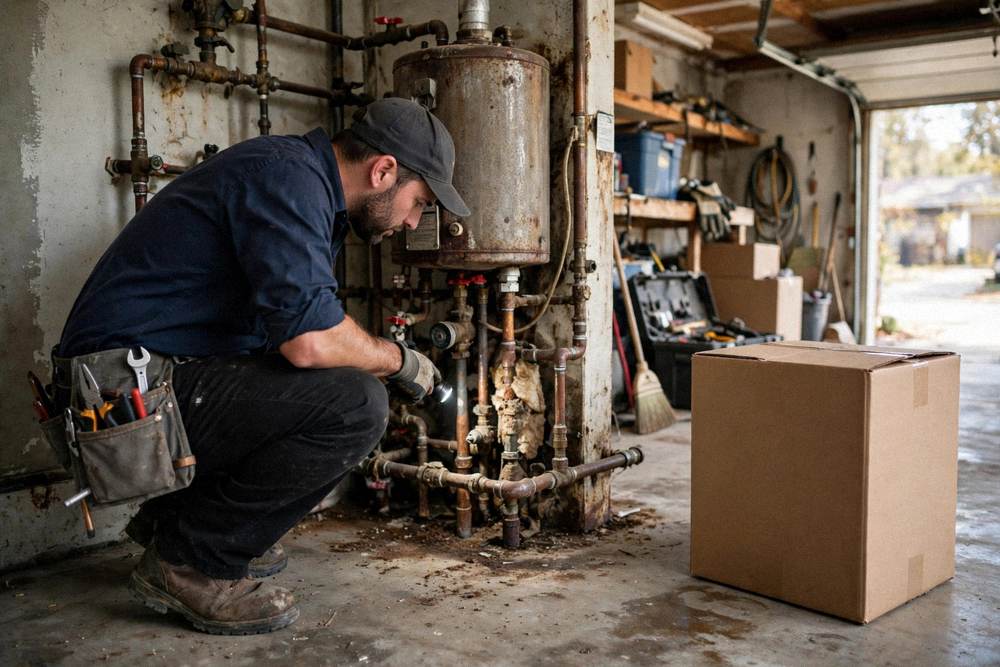
A water heater problem leaves every homeowner with the same question: fix it or swap it? The answer comes down to three facts: how old the unit is, what exactly failed, and what the repair costs next to a new unit. This guide walks you through all three, with real national figures, so you can make the call with confidence instead of guessing.
The Short Answer
If you want the fast version, here it is. Repair the heater when it is under 8 years old, one part failed, and the tank is sound. Replace it when the tank leaks, when it is over 10 years old and failing, or when the repair costs more than half of a new unit.
| What you see | Likely cause | Best next step |
|---|---|---|
| No hot water | Failed element, thermostat, pilot, or breaker | Repair, if the unit is under 8 years old |
| Water gets cold fast | Sediment, failed element, or wrong size | Diagnose first, often repair |
| Popping or rumbling | Sediment buildup | Flush, if the tank is sound |
| Rusty hot water | Tank corrosion, worn anode rod | Replace, if rust keeps coming back |
| Pilot will not stay lit | Thermocouple or gas valve | Repair, if the tank is sound |
| Water pooling at the base | Fitting, valve, or tank leak | Diagnose first, urgent if the tank leaks |
| Tank body or seam leaks | Internal corrosion, tank failure | Replace, urgent |
| Two repairs in one year | System wearing out as a whole | Compare total costs, lean replace |
This table is a starting point. A plumber has to confirm the leak source and the failed part first.
The 50 Percent Rule, With Real Numbers
The 50 percent rule is the clearest tool for this decision. If the repair costs more than half of what a new comparable unit costs installed, replace the unit. If it costs less than half and the heater is young, repair it.
Here is how the numbers work with national figures. A tank replacement runs 600 to 3,100 dollars installed (HomeGuide, January 2026), with the average near 1,400 dollars (Fixr, 2026). Half of that average is about 700 dollars. So a repair quoted at 300 dollars on a 5 year old tank is a clear repair. A repair quoted at 800 dollars on a 10 year old tank is a clear replacement.
Three worked examples make it concrete.
Example one: a 4 year old electric tank, no hot water, failed heating element. The element runs 100 to 350 dollars (HomeGuide, 2026). That is far under half of a replacement. Repair it.
Example two: a 9 year old gas tank, pilot will not stay lit, gas valve failed. The gas control valve runs 150 to 550 dollars (HomeGuide, 2026). That is under half of a replacement, but the tank is 9 years old, past three quarters of its expected life, so most plumbers would lean replace.
Example three: an 11 year old tank, leaking at the bottom seam. No repair price applies. A tank body leak cannot be fixed at any price. Replace it.
The rule has one more layer. On a young unit, a repair at 40 percent of replacement can make sense. On a 9 or 10 year old heater, even a repair at 35 to 40 percent is hard to justify, because you are paying good money into a tank with a year or two left.
Age Bands: What Your Heater's Age Tells You
Age is the single most useful fact in this decision. Find the serial number on the rating plate on the side of the tank. The first four digits usually give the month and year the unit was made.
| Age | What it means | Usual direction |
|---|---|---|
| Under 6 years | Young unit, most of its life left | Repair, unless the tank leaks |
| 6 to 8 years | Mid life, one failed part is normal | Repair, if the cost is under half of replacement |
| 8 to 10 years | Past mid life, parts start failing in turn | Compare both options, check the 50 percent rule |
| 10 to 12 years | End of expected tank life (DOE: 8 to 12 years) | Lean replace, even for a fixable problem |
| Over 12 years | Past its life, living on borrowed time | Replace, plan it before it fails |
Tankless units run on a different clock. A tankless heater lasts 15 to 20 years (DOE), so a 10 year old tankless unit with a failed flow sensor is still a repair. The same failure on a 10 year old tank is a replacement question. Heat pump water heaters last 10 to 15 years (DOE), so they sit between the two.
One more age fact matters. A tank that has never been flushed and never had its anode rod checked will die younger than its label promises. In Nampa hard water, a neglected tank can fail at 7 or 8 years. A maintained tank can reach 12. Age is a guide, not a guarantee.
7 Signs That Point to Repair
Repair is the right call when the tank itself is sound and one part has failed.
- The unit is under 8 years old. Most of its life is still ahead of it, and a single part is a small investment.
- One part failed. A thermostat, an element, a thermocouple, a pilot assembly, or a relief valve are all single part fixes.
- The leak is at a fitting, a valve, or a pipe. A loose connection or a failed drain valve is a plumbing repair, not a tank failure.
- The repair costs under half of a replacement. Use the 50 percent rule and the national figures in this guide.
- The water is clear. Rusty water that clears after a few seconds can be a pipe issue. Rusty water that never clears is a tank issue.
- The noise stops after a flush. Popping and rumbling from sediment go away with a flush if the tank is still sound.
- This is the first repair in years. A heater that has run well for 7 years and now needs one part is a good repair candidate.
If three or more of these fit your heater, repair it. The money is well spent.
7 Signs That Point to Replace
Replacement is the right call when the tank itself has failed or the heater is worn out as a whole.
- The tank body or seam leaks. Water coming from the metal shell of the tank means the steel has rusted through. No part fixes this.
- Rusty water keeps coming back. Rust in the hot water that does not clear means the inside of the tank is corroding, and the anode rod is gone.
- The unit is over 10 years old and failing. A tank past 10 years is at the end of its expected life, and every repair after that is money into a dying unit.
- The repair costs more than half of a new unit. The 50 percent rule says replace, and the math backs it up.
- You have paid for two or more repairs in the last 12 to 18 months. That pattern means the system is wearing out as a whole, not failing one part at a time.
- Hot water runs out fast even after a flush. The tank has lost capacity to sediment that has hardened into scale, or the household has outgrown it.
- Energy bills keep climbing. An old tank with a scaled bottom and a dead anode rod heats water badly, and the extra gas or electricity shows up on the bill every month.
If three or more of these fit your heater, replace it. The repair money is better spent on a new unit with a fresh warranty.
Tank vs Tankless: Does the Decision Change?
Yes, in two ways. First, the age clock is longer. A tankless unit lasts 15 to 20 years, so a repair on a 10 year old tankless unit is usually worth doing. Second, the repair costs are higher. A tankless repair runs 300 to 1,300 dollars, and a heat exchanger runs 600 to 1,300 dollars (HomeGuide, 2026). That changes the 50 percent math, because a tankless replacement runs 1,400 to 5,600 dollars installed (HomeGuide, January 2026). A 900 dollar heat exchanger repair on a 12 year old tankless unit can still make sense, because the new unit would cost 3,000 dollars or more and the repaired unit has years left.
One tankless problem is different from tank problems. Scale. Hard water scale in the heat exchanger causes error codes and overheat shutdowns, and a descale at 75 to 300 dollars (HomeGuide, 2026) fixes it if the exchanger is not damaged. If the exchanger is cracked or scaled past cleaning, replacement is the answer. In Nampa hard water, a yearly descale is what keeps a tankless unit on the repair side of this decision instead of the replace side.
The Nampa Factor: Hard Water Shortens the Math
Nampa water changes this decision. Hardness runs at none to 7.08 grains per gallon (City of Nampa 2024 Consumer Confidence Report), and hard water does two things to a tank. It lays down sediment that insulates the bottom of the tank, so the burner works harder and the steel overheats. And it eats the anode rod faster, so the tank starts rusting sooner.
In Nampa, a tank that has never been flushed and never had its anode rod checked will fail younger than the 8 to 12 year DOE range suggests. A tank that gets a yearly flush and an anode rod check every 3 to 4 years will reach the top of the range. When you weigh repair against replace, ask when the tank was last flushed and when the anode rod was last checked. If the answer is never and the tank is over 8 years old, lean replace.
> The cheapest water heater is the one you already own, but only while the tank is sound. Once the tank itself fails, no repair price makes sense, because the tank is the heater.
What a Repair Costs vs What a Replacement Costs
All figures below are national ranges, labelled national. Nampa prices are not published, and your written quote is the number that counts.
| Job | National range | Source |
|---|---|---|
| Typical repair | 150 to 750 dollars, avg 450 | Fixr, Aug 2025 |
| Thermostat | 100 to 350 dollars | HomeGuide, 2026 |
| Heating element | 100 to 350 dollars | HomeGuide, 2026 |
| Thermocouple | 100 to 325 dollars | HomeGuide, 2026 |
| Anode rod | 150 to 350 dollars | HomeGuide, 2026 |
| Relief valve | 50 to 300 dollars | HomeGuide, 2026 |
| Gas control valve | 150 to 550 dollars | HomeGuide, 2026 |
| Tank flush | 75 to 250 dollars | HomeGuide, 2026 |
| Tankless repair | 300 to 1,300 dollars | HomeGuide, 2026 |
| Tankless descale | 75 to 300 dollars | HomeGuide, 2026 |
| Tank replacement installed | 600 to 3,100 dollars | HomeGuide, Jan 2026 |
| Tankless replacement installed | 1,400 to 5,600 dollars | HomeGuide, Jan 2026 |
| Hybrid replacement installed | 2,000 to 4,600 dollars | HomeGuide, Jan 2026 |
Labor for a tank swap runs 200 to 1,000 dollars, and tank to tankless conversion labor runs 600 to 2,500 dollars (HomeGuide, 2026). Removal of the old unit runs 75 to 500 dollars. A permit, where required, runs 50 to 200 dollars (HomeGuide, 2026). When you compare quotes, make sure both include the same extras: removal, permit, and any venting or gas line work.
One more cost to count. A leaking tank can flood a room, and the average water damage claim in the US runs about 15,400 dollars (Insurance Information Institute). A planned replacement on a 12 year old tank is not just a new heater. It is insurance against a flooded garage floor in January.
FAQs: Repair or Replace a Water Heater
How do I know if my water heater is worth repairing?
Check three facts: age, fault, and cost. If it is under 8 years old, one part failed, and the repair is under half of a replacement, repair it. If the tank leaks, it is over 10 years old, or the repair is over half of a replacement, replace it.
Is it worth repairing a 10 year old water heater?
Usually not. A tank at 10 years is at the end of its expected life, and a repair now is often followed by another repair within a year. Spend the money on a new unit with a fresh warranty instead, unless the fix is very small, like a thermostat.
What is the 50 percent rule for water heaters?
If the repair costs more than half of what a new comparable unit costs installed, replace the unit. If it costs less, and the heater is young with a sound tank, repair it. Age bends the rule: on a 9 or 10 year old tank, even a 35 to 40 percent repair is hard to justify.
Can a leaking water heater be repaired?
It depends where it leaks. A leak at a fitting, a valve, or a pipe can be repaired. A leak from the tank body or a seam cannot. The steel has rusted through, and the only dependable fix is a new heater. If water is pooling at the base, call us and we will tell you which one it is.
Get a Straight Answer on Repair or Replace in Nampa
If your water heater is failing and you cannot tell whether to fix it or swap it, call Nampa HeatPros. We will test the heater, find the real fault, and give you an upfront written price for the repair and for a replacement, side by side. Then you decide, with real numbers in front of you. That is how the repair or replace decision should work.
Our Service Area
We serve Nampa and the towns around it. Pick your area to see water heater repair there.