
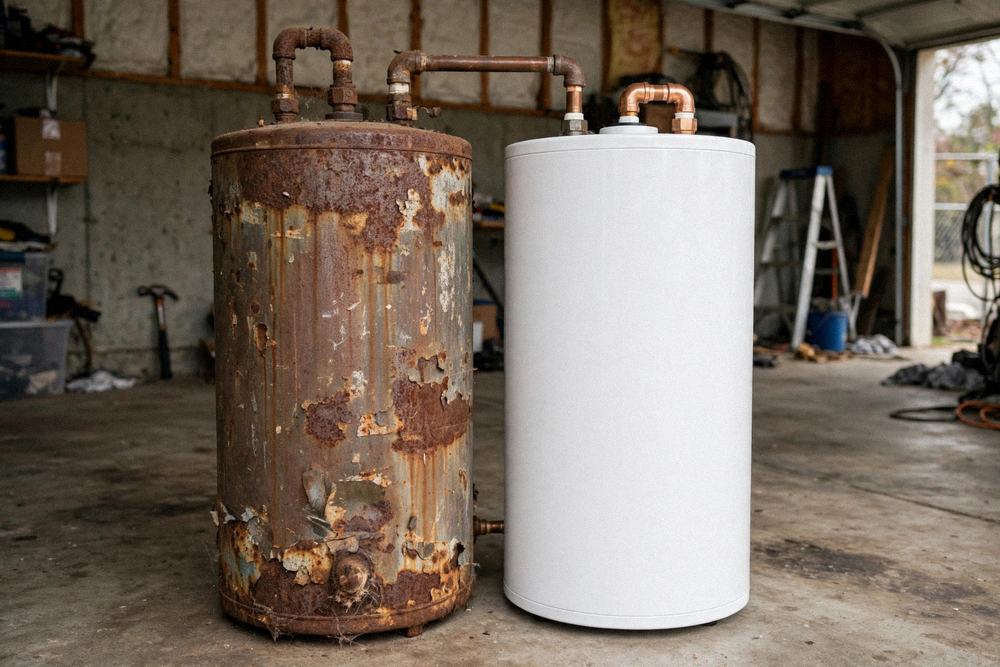
A tank water heater lasts 8 to 12 years. A tankless unit lasts 15 to 20 years. A heat pump water heater lasts 10 to 15 years. Those are the US Department of Energy figures, and they are the starting point. What your heater actually lasts depends on your water, your maintenance, and where the unit sits. This guide covers each type in depth, what kills it, and how to get the most years out of the one you have.
The Short Answer
| Type | Typical life | What usually kills it | Maintenance that extends it |
|---|---|---|---|
| Tank, gas or electric | 8 to 12 years | Tank corrosion once the anode rod is gone; sediment damage | Anode rod check every 3 to 4 years; yearly flush |
| Tankless, gas or electric | 15 to 20 years | Scale on the heat exchanger; neglected descaling | Yearly descale; inlet filter cleaning |
| Heat pump (hybrid) | 10 to 15 years | Compressor or electronics failure; poor placement | Air filter cleaning; clear space around the unit; condensate drain care |
Those ranges assume normal municipal water and correct installation. Hard water, high pressure, or a unit in a freezing garage can pull any type well below its range. Nampa water is hard, so maintenance matters more here than in a soft water town.
Tank Water Heaters: 8 to 12 Years
The tank is the most common heater in Nampa, and its life is decided by corrosion. A steel tank holds hot water, and hot water rusts steel. Two things slow that rust down. The glass lining inside the tank, and the anode rod, a metal rod that rusts in place of the tank steel. The rod is the tank's life clock. Once it is eaten away, the tank starts rusting, and from that point the clock runs fast.
Gas tanks tend toward the low end of the range and electric tanks toward the high end, because gas burners heat the tank bottom harder and sediment cooks onto the bottom faster. A gas tank in a hard water home that has never been flushed may fail at 7 or 8 years. An electric tank in the same home, flushed yearly with a fresh anode rod, can reach 12.
Sediment is the second killer. Nampa water leaves mineral scale at the bottom of the tank. That scale insulates the bottom, so the burner or element has to push more heat through it. The tank pops and rumbles, heats slow, and the steel at the bottom overheats and weakens. A yearly flush removes the sediment before it hardens into scale. A tank that has never been flushed in 10 years often has sediment that no flush will move.
The signs a tank is near the end are easy to read. Rusty or discoloured hot water that does not clear. Water pooling at the base. Popping that comes back weeks after a flush. Two repairs in one year. If your tank shows two of these and it is over 10 years old, plan a replacement. Read the full guide on water heater replacement in Nampa.
Tankless Water Heaters: 15 to 20 Years
A tankless unit lasts longer because it has no tank to rust. It heats water as it flows through a heat exchanger, so there is no stored water eating steel all day. The DOE puts tankless life at about 20 years, and a well maintained unit can pass it.
The killer of tankless units is scale. The heat exchanger runs hot, and hard water leaves mineral scale on its surfaces fast. In Nampa, at none to 7.08 grains per gallon (City of Nampa 2024 Consumer Confidence Report), a tankless unit that is never descaled can fail years early. The scale blocks flow, trips the overheat sensor, and throws error codes. One study of hard water effects found a tankless unit on very hard water failed from scale blockage after only 1.6 years of equivalent use. Nampa water is not that hard, but the lesson holds: descale every year, or twice a year if your water is at the hard end of the range.
Other tankless parts wear too. The flow sensor, the igniter, and the gas valve all have finite lives. But these are repairs, not replacements. A 12 year old tankless unit with a failed flow sensor is still worth fixing, because the unit has years left and a new one costs 1,400 to 5,600 dollars installed (HomeGuide, January 2026). The repair runs 300 to 1,300 dollars (HomeGuide, 2026). That math favors repair until the heat exchanger itself fails.
Tankless units also need the right setting. A unit in a freezing garage with a condensate line running outside will shut down in a cold snap. A unit with a gas line that is too small will starve the burner and throw ignition codes. Both are installation problems, not age problems, and both are fixable. Read the full guide on tankless water heater repair in Nampa.
Heat Pump Water Heaters: 10 to 15 Years
A heat pump water heater, also called a hybrid, is a tank with a heat pump on top. It pulls heat from the surrounding air and moves it into the water, instead of making heat with a burner or an element. That makes it 2 to 3 times more efficient than a standard electric tank, and the DOE puts its life at 10 to 15 years.
The tank part of a hybrid dies the same way any tank dies: corrosion once the anode rod is gone, and sediment at the bottom. The heat pump part dies differently. The compressor and the electronics are the weak points, and they fail sooner if the unit sits in a cold or cramped space. A hybrid needs room to breathe, at least 50 square feet of space with air moving around it, and air warm enough for the heat pump to work. In a cold garage in a Nampa January, a hybrid runs its backup electric element most of the time, which wipes out the efficiency gain and wears the element fast.
Hybrids cost more up front, 2,000 to 4,600 dollars installed (HomeGuide, January 2026), and they run cheaper, because water heating is about 18 percent of a typical home's energy use (DOE) and a hybrid uses far less electricity per gallon. The federal 25C credit that once cut the cost ended for equipment placed in service after December 31, 2025, so do not count on it. The efficiency case still holds on its own in a home with the right space for the unit.
One honest note. Heat pump water heaters are newer than tanks, and their long term track record is shorter. Treat the 10 to 15 year range as the best current estimate, not a promise. And no Nampa plumber we checked advertises heat pump repair specifically, so confirm service support before you buy one here.
What Shortens a Water Heater's Life in Nampa
Five local factors cut years off a heater in this city.
- Hard water. At none to 7.08 grains per gallon, Nampa water lays down scale in tanks and tankless exchangers alike. Scale is the number one life shortener here.
- No maintenance. A tank that is never flushed and never gets an anode rod check will die years before its range. The maintenance schedule in the next section is the difference between 8 years and 12.
- High temperature setting. A thermostat set above 120 degrees Fahrenheit scales the tank faster and wears parts harder. Set it to 120 and leave it there.
- Garage placement. Heaters in unheated garages face freezing nights, 132 a year in Nampa (NOAA 1991 to 2020). Cold air makes the unit work harder and risks frozen pipes and condensate lines.
- Wrong size. A tank that is too small for the household cycles constantly and wears out fast. A tank that is far too big wastes energy heating water nobody uses. Size it to the household, not to the sale price.
How to Read Your Heater's Age
Find the rating plate on the side of the tank or on the front of a tankless unit. It lists the model, the serial number, and the manufacture date. The serial number usually starts with four digits that give the month and year the unit was made. A serial starting 0319 means March 2019. If the plate is worn or the code is unclear, call us with the brand and model and we will decode it for you.
Knowing the age matters because it changes every decision. A 4 year old tank with a failed element is a repair. A 12 year old tank with the same failure is a replacement. A 15 year old tankless unit with a failed sensor is still a repair. Age is the first fact we check on every visit.
6 Habits That Add Years to Any Water Heater
- Flush a tank every year. Drain a few gallons from the bottom valve until the water runs clear. In Nampa hard water, this is the single best habit you can build.
- Descale a tankless unit every year. Run a vinegar flush through the heat exchanger, or have us do it. Twice a year if your water is at the hard end of the range.
- Check the anode rod every 3 to 4 years. If it is eaten down to a thin wire, replace it. A new rod costs 150 to 350 dollars installed (HomeGuide, 2026) and can add years to a tank.
- Test the T and P valve every 6 months. Lift the lever and let it snap back. It should release a little water and stop. If it drips after, replace the valve.
- Set the temperature to 120 degrees Fahrenheit. It is hot enough for showers and dishes, and cool enough to slow scale and save energy.
- Give the unit room and air. Keep the area around the heater clear, keep the vent and intake screen clean, and insulate pipes in cold spaces before November.
> A water heater is not a fit and forget appliance. The difference between a tank that dies at 8 years and one that reaches 12 is almost always maintenance, and maintenance is cheaper than a new heater.
Cost Per Year: The Real Comparison
Sticker price is not the whole story. Divide the installed cost by the years of life, and the picture changes.
| Type | Installed cost (national) | Typical life | Cost per year (unit only) |
|---|---|---|---|
| Tank | 600 to 3,100 dollars | 8 to 12 years | About 60 to 390 dollars |
| Tankless | 1,400 to 5,600 dollars | 15 to 20 years | About 70 to 375 dollars |
| Heat pump | 2,000 to 4,600 dollars | 10 to 15 years | About 130 to 460 dollars |
Cost per year alone favors the tank, but it leaves out running costs. Water heating is about 18 percent of a typical home's energy use (DOE). A tankless unit is 24 to 34 percent more efficient than a tank for homes using 41 gallons a day or less (DOE). A heat pump unit is 2 to 3 times more efficient than a standard electric tank. Over 15 years, the running cost savings of a tankless or hybrid unit can outweigh the higher sticker price, especially in a home that uses a lot of hot water. The right comparison is total cost: unit plus install plus 15 years of energy. That is the number that decides which type is cheapest for your home.
One more cost to count. A tank that fails by leaking can flood a room, and the average water damage claim in the US runs about 15,400 dollars (Insurance Information Institute). A tankless unit has no tank to leak, which is one more reason its longer life is worth money.
FAQs: How Long Does a Water Heater Last?
How long does a gas water heater last?
A gas tank lasts 8 to 12 years, toward the low end of the range, because the burner heats the tank bottom harder and sediment cooks on faster. A gas tankless unit lasts 15 to 20 years with yearly descaling. Gas or electric matters less than water hardness and maintenance.
How long does an electric water heater last?
An electric tank lasts 8 to 12 years, toward the high end of the range, because the elements heat more gently than a gas burner. An electric tankless unit lasts 15 to 20 years. A heat pump water heater, which is electric, lasts 10 to 15 years.
Can a water heater last 20 years?
A tankless unit can, with yearly descaling and clean water. A tank almost never reaches 20 years. The steel tank corrodes once the anode rod is gone, and no maintenance can stop that forever. If your tank is 15 years old, plan a replacement before it leaks.
Does hard water shorten a water heater's life?
Yes, and in Nampa it is the biggest factor. Hard water lays down scale that insulates the tank bottom, eats the anode rod faster, and blocks tankless heat exchangers. A yearly flush for tanks and a yearly descale for tankless units are what keep Nampa heaters alive to the top of their range.
Find Out How Much Life Your Water Heater Has Left
If you do not know how old your heater is, or whether it is worth maintaining or replacing, call Nampa HeatPros. We will read the serial number, check the anode rod, test the parts, and tell you straight how many years your heater has left and what it needs to reach them. Water heaters are all we do.
Our Service Area
We serve Nampa and the towns around it. Pick your area to see water heater repair there.