
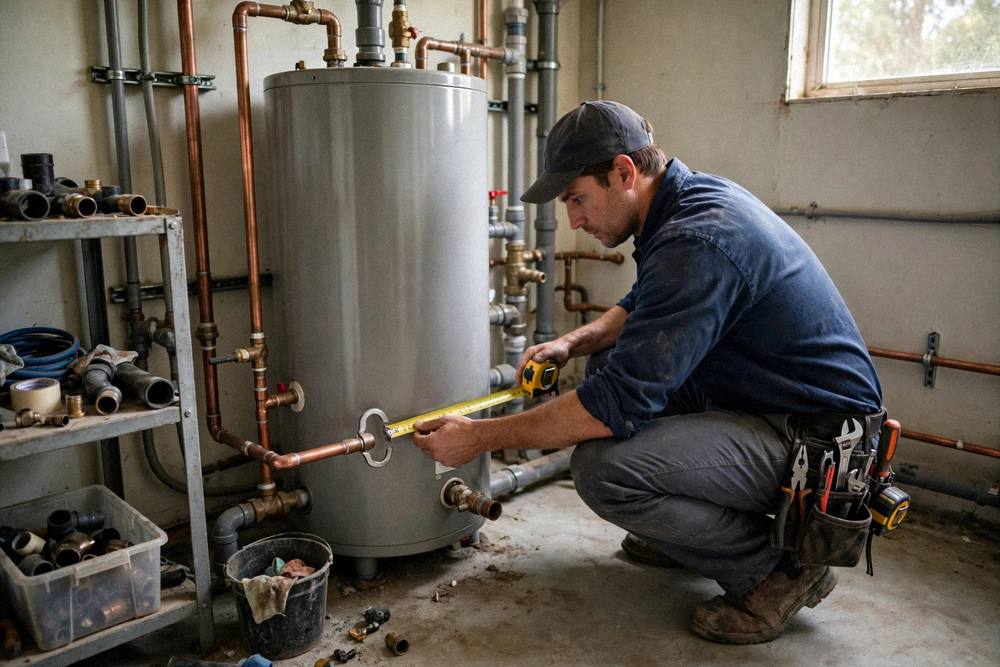
Idaho has one plumbing code for the whole state, and Nampa follows it. The code is the 2017 Idaho State Plumbing Code, which is based on the 2015 Uniform Plumbing Code, with Idaho amendments. This page explains what that code is, who enforces it in Nampa, and what it means for your water heater.
What the Code Is
The Idaho State Plumbing Code is adopted in IDAPA 24.39.20, Rule 600. The rule adopts the 2015 Uniform Plumbing Code, known as the UPC, including Appendices A, B, C, D, E, G, I, J, K and L, with amendments set by the Idaho Plumbing Board. The published code is the 2017 edition.
The UPC is a model code written by IAPMO, the International Association of Plumbing and Mechanical Officials. Idaho is a UPC state. It does not use the International Plumbing Code. That matters because the two model codes differ in details, and a plumber trained on one cannot assume the other.
The current rule version took effect on March 28, 2023. Idaho updates its plumbing code on a multi year cycle. The Idaho Plumbing Board has said the code is reviewed every six to nine years, which can span two or three code development cycles. When a new edition is adopted, the Board gets the Board approved edition from IAPMO for review, the legislature adopts it, and the amendments go back to IAPMO for the next Idaho edition. As of this writing, the 2015 UPC base is the edition in force.
The state code has about 50 amendments to the base UPC. The amendments change or add rules where Idaho needs something different from the model code. A plumber working in Nampa must follow the Idaho version, not the plain UPC book.
Who Enforces the Code in Nampa
The code is enforced by the local authority having jurisdiction. Inside Nampa city limits, that is the City of Nampa Building Department. The City issues plumbing permits separately from building permits, and permitted work is inspected against the Idaho State Plumbing Code.
Outside city limits, in unincorporated Canyon County, permits and inspections usually run through Idaho DOPL instead. Your address decides which office issues the permit, so check whether your home sits inside city limits before you ask.
The City requires permitted work to be done by a state licensed journeyman plumber working for an Idaho licensed plumbing contractor, and the plumber pulls the permit as part of the job. That rule links the licence page and the code page together: the code sets the standard, the permit proves the work was checked against it, and the licence proves the person doing it was qualified.
What the Code Covers on a Water Heater
The code covers the whole water heater install, not just the tank. Here is what an inspector looks at on a water heater job in Nampa.
First, the relief valve. Every water heater must have a temperature and pressure relief valve, called a T and P valve. It opens if the tank gets too hot or the pressure gets too high. The valve needs a discharge pipe that runs to a safe place, so scalding water does not spray onto a person or a floor. A missing or capped relief valve is one of the most dangerous faults a plumber sees.
Second, the drain pan. Where a leaking tank would cause damage to the home, the code calls for a drain pan under the heater, with a drain to a safe place. A tank in a garage over a concrete floor is a different case from a tank in a second floor closet over finished rooms.
Third, venting. A gas water heater must vent combustion gases outside through a proper vent. The vent must be the right size and material, run the right way, and clear the roof by the right distance. Bad venting can push carbon monoxide back into the home. An electric heater has no vent, but a gas to electric change still needs the old vent dealt with.
Fourth, the gas line. A gas water heater needs a gas supply sized for the unit. A tankless unit burns far more gas at full fire than a tank unit, often 150,000 to 199,000 BTU per hour, about four to five times a tank unit. A tank to tankless change usually needs a larger gas line, and that work needs its own permit.
Fifth, the expansion tank. Many Nampa homes have a closed water system, where a check valve or pressure regulator stops water flowing back into the city main. When water heats, it expands, and in a closed system that expansion has nowhere to go. An expansion tank gives it somewhere to go. Without one, pressure spikes can wear out the heater, trip the relief valve, and shorten the life of fixtures.
Sixth, the water temperature. The US Department of Energy recommends setting a water heater to 120 degrees Fahrenheit. That setting is hot enough for showers and dishes, and cool enough to cut scald risk and save energy. The code and the maker instructions set the safety rules for the install; the 120 degree setting is the practical number to run at.
Seventh, the install itself. The heater must be installed per the maker instructions and the code. That covers clearances around the unit, access for service, earthquake strapping where the code calls for it, and the shut off valve on the cold water line. A heater crammed into a closet with no access is a code problem even if it heats water fine.
Note: this page does not quote UPC section numbers. The section numbers were not verified against the code text in this round, and a wrong number is worse than no number. The rules above are the substance of what the code requires on a water heater job.
Repairs Versus Replacements Under the Code
Not every water heater job needs a permit. The general line, as Nampa plumbers describe it, is simple: a repair needs no permit, a replacement or a new install needs one. The City's own residential permit bulletin was not found in our research, so our permit page at /water-heater-replacement-permit-nampa-id/ states the rule and the gap in full.
Fixing a leak, replacing a broken fixture, or swapping a failed part such as a thermostat, an element, or a thermocouple is a repair. Emergency leak repairs are exempt from permits. A like for like fixture swap generally needs no permit either.
Replacing the whole heater is a new installation, and it usually needs a permit and an inspection. Converting from a tank to a tankless unit usually needs a plumbing permit and a gas permit. Installing a heat pump water heater usually needs a plumbing permit and an electrical permit, because the unit needs a dedicated 240 volt, 30 amp circuit. Moving a heater to a new spot usually needs the full permit stack for the new water, gas, and electrical connections.
Our permit page at /water-heater-replacement-permit-nampa-id/ covers the Nampa permit rule in full, including how to check whether your job needs one.
What This Means for You
You do not need to read the code book. You need to know what to ask before the work starts.
Ask whether the job needs a permit, and who pulls it. If the job is a replacement, the answer is usually yes, and the plumber should pull it. Our permit page explains what we could and could not verify about the City's rule. If a plumber says a replacement needs no permit, ask them to show you the rule in writing, or call the City of Nampa Building Department yourself.
Ask about the relief valve and the discharge pipe. A new heater should leave your home with a working T and P valve and a discharge pipe that runs to a safe place. If the old discharge pipe is missing or wrong, the install should fix it.
Ask about the expansion tank. If your home has a closed system, a new heater without an expansion tank will wear out faster and trip the relief valve. Ask the plumber whether your system is closed and whether the quote includes an expansion tank.
Ask about venting on a gas unit. A new gas heater needs a vent that matches the unit and the code. On a tank to tankless change, ask whether the gas line needs upsizing, because that changes the price and the permit.
Ask what the inspection covers. The inspector checks the venting, the relief valve, the drain pan, and the gas piping test where one applies. A passed inspection is your proof the install meets the code.
Questions About the Idaho Plumbing Code
Which plumbing code does Nampa use?
Nampa uses the 2017 edition of the state plumbing code, which is based on the 2015 Uniform Plumbing Code with Idaho amendments. It is adopted in IDAPA 24.39.20, Rule 600, and enforced by the City of Nampa Building Department inside city limits.
Does the code require an expansion tank?
It depends on your system. On a closed water system, where a check valve or pressure regulator stops water flowing back to the city main, heated water has nowhere to expand. An expansion tank is the fix the code calls for in that case. Ask your plumber whether your home has a closed system.
How hot should my water heater be set?
The US Department of Energy recommends 120 degrees Fahrenheit. That is hot enough for showers and dishes, and it cuts scald risk and saves energy. If your household needs hotter water for a dishwasher without a booster, talk to your plumber before you raise it.
Who inspects the work after a water heater replacement?
The authority that issued the permit inspects it. Inside Nampa city limits, that is the City of Nampa Building Department. Outside city limits, it is usually Idaho DOPL. The inspection checks venting, the relief valve, the drain pan, and related code items.
Know the Code Before the Job Starts
The code is there to keep your home safe, not to slow the job down. A water heater done to code vents right, relieves pressure right, and drains right. Ask the questions above before the work starts, and read our permit page at /water-heater-replacement-permit-nampa-id/ and our licence page at /idaho-plumbing-licence-nampa/ so you know what the law requires and who is allowed to do the work.
Our Service Area
We serve Nampa and the towns around it. Pick your area to see water heater repair there.