
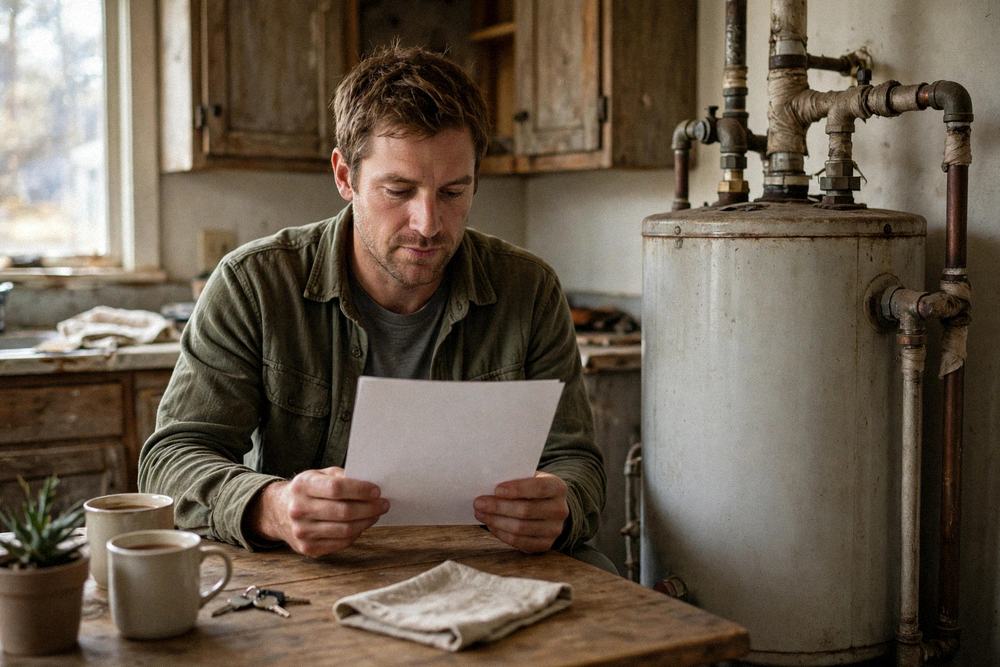
Water heating takes about 18 percent of a typical home's energy use, based on the US Department of Energy. If your water heater is expensive to run, the cause is usually one of five things: standby heat loss, sediment in the tank, a thermostat set too high, a worn out part, or a heater that is simply old.
That makes the water heater the second biggest energy user in most homes, after heating and cooling. Most of these faults have a fix that costs far less than a new unit.
Where Your Water Heating Money Goes
A tank water heater spends fuel in three ways. First, it heats the cold water that comes in. Second, it keeps the stored water hot all day and night, even when no one is using it. Third, it fights the heat that escapes through the tank walls and the pipes. That second and third kind of spending is called standby loss, and the US Department of Energy estimates it at 20 to 45 percent of total water heating energy.
Think of it this way. Your heater is a kettle that never leaves the stove. It heats the water, then it keeps heating it again each time the water cools a little. The better the tank is insulated, the less often it has to reheat. Tanks built after 2004 carry good insulation, and they lose far less heat than the thin walled tanks of the past.
How much does all this cost? It depends on the fuel, the household, and the rates. For a family of four, water heating often runs past 1,000 dollars a year on electricity at national rates. At Idaho rates the number is lower, because Idaho power costs less than the national average. The US Energy Information Administration put Idaho residential electricity near 12.35 cents per kWh in May 2026, against a national average near 18 cents. Gas is cheaper still per unit of heat. That is why the same heater can look pricey in one state and fair in another.
1. Standby Heat Loss: The Heater Works While You Sleep
Standby loss is the heat that escapes from the tank and the pipes while no tap is open. The water inside the tank cools slowly, the thermostat senses the drop, and the burner or element fires to top it up. This cycle runs all day and all night, and it runs hardest in winter, when the room around the heater is cold.
Three things make standby loss worse. Thin insulation on an old tank. Bare pipes with no insulation, which lose heat along every foot of run. And a thermostat set high, because hotter water loses heat faster to the air around it. A tank in a cold Nampa garage in January loses far more heat than the same tank in a warm closet.
What to do: insulate the first few feet of hot and cold pipe near the heater with pipe insulation, and fit a tank blanket only if the manual for your model allows it. Some newer tanks already carry enough insulation, and a blanket on those adds nothing. Keep the thermostat at 120 degrees F, based on US Department of Energy guidance. Many units leave the factory set near 140 degrees F. Lowering the setting from 140 to 120 degrees F can cut water heating costs by roughly 4 to 22 percent, based on US Department of Energy and Energy Star figures. The saving comes straight off standby loss, because cooler water loses heat more slowly.
2. Sediment: The Hidden Tax in Nampa Hard Water
Nampa water comes from city wells in the Snake River Plain Aquifer, and it carries calcium and magnesium. The City of Nampa 2024 Consumer Confidence Report lists hardness from none to 7.08 GPG across the city system. When hard water heats up, minerals settle at the bottom of the tank as sediment. The layer acts like a blanket between the burner or the lower element and the water.
Sediment forces the heater to run longer to make the same hot water. The heat has to push through the mineral layer, so the burner stays on and the element runs hotter. In an electric tank, sediment can bury the lower element until it burns out. In a gas tank, the extra heat cooks the bottom of the tank. Either way, the fuel bill climbs while the hot water stays the same.
How much does sediment cost? A tank that has never been flushed can lose 10 to 20 percent of its efficiency by year 10, and 20 to 30 percent by year 15, based on a 2026 running cost guide. That is a rough guide, not a metered bill, but the direction is clear. A flush costs far less than the fuel it saves. A tank flush runs 75 to 250 dollars nationally, based on HomeGuide 2026. A tankless descale runs 75 to 300 dollars nationally, based on HomeGuide 2026.
What to do: flush a tank once a year and descale a tankless unit once a year. In Nampa, once a year is the right pace because the top of the city hardness range sits at 7.08 GPG. If you hear popping or rumbling noises, the sediment is already thick, and a flush should come first on the list. Our water heater flushing in Nampa page walks through what a flush covers, and our yearly water heater maintenance in Nampa visit covers the flush and the checks around it.
3. A Thermostat Set Too High, or a Thermostat That Sticks
The thermostat is the brain of the heater. It tells the burner or the element when to fire and when to stop. Two thermostat problems raise the bill. The first is a setting that is too high. The second is a thermostat that sticks closed and keeps heating past the set point.
A setting near 140 degrees F costs more than a setting at 120 degrees F in two ways. The water loses heat faster while it sits, and the heater fires more often to replace it. The US Department of Energy puts the saving from dropping to 120 degrees F at 6 to 10 percent, and Energy Star puts the range at 4 to 22 percent when the drop is from 140 to 120. Either way, the saving is real money every month.
A thermostat that sticks closed is worse. The heater keeps heating, the water gets very hot, and the T and P valve may start to drip. That drip is the safety valve doing its job. Never cap a dripping T and P valve. The fix is the thermostat, not the valve. A thermostat runs 100 to 350 dollars nationally, based on HomeGuide 2026.
What to do: check the setting with a thermometer at the tap. Set the dial to 120 degrees F and wait a day. If the tap reads far above 120 or swings by a wide margin, the thermostat is suspect. Do not keep turning the dial up to fix lukewarm water. If the dial reads 120 and the water is still lukewarm, the fault is the element, the burner, or sediment.
4. Worn Out Parts That Make the Heater Work Harder
Parts wear out, and worn parts waste fuel before they fail outright. A heating element coated in scale has to run hotter and longer to push the same heat into the water. A gas burner clogged with dust burns weak and uneven. A dip tube that breaks lets cold water mix at the top of the tank, so the heater fires again and again to keep up.
The signs are easy to spot once you know them. Hot water runs out faster than it used to. The water turns lukewarm halfway through a shower. The heater runs for long stretches and the bill climbs while the hot water stays the same. A heating element runs 100 to 350 dollars nationally, based on HomeGuide 2026. A thermostat runs 100 to 350 dollars nationally, based on HomeGuide 2026. A thermocouple runs 100 to 325 dollars nationally, based on HomeGuide 2026.
Use the 50 percent rule before you spend. If the repair quote is more than half the cost of a new heater and the heater is past half its expected life, replace it. Our water heater repair cost in Nampa page shows how the rule works with real prices. A tank lasts 8 to 12 years and a tankless unit lasts 15 to 20 years, based on the US Department of Energy. A 200 dollar element on a 5 year old tank is a fair fix. A 550 dollar gas valve on a 10 year old tank is money you will not get back.
5. Winter Cold Water and an Old Heater
Nampa winters make every heater work harder. The cold season runs Nov 19 to Feb 18, with 132 freezing nights a year, based on NOAA 1991 to 2020 data. The water coming into the house in January is far colder than the water coming in during July. The heater has to lift that cold water further to reach 120 degrees F, and it runs longer to do it.
An old heater feels winter worst. A tank past 10 years old has thinner insulation than a new one, more sediment on the floor, and parts that are already tired.
A tankless unit faces the same math in a different way. It heats water as it flows, so cold inlet water means the burner must run harder and longer for the same flow. In a cold snap, a tankless unit may deliver less hot water per minute than it does in summer. That is normal, and it is not a fault. The fix is to descale on schedule and to size the unit for winter inlet temperatures, not summer ones. Our tankless water heater repair in Nampa page covers the winter faults we see most. A tankless unit that is sized for July will leave you short in January.
What to do: book the yearly flush and check in the fall, before the first freeze. A flushed tank with a sound anode rod and a working relief valve goes into winter ready. A neglected one goes in already tired. If the heater is past 12 years old and the bills keep climbing, ask us for a written price on a replacement and run the 50 percent rule on real numbers.
6. The Cheaper Options: What Actually Saves Money
Here is the fix list in order, cheapest first. Each item pays for itself in fuel savings, and none of them needs a new heater.
| Fix | Cost, national | What it saves |
|---|---|---|
| Set thermostat to 120 degrees F | Free | 4 to 22 percent of water heating cost |
| Insulate the first feet of pipe | Low cost | Less standby loss on every run |
| Flush the tank yearly | 75 to 250 dollars | Restores heat transfer, stops sediment loss |
| Descale a tankless unit yearly | 75 to 300 dollars | Keeps the heat exchanger clear |
| Fix a worn element or thermostat | 100 to 350 dollars per part | Stops long run times and short hot water |
| Replace a failing tank | 600 to 3,100 dollars installed | Ends the repair cycle on an old unit |
All prices are national ranges with sources in the Notes below, not Nampa prices. Labor runs 75 to 150 dollars an hour nationally, based on Fixr, updated Aug 29, 2025.
The third option is worth a look if you are replacing anyway. A heat pump water heater moves heat instead of making it, and it runs at about 200 to 300 dollars a year in energy, against 600 to 840 dollars a year for a standard electric tank at national rates. A heat pump unit runs 2,000 to 4,600 dollars installed nationally, based on HomeGuide 2026. Idaho Power offers a 300 dollar rebate on qualifying heat pump units, form CRR 211. The federal 25C credit ended Dec 31, 2025, so do not count on it. A heat pump unit needs a warm space with room to breathe, like a garage or a large utility room, and it lasts 10 to 15 years, based on the US Department of Energy.
Frequently Asked Questions
Why did my electric bill jump all of a sudden?
A sudden jump points to a fault, not to normal use. The usual suspects are a failed lower element, a thermostat that sticks closed, or a hot water leak. A dripping hot tap can make the heater run all day. Check the taps first, then call us to test the element and the thermostat.
Does turning the water heater off at night save money?
Very little. A modern insulated tank loses only a small amount of heat overnight, and the heater uses nearly as much fuel reheating the tank in the morning as it saved. The bigger wins are the thermostat setting and the yearly flush.
Is a tankless water heater cheaper to run than a tank?
Yes. A tankless unit is 24 to 34 percent more efficient than a tank for homes using 41 gallons of hot water a day or less, based on the US Department of Energy. It has no standby loss, because it heats water when a tap opens. The catch is the install cost, at 1,400 to 5,600 dollars, per HomeGuide 2026.
How much can I save by flushing the tank?
A tank that has never been flushed can lose 10 to 20 percent of its efficiency by year 10, based on a 2026 running cost guide. A flush runs 75 to 250 dollars nationally, based on HomeGuide 2026, and it restores heat transfer in one visit.
Get a Straight Answer on Your Water Heater Bill
If your water heater costs more to run than it used to, something changed, and the cause is usually on this page. Tell us what you have noticed, and we will test the heater, give you a written price, and tell you straight whether a flush, a part, or a replacement is the right move. Water heaters are all we do, and we do them in Nampa.
Our Service Area
We serve Nampa and the towns around it. Pick your area to see water heater repair there.