
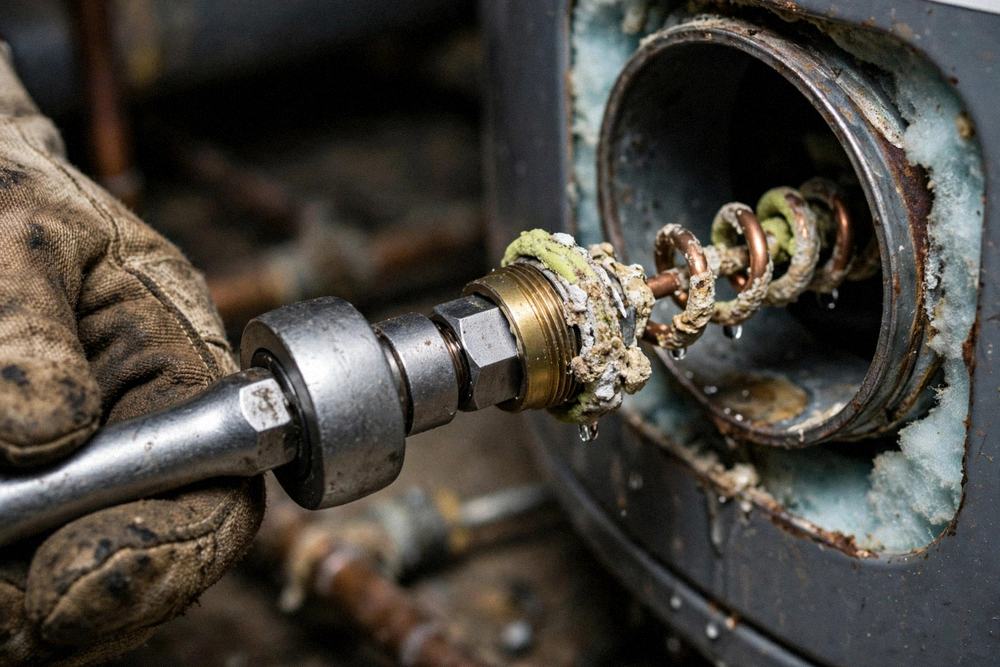
The heating element is the part that fails most often in an electric tank, and replacing it is our most common electric repair in Nampa. The part itself is cheap. The skill is knowing which element failed, why it failed, and whether the tank is worth saving. This guide covers the signs, the test, the job, and the cost.
What the Element Does and Why It Fails
A heating element is a metal loop inside the tank that turns electricity into heat. Current runs through the coil, the coil gets hot, and the water around it carries the heat away. An electric tank has two of them, one near the top and one near the bottom, and each one has its own thermostat. When current flows, the element heats. When the wire inside snaps, or the coil shorts to its metal sheath, the element is done.
Elements fail in four ways. The first is sediment. Nampa water runs from none to 7.08 GPG in hardness, based on the City of Nampa 2024 Consumer Confidence Report, and that mineral load settles at the bottom of the tank as scale. The lower element sits in that zone. Scale coats the coil, traps heat against it, and the coil overheats until the wire snaps. That is the number one killer in Nampa.
The second is dry firing. An element must sit under water to shed its heat. If the power comes on while the tank is empty, the coil glows red hot and burns through its casing in seconds. That is why a pro never turns the breaker on until the tank is full again.
The third is age. An element is a wear part, like a light bulb. After years of heat cycles, the wire inside gets brittle and breaks. A tank lasts 8 to 12 years, based on the US Department of Energy. On a tank past 10 years, a failed element is often the first sign the whole unit is near the end.
The fourth is a power surge or loose wiring. A surge can melt the wire inside, and a loose wire at the terminals can arc and burn the connection. A pro checks the terminals on every element job, because a new element on a burned terminal will fail again fast.
The Signs Your Element Has Failed
A failed element does not always mean no hot water. The symptom depends on which element failed, and the pattern is steady enough to read like a chart.
| Symptom | Most likely failure |
|---|---|
| Steady lukewarm water | Upper element |
| Hot water runs out fast | Lower element |
| Popping or rumbling from the tank | Sediment on the lower element |
| Breaker trips again and again | Grounded element, coil shorted to sheath |
| Higher power bill with less hot water | Element working harder through scale |
No hot water at all points up. The upper element heats the top of the tank, and the top is what reaches your taps. Before you blame the element, check the breaker and press the red reset button on the upper thermostat with the breaker off. A tripped breaker or a tripped reset gives the same symptom for free.
Steady lukewarm water also points up. The lower element still heats the bottom of the tank, so the tap gets a mix of warm bottom water and cold top water that never gets hot.
Hot water that runs out fast points down. The lower element does most of the heating, so when it fails, the tank holds only the hot water the upper element can make at the top. The first shower is fine and the second goes cold.
Popping or rumbling from the tank bottom is sediment noise, and it is the warning that the lower element is buried. Water trapped under sediment flashes to steam and pops.
A breaker that trips again and again points at a grounded element. The coil has shorted to its metal sheath and is leaking current to the tank. Stop resetting the breaker and call a pro.
Upper or Lower: Which One Is It
The symptom points, but a meter test proves it. A pro test takes about 20 minutes and runs with the breaker off the whole time. The test has two parts, and both matter.
First, the continuity test. A multimeter set to ohms reads across the two element terminals. A good element reads in a low range, usually around 10 to 16 ohms for a standard 240 volt element. A dead element reads open, which the meter shows as OL or infinity. That means the wire inside has snapped.
Second, the ground test. The meter reads from one element terminal to the metal tank. A good element reads open, which means no path from the coil to the tank. A grounded element reads a number, which means current is leaking to the tank. That is the test that finds the breaker tripping fault, and it is the test a symptom chart cannot do.
The pro tests both elements, even when the symptom points at one. The parts fail together often enough that testing one and guessing the other wastes a visit. A shorted element can also cook its thermostat, so the pro tests the thermostats too. If the thermostat is the fault and you replace the element, the new element fails the same way a month later.
There is one more check that decides the job: the tank itself. A pro looks for rust in the hot water, water pooling at the base, and the age on the rating plate. An element swap on a leaking tank is money thrown away.
What a Pro Replacement Looks Like, Step by Step
A pro element swap follows the same steps on every tank, and the order is the safety of the job.
First, the power goes off at the breaker, and the pro proves it is off with a meter before touching a wire. An electric tank runs on 240 volt power, and working on a live unit can be fatal. The breaker stays off until the tank is full again.
Second, the tank drains down below the failed element. The pro connects a hose to the drain valve, opens a hot tap to let air in, and drains enough water to clear the element opening. The lower element sits near the bottom, so that job drains more water.
Third, the pro removes the access panel, folds back the insulation, and takes the wires off the element terminals. The element comes out with an element wrench, a wide socket made for the job. A stuck element that has sat in hard water for a decade can need a long wrench and steady force.
Fourth, the new element goes in with a fresh gasket, and it must match the old one on voltage and wattage. A 240 volt element on a 120 volt circuit will not heat, and a higher wattage element can trip the breaker. The pro reads the rating plate on the old element before picking the new one. In Nampa hard water, a low watt density element is often the better pick, because it spreads the heat over more surface and runs cooler.
Fifth, the tank fills again before the power goes back on. The pro closes the drain valve, fills the tank, and opens a hot tap until water runs steady with no air. Only then does the breaker go back on. Power to an element that is not under water destroys it in seconds.
The whole job usually takes about an hour on site, plus the time to test both elements and both thermostats first. A second element in the same visit adds little time, because the tank is already drained and the power is already off, which is why a pro will often suggest doing both when the tank is past eight years.
What It Costs, and What Changes the Price
The element is one of the cheapest parts in a water heater, which is why the bill is mostly labor.
A heating element runs 100 to 350 dollars nationally when a pro supplies and fits it, based on HomeGuide, 2026. The part alone runs about 20 to 80 dollars at a supply house, based on competitor parts guides from 2026. A full repair visit runs 150 to 750 dollars nationally, with an average near 450 dollars, based on Fixr, updated Aug 29, 2025. A plumber visit runs 75 to 150 dollars an hour nationally, with an average near 90 dollars, based on Fixr, Jan 30, 2025. A single element swap on a tank with clear access often lands near the low end of that range, because the job is one part and about an hour.
Four things change the price. Access is the first. A tank in an open garage is a fast job, and a tank in a tight closet takes longer. A stuck element is the second. An element that has sat in hard water for a decade can seize in the fitting, and freeing it takes time and care. Both elements at once is the third, and it adds the cost of the second part but little extra labor. A thermostat in the same visit is the fourth. A thermostat runs 100 to 350 dollars nationally, based on HomeGuide, 2026, and pairing it makes sense when the test shows the thermostat is also weak.
Get the quote in writing before work starts, and ask what it covers: the part, the gasket, the drain and refill, and the test of the other element and both thermostats. A quote that skips the test is a second visit waiting to happen.
When a New Element Is the Wrong Call
A new element fixes a failed element. It does not fix a failed tank, and knowing the difference saves the cost of a repair that lasts a month.
Do not put a new element in a tank that leaks from the bottom. That leak means the steel tank has rusted through, and no part will save it. Do not put a new element in a tank with heavy rust in the hot water that returns after an anode rod change. That rust is the tank itself breaking down.
Use the 50 percent rule. If the repair quote is more than half the cost of a new unit and the heater is past half its life, replace it. A new tank install runs 600 to 3,100 dollars installed nationally, based on HomeGuide, Jan 2026. On a tank past 10 years, a second element failure in the same year is the sign the tank is done. On a tank under 8 years, a single element is a fair fix, and the tank should give years more service after it.
A tank that has never been flushed and sits on a decade of sediment is a judgment call. A new element will work, but it will live in the same sediment that killed the last one. A flush with the element swap costs little extra while the tank is already drained. If the tank is also past 10 years, the honest call is often a replacement.
Making the Next Element Last Longer in Nampa
An element in Nampa lives or dies by scale. The habits that slow scale down cost less than a single element swap.
Flush the tank once a year. A flush runs 75 to 250 dollars nationally, based on HomeGuide, 2026, and it clears the sediment before it can bury the lower element. Check the T and P valve every 6 months and the anode rod every 3 to 4 years, based on US Department of Energy guidance.
Ask for a low watt density element when the old one comes out. It spreads the same heat over more surface, runs cooler at any one spot, and builds scale more slowly. In water that runs to 7.08 GPG at the top of the city range, that cooler surface is worth real years of element life.
A water softener slows scale too, but it does not remove the need for a flush. Homes on private wells outside the city system can run harder than the city range, so test your well water before you pick an element type.
Frequently Asked Questions
How do I know if my heating element is bad?
The symptom points first: no hot water at all points at the upper element, lukewarm water points at the upper element too, and hot water that runs out fast points at the lower element. A pro proves it with a meter test. A dead element reads open on the ohms test, and a grounded element reads a path to the tank.
How much does heating element replacement cost?
A pro element swap runs 100 to 350 dollars nationally, based on HomeGuide, 2026. The part alone runs about 20 to 80 dollars, so the rest of the bill is labor, the gasket, the drain and refill, and the test of the other parts. A full repair visit runs 150 to 750 dollars nationally, with an average near 450 dollars, based on Fixr, updated Aug 29, 2025.
Should I replace both heating elements at the same time?
Often yes when the tank is past eight years. The second element costs little extra while the tank is already drained and the power is already off, and the parts fail together often enough that a second visit a month later costs more than the part does now. On a young tank with one clear failure, one element is enough.
Can I replace a heating element myself?
The part swap looks simple, but the job runs on 240 volt power and ends with a tank that must be full before the power goes back on. Power to an element that is not under water destroys it in seconds. If your maker manual covers the job and you are sure about the power off steps, it is your call. If you are not sure, a pro does it in about an hour.
Call Nampa HeatPros for a Straight Answer on a Failed Element
A failed element is a small job when the tank is sound and a wasted job when it is not. Tell us your symptom, cold everywhere, lukewarm, or gone after one shower, and how old the tank is, and we will tell you whether an element will fix it and what it will cost before we start. Water heaters are all we do, and we do them in Nampa.
Our Service Area
We serve Nampa and the towns around it. Pick your area to see water heater repair there.