
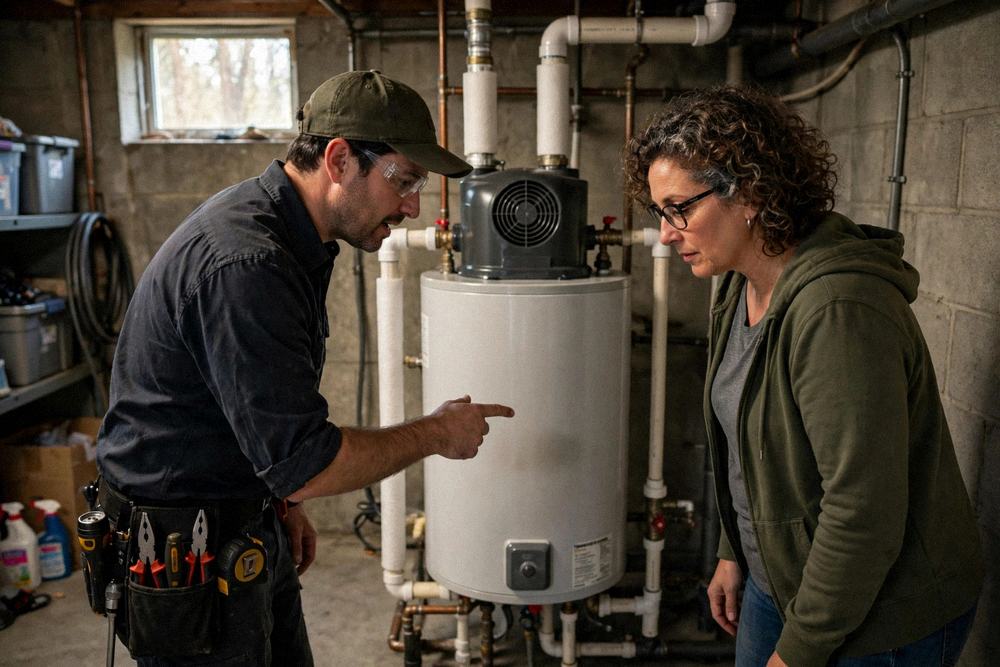
A hybrid unit is the water heater most homeowners have never seen, and the questions about it are always the same: how does it work, what does it cost, and is it worth it. This guide answers all three in plain terms, part by part, dollar by dollar, with no jargon and no sales talk.
How It Works, Part by Part
A hybrid unit is a storage tank with a small heat pump on top. It works like a refrigerator in reverse. A refrigerator pulls heat out of a cold box and dumps it into the room. A hybrid pulls heat out of room air and puts it into the water in the tank. It moves heat instead of making it, and moving heat takes far less power than making it.
Four parts do the work. The evaporator is a coil that sits in the air stream. A fan pulls room air across it, and the refrigerant inside the coil picks up heat from that air, even when the air feels cool to you. The compressor squeezes the refrigerant, which makes it hotter, the same way a bike pump gets warm when you squeeze air into a tire. The condenser is a second coil wrapped around the tank, and the hot refrigerant gives its heat to the water through it. The expansion valve lets the refrigerant cool and drop in pressure so it can go around the loop again and pick up more heat.
Two backup electric elements sit inside the tank as well. They take over when the household draws a lot of hot water at once, or when the air around the unit is too cold for the compressor to do the job alone. The unit decides when to call them in, based on the mode you pick and the temperature of the water.
The whole loop runs on electricity, but the power goes mostly to the fan and the compressor, not to a heating coil. That is why the ratio is so good. A standard electric element turns one unit of electricity into one unit of heat. A hybrid moves two to three units of heat for each unit of electricity, based on US Department of Energy figures. The ratio is called the coefficient of performance, and a standard tank has a ratio of 1.
The unit also pulls moisture out of the air while it works, because cool coils condense water vapor. That water has to drain away, which is why every install needs a condensate drain or a pump. A unit with no drain plan will puddle water on the floor, and a drain that runs to the wrong place will cause trouble later.
The Modes, in Plain Terms
Most hybrid units have three or four modes, and the mode you pick decides how much you save and how fast the water recovers.
Efficiency mode, sometimes called economy mode, runs the compressor only. It saves the most power and recovers the slowest. It is the right mode for a household with steady, light use, where the tank has all day to recover between showers.
Hybrid mode runs the compressor first and calls the elements in when the tank needs fast recovery. It is the default mode on most units, and it is the right mode for a family of four or more. You keep most of the saving and you keep hot water on a busy morning.
Electric mode runs the elements only and turns the unit back into a plain electric tank. It is the fallback mode for a cold snap, or for a day when the household needs far more hot water than usual. It costs the most to run, and it is there so the unit never leaves you cold.
Vacation mode, on units that have it, drops the tank to a low hold temperature while you are away.
The mode is set on the control panel on the unit, and some models let you set it from a phone app. The right habit is hybrid mode for everyday life, efficiency mode when the house is quiet, and electric mode only when you need fast recovery and accept the higher bill for a day.
What Size Do You Need
Sizing a hybrid is different from sizing a plain tank, because the recovery is slower. A hybrid heats water at about 8 to 10 gallons an hour on the compressor, against 20 gallons an hour or more for a standard electric tank. That means the tank has to hold more hot water up front, because it cannot make it back as fast.
The number that matters is the first hour rating. That is how many gallons of hot water the unit can deliver in the first hour of use, starting with a full hot tank. ENERGY STAR sets a minimum first hour rating of 45 gallons an hour for certified hybrid models. A family of two can live with a 50 gallon tank. A family of four should look at a 65 or 80 gallon tank, because the slower recovery needs the extra storage. A family of five or more should look at the largest tank that fits the room, and run hybrid mode so the elements help on busy mornings.
Oversizing by one step is the usual call for a hybrid, and it is the opposite of the advice for a plain tank, where oversizing wastes power keeping extra water hot. On a hybrid, the extra storage is what covers the slow recovery, and the cost of keeping it hot is small, because the compressor heats it so cheaply.
The room decides the size too. A hybrid needs about 1,000 cubic feet of air around it, based on ENERGY STAR guidance, and a room that stays between 40 and 90 degrees F through the year, based on US Department of Energy guidance. Measure the room first, then pick the tank that fits it.
What the Install Needs
A hybrid install needs more than a tank swap, and the extra work is where the cost sits.
First, power. The unit needs a 240 volt circuit, the same as a standard electric tank, but the circuit must be checked, because the unit also runs a fan and a compressor with their own draw. A panel that is already full may need work before the unit goes in.
Second, a drain. The unit pulls moisture from the air and has to drain it away. The install needs a condensate drain to a floor drain, a laundry standpipe, or a pump that lifts the water to a drain. A unit with no drain plan will puddle.
Third, air and space. The unit needs about 1,000 cubic feet of air around it and a room that stays between 40 and 90 degrees F. A small closet will starve it. A freezing garage will push it onto its backup elements all winter. In Nampa, with 132 freezing nights a year based on NOAA data for 1991 to 2020, and a January average low of 23 degrees F, that means a conditioned basement or a large utility room, not an unheated garage. Our most efficient option guide covers the Nampa winter question in full.
Fourth, ducting, if the room needs it. Some models let you duct air in from a warmer room, or duct the cooled air out of the room. Ducting adds cost, but it can make a borderline room work. A unit that cools the room it sits in will make a cold room colder in winter, which is another reason the room choice matters.
A standard tank swap takes 3 to 5 hours. A hybrid install takes half a day or more, because of the drain, the power check, the ducting if needed, and the setup of the modes and the first hour rating for the household.
What It Costs, Line by Line
The install runs 2,000 to 4,600 dollars nationally, based on HomeGuide, 2026. That covers the unit, the labor, the drain, and the power check. A standard electric tank install runs less, and the gap is the price of the saving.
The running cost is where the unit earns it back. A hybrid for a family of four runs about 300 dollars a year in power at Idaho prices, based on the Bright Side Kit 2026 guide and EIA Idaho power at about 12.35 cents per kWh for May 2026. A standard electric tank for the same household runs about 475 dollars a year. The saving is about 175 dollars a year at Idaho prices. Nationally, ENERGY STAR puts the saving at about 550 dollars a year for a household of four, and the Department of Energy puts it near 330 dollars a year. The Idaho figure is smaller because Idaho power is cheap. That is the honest math for Nampa.
Idaho Power offers a 300 dollar rebate on qualifying hybrid units, form CRR 211. That rebate is for hybrid units only, and it cuts the upfront gap by 300 dollars. Ask for the form and the qualifying list before you buy.
The federal 25C credit ended Dec 31, 2025, based on IRS guidance FS-2025-05. Do not count on it. If a seller quotes a federal credit on a hybrid install in 2026, that quote is out of date.
A hybrid lasts 10 to 15 years, based on the US Department of Energy. A standard tank lasts 8 to 12 years. Over 10 years, the total cost looks like this, using national install figures and Idaho running costs.
| Cost over 10 years | Hybrid unit | Standard electric tank |
|---|---|---|
| Power, 10 years at Idaho prices | About 3,000 dollars | About 4,750 dollars |
| Rebate | Less 300 dollars (Idaho Power, form CRR 211) | None |
| Total, rough | 4,700 to 7,300 dollars | 5,350 to 7,850 dollars |
The totals overlap, which is the honest answer. The hybrid wins when the install is at the low end and the household uses a lot of hot water. The standard tank wins when the install is at the high end and the household is small. The rebate and the longer life tilt the math toward the hybrid, but they do not settle it on their own. The room and the household size settle it.
Hybrid vs Standard Electric vs Gas
| Hybrid unit | Standard electric tank | Gas tank | |
|---|---|---|---|
| Efficiency ratio | 2 to 3 units of heat per unit of power | 1 to 1 | Less than 1 |
| Power cost a year, family of four, Idaho prices | About 300 dollars | About 475 dollars | About 250 to 400 dollars for gas |
| Install, national | 2,000 to 4,600 dollars | 600 to 3,100 dollars | 600 to 3,100 dollars |
| Life, DOE | 10 to 15 years | 8 to 12 years | 8 to 12 years |
| Recovery | Slow, 8 to 10 gallons an hour | Fast, 20 gallons an hour or more | Fast |
| Needs | 240 volt, drain, 1,000 cubic feet of air, room 40 to 90 degrees F | 240 volt | Gas line, vent, combustion air |
Gas is still the cheapest to run in a home that already has a gas line, because Idaho gas runs about 1.08 dollars a therm, based on EIA data for May 2026. The hybrid is the cheapest electric option, and the best pick for a home with no gas line. A standard electric tank is the cheapest to buy and the most expensive electric option to run. The right pick depends on what is already in the house, how many people use hot water, and where the unit will sit.
Frequently Asked Questions
How does a heat pump water heater work?
It moves heat instead of making it. A fan pulls room air across a coil, a refrigerant loop picks up the heat, a compressor squeezes it hotter, and a second coil gives that heat to the water in the tank. Backup electric elements take over when demand is high or the air is too cold. A standard electric tank turns one unit of power into one unit of heat. A hybrid moves two to three units of heat for each unit of power, based on US Department of Energy figures.
How much does a heat pump water heater cost?
The install runs 2,000 to 4,600 dollars nationally, based on HomeGuide, 2026. The running cost for a family of four is about 300 dollars a year at Idaho power prices, against about 475 dollars a year for a standard electric tank. Idaho Power offers a 300 dollar rebate on qualifying units, form CRR 211. The federal 25C credit ended Dec 31, 2025, so do not count on it.
What size heat pump water heater do I need?
Size by the first hour rating, not just the gallons. ENERGY STAR sets a minimum first hour rating of 45 gallons an hour for certified hybrid models. A family of two can live with a 50 gallon tank. A family of four should look at a 65 or 80 gallon tank, because the slower recovery needs extra storage. Oversizing by one step is the usual call for a hybrid.
Where should a heat pump water heater be installed?
In a room that stays between 40 and 90 degrees F through the year, with about 1,000 cubic feet of air around it, based on US Department of Energy and ENERGY STAR guidance. A conditioned basement or a large utility room works. An unheated garage that drops near freezing does not, because the unit will run on its backup elements all winter and the saving will shrink. The unit also needs a 240 volt circuit and a condensate drain.
Call Nampa HeatPros for a Straight Answer on a Hybrid Unit
A hybrid is a simple idea with a room problem, a sizing problem, and a payback problem, and all three are settled by looking at your house, not by reading a brochure. Tell us where the unit would sit, how many people use hot water, and whether you have a gas line, and we will tell you whether it fits and what it will cost before we start. Water heaters are all we do, and we do them in Nampa.
Our Service Area
We serve Nampa and the towns around it. Pick your area to see water heater repair there.