
A gas unit heats your water with a real flame, and that flame needs air in, exhaust out, and a gas line with no leaks. When one of those fails, the risk is carbon monoxide in your home or gas in a closed room. This gas water heater safety guide shows what to watch for and when to call a pro.
How a Gas Unit Works, and Where Safety Lives
A gas tank burns natural gas or propane in a burner under the tank. The flame heats the water through the bottom of the tank and through a flue that runs up the middle. A thermostat calls for heat, the gas valve opens, and the burner runs until the water hits the set point of 120 degrees F, based on US Department of Energy guidance.
Three systems keep that flame safe. The gas line brings fuel in through a shutoff valve and a gas control valve. The burner and combustion air supply give the flame the oxygen it needs to burn clean. The vent carries exhaust gas up and out of the house. If the gas line leaks, fuel escapes into the room. If the air supply is short, the flame burns dirty and makes carbon monoxide. If the vent is blocked or broken, exhaust spills back into the room instead of leaving the house.
Most gas units in Nampa sit in a garage, a utility closet, or a small mechanical room. A gas unit in a garage must sit 18 inches above the floor, so gas fumes from a car or a stored can cannot reach the flame. That rule is part of the home inspection checks we use on every visit, and it is one of the first things we look at on a new home call.
A gas tank lasts 8 to 12 years, based on the US Department of Energy. A tankless gas unit lasts 15 to 20 years. An older unit has more years of heat cycles on its vent, its gas valve, and its burner, so a safety check matters more after year eight.
Carbon Monoxide: The Risk You Cannot See or Smell
Carbon monoxide, called CO, is a colorless gas with no smell and no taste. It comes from incomplete combustion, which means the burner did not get enough oxygen to burn the fuel clean. A healthy flame burns blue and makes mostly carbon dioxide and water vapor. A starved flame burns yellow or orange and makes carbon monoxide instead. You cannot see CO, and you cannot smell it, so the only safe way to catch it is a working alarm and a pro with a test meter.
The early signs of CO exposure look like the flu. Headache, dizziness, nausea, and confusion are the usual first signs. The key clue is the pattern: the signs ease when you leave the house and come back when you return. If more than one person in the home feels ill at the same time, and the signs lift outside, treat it as a CO problem until a pro proves otherwise.
If a carbon monoxide alarm sounds, get everyone out of the house into fresh air first. Call 911 or your gas company from outside the house. Do not open windows and wait inside to see if the alarm stops. Do not try to find the source yourself. A pro with a combustion meter can test the air and the vent after the home is safe to enter again.
Every home with a gas unit should have a CO alarm on each level and near sleeping areas. Test it once a month. An alarm does not stop CO from forming. It buys you the minutes you need to get out.
How Venting Fails in Nampa Homes
The vent is a metal pipe that runs from the draft hood on top of the tank up through the roof. Hot exhaust rises through it by natural draft. When the vent works, exhaust leaves the house. When it fails, exhaust spills back into the room. Plumbers call that backdrafting, and it is the most common way a gas unit puts CO into a home.
Vents fail in a few plain ways. A bird nest, debris, or ice can block the pipe. Nampa winters bring 132 freezing nights a year, based on NOAA data for 1991 to 2020, and a cold snap can freeze condensate in a vent or cap the top with ice. A vent joint can come loose or rust through after years of hot, wet exhaust. A vent with no slope, a sag, or a gap lets exhaust leak at the joint instead of rising out. A house with a strong exhaust fan, a dryer, or a range hood can pull air down the vent and reverse the draft.
You can spot vent trouble without tools. Look for black soot or yellow brown stains on top of the tank or around the draft hood, rust on the top of the tank from wet exhaust, a vent pipe that is loose or dented, melted plastic on the draft hood, or heavy condensation on windows near the unit. Any one of these signs means the vent needs a pro look before the unit runs another week.
The fix is never to tape a vent joint or to seal a draft hood shut. The vent needs a clear path, tight joints, steady slope up, and a cap that keeps rain and animals out while letting exhaust leave. On a safety visit we check the full vent run, the joints, the slope, and the cap, and we test the draft with the burner running to prove exhaust is going up and out.
Gas Leaks: What to Smell, What to Do
Natural gas has no smell of its own, so the gas company adds an odorant called mercaptan. That is the rotten egg smell most people know. A gas leak smells like rotten eggs, and the smell gets stronger near the leak. Carbon monoxide has no smell at all, so the rotten egg smell is never a CO sign. It is a gas leak sign, and the two problems need different action.
Gas leaks most often show up at the joints: where the gas line meets the gas control valve, at the shutoff valve, or at a union that has worked loose over years of heat cycles. A cracked flex connector or a valve that no longer seals can leak too. In a garage, a gas leak can pool near the floor, which is one more reason the 18 inch rule for gas units matters.
If you smell gas, act in this order. First, do not flip a light switch, do not use a phone inside, and do not light anything. A spark can ignite gas in the air. Second, get everyone out of the house. Third, call your gas company or 911 from outside. Fourth, if you can reach the gas shutoff valve on the way out, turn it a quarter turn so the handle sits across the pipe. If you cannot reach it safely, leave it.
If the smell is strong, or if you feel dizzy or sick, skip the valve and leave at once. A small leak found early is a repair visit. A strong smell is an emergency call. Do not try to find the leak with a lighter or a match. A pro finds leaks with a test fluid that bubbles at the joint, or with a gas meter that reads the air.
The Warning Signs on the Unit Itself
Your gas unit tells you when combustion is going wrong. Check these signs once a month.
A steady blue flame is healthy. A yellow or orange flame that never turns blue means the burner is not getting enough air, or the burner is dirty. A flame that lifts off the burner or floats is also a bad sign. A pilot light that keeps going out points to a thermocouple that is worn, dirty, or out of place, or to a draft that blows the flame around.
Soot is a warning. Black soot on top of the tank, around the draft hood, or on the vent pipe means the burner has been making carbon monoxide. Scorch marks or brown stains near the draft hood mean hot exhaust has been spilling out instead of rising up the vent. Melted plastic on the draft hood or on nearby pipes means the same thing, and it means the unit should not run until a pro has looked at it.
None of these signs proves CO is in the air. A unit can look fine and still vent badly, which is why the alarm and the pro test matter more than a visual check. But a unit that shows soot, scorch marks, or a yellow flame has already told you something is wrong. Listen to it.
What We Check on a Gas Water Heater Safety Visit
A gas safety visit is a fixed list, and we run the same list on every gas unit in Nampa, whether the call is a repair, a replacement, or a check on a new home purchase.
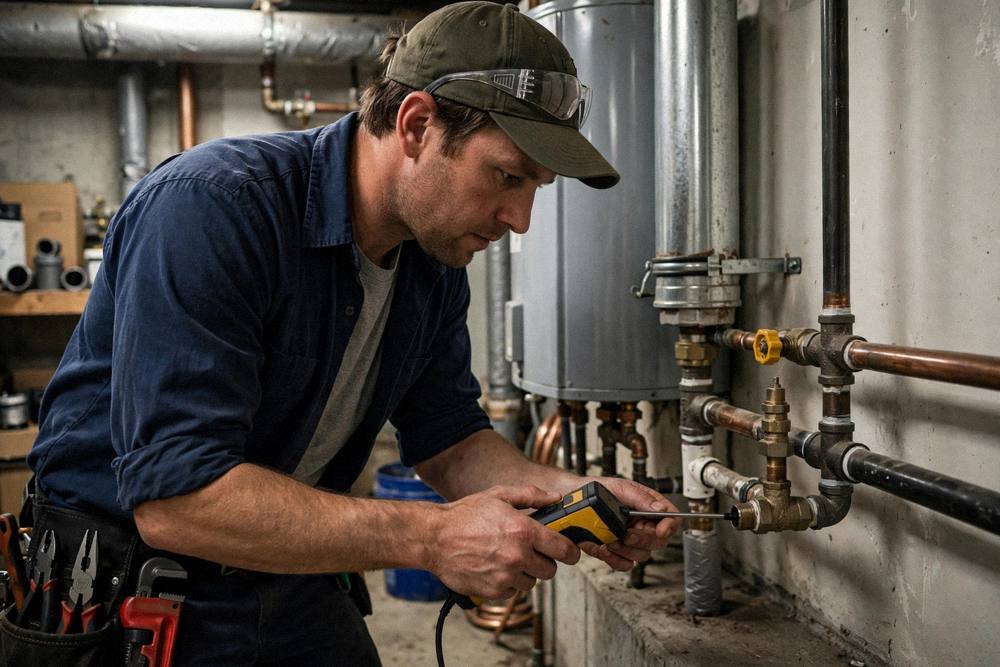
First, we check the gas line. We look at the shutoff valve, the flex connector, and every joint for rust, damage, or a loose fit. We test the joints with leak check fluid and watch for bubbles. We check that the gas line is the right size for the unit, because a line that is too small starves the burner.
Second, we check combustion air. The burner needs fresh air, and a unit locked in a small closet with no air opening will burn dirty. We check the air openings, the room size, and whether a dryer or a fan in the same room can pull air away from the burner.
Third, we check the vent from the draft hood to the roof cap. We look for a clear path, tight joints, steady slope up, and a cap in good shape. We check for soot, rust, and corrosion at each joint. Then we test the draft with the burner running to prove exhaust is rising out of the house.
Fourth, we check the burner and the flame. A blue flame, a clean burner, and a pilot that holds steady are the pass marks. We check the thermocouple, the gas control valve, and the temperature setting, which should sit at 120 degrees F. We also check the T and P valve, which opens at 150 psi or 210 degrees F, and we check that its discharge pipe ends within 6 inches of the floor with no valve or cap in the line.
Fifth, we test the air in the room with a CO meter and we check your CO alarms. The visit ends with a written note of what passed, what needs work, and what can wait.
How Much Does Gas Safety Work Cost in Nampa?
Nampa prices are not published, so the figures below are national ranges, labelled national, with the source and date. Get a written quote before work starts, and ask what the quote covers.
A gas unit repair runs 150 to 750 dollars nationally, with an average near 450 dollars, based on Fixr, updated Aug 29, 2025. A thermocouple runs 100 to 325 dollars nationally, and a pilot light repair runs 75 to 175 dollars nationally, both from the same Fixr guide. A gas control valve runs 150 to 550 dollars nationally, based on HomeGuide, 2026. A plumber visit runs 75 to 150 dollars an hour nationally, with an average near 90 dollars, based on Fixr, Jan 30, 2025.
A gas safety check on its own is usually the smallest bill on this list, because it is mostly time and testing, not parts. A tank swap runs 600 to 3,100 dollars installed nationally, based on HomeGuide, Jan 2026, and a tankless install runs 1,400 to 5,600 dollars installed nationally from the same guide.
If a permit is needed for a replacement, the national cost runs 50 to 200 dollars, based on HomeGuide, 2026. The Nampa permit rule itself is unverified, so we check with the City of Nampa before we start, and we say so on the quote.
Frequently Asked Questions
Can a gas water heater give off carbon monoxide?
Yes, if the burner does not get enough air or the vent is blocked, the flame makes carbon monoxide instead of burning clean. CO has no smell and no color, so a working alarm on each level and a pro test with a meter are the only safe ways to catch it. If an alarm sounds, get out and call 911 from outside.
What should I do if I smell gas near my water heater?
Do not flip a switch or use a phone inside. Get everyone out of the house, then call your gas company or 911 from outside. If you can reach the gas shutoff valve on the way out, turn it a quarter turn so the handle sits across the pipe. If the smell is strong, leave at once and let the gas company shut it off.
Is a yellow flame on my gas water heater dangerous?
A yellow or orange flame means the burner is not burning clean, and that can mean carbon monoxide is being made. A healthy flame burns steady blue. If your flame stays yellow, turn the unit off at the gas valve if you can do it safely, air the room out, and call a pro the same day.
How often should a gas water heater be checked for safety?
Once a year is the right pace, and the visit should cover the gas line, the combustion air, the full vent run, the burner flame, and a CO test. A unit past eight years, or a unit that shows soot, scorch marks, or a pilot that keeps going out, should be checked sooner rather than later.
Call Nampa HeatPros for a Straight Answer on Gas Safety
Gas water heater safety is not a job for guesswork. If your flame burns yellow, if you see soot or scorch marks, if your pilot keeps going out, or if you smell gas, call us and tell us what you see. We will tell you what is urgent, what can wait, and what it will cost before we start. Water heaters are all we do, and we do them in Nampa.
Our Service Area
We serve Nampa and the towns around it. Pick your area to see water heater repair there.