
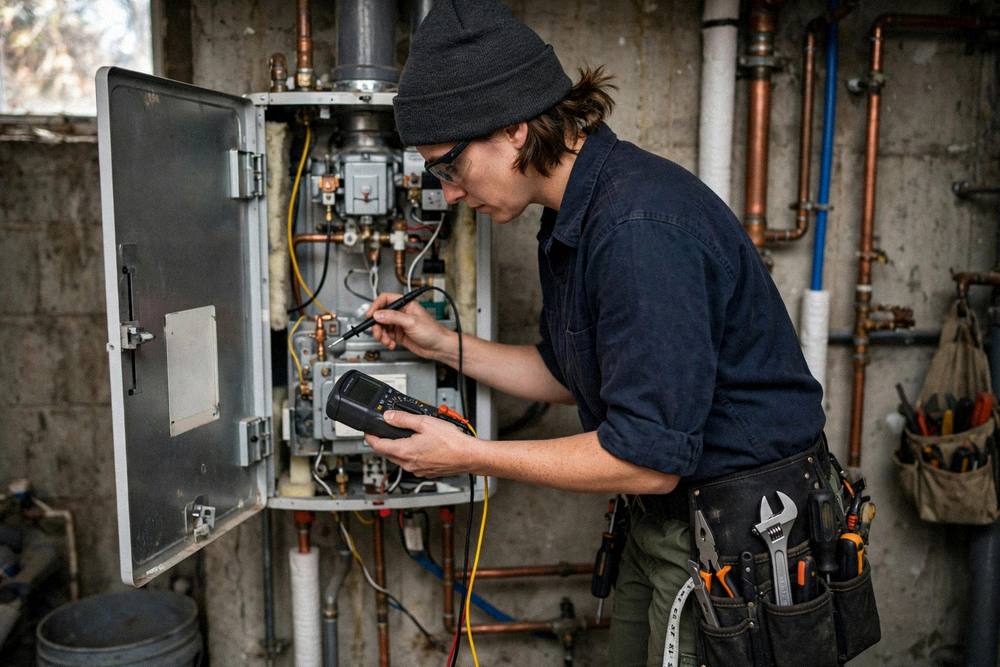
An electric water heater not heating usually comes down to three parts: the breaker, the reset button, or one of the two elements and two thermostats inside the tank. The symptom tells you which one to check first. This guide walks through the checks in order, so you can tell a free fix from a part that needs a pro.
How an Electric Unit Heats Water
An electric tank has no flame and no vent. It heats water with two heating elements, one near the top and one near the bottom, and two thermostats that switch them on and off. The unit runs on 240 volt power through a double pole breaker in your panel. The set point should be 120 degrees F, based on US Department of Energy guidance, and both thermostats should match.
The two elements split the work. The upper element heats the top of the tank first, because hot water rises and the top is what reaches your taps. The lower element does most of the everyday heating once the tank is up to temperature. When you draw a lot of hot water at once, the upper element fires first to recover the top of the tank fast. When the tank sits idle, the lower element holds the whole tank at the set point.
The two thermostats work the same way. The upper thermostat controls the upper element and carries the high limit reset, a small red button that cuts power to both elements if the water gets too hot. The lower thermostat controls the lower element only. Because the parts work in pairs, the symptom points at the pair.
An electric tank lasts 8 to 12 years, based on the US Department of Energy. That is the same life as a gas tank. Age matters because sediment builds up over the years, and sediment is what kills the lower element first. Nampa water runs from none to 7.08 GPG in hardness, based on the City of Nampa 2024 Consumer Confidence Report, and that mineral load settles at the bottom of the tank as scale. A lower element buried in scale overheats inside its mineral jacket until the wire inside snaps.
Start Here: The Three Checks That Cost Nothing
Before you call anyone, run three checks that cost nothing. Do them in order, and stop at the first one that brings the hot water back.
First, check the breaker. Find the breaker marked Water Heater in your main panel. It should be a double pole breaker, often 30 amp. If it sits in the middle or in the off position, it has tripped. Flip it fully off, wait a moment, then flip it fully back on. If it trips again right away, stop. A breaker that will not stay on points to a short in the wiring or a grounded element, and that is pro work, not a homeowner fix.
Second, press the red reset button. Turn the breaker off first and leave it off for every step that follows. Remove the upper access panel and fold back the insulation. You will see the upper thermostat with a small red button on it. That button is the high limit reset, also called the ECO. It trips when the water passes about 170 degrees F, and once it trips it stops the heater from running until you press it by hand. Press it firmly until you feel a soft click. Put the insulation and the panel back, turn the breaker on, and wait 30 to 60 minutes. If hot water comes back, you are done.
Third, check the thermostat setting. Both thermostats should sit at 120 degrees F, and they should match. Set both to 120 and give the tank an hour to catch up.
If the reset trips again within a few hours, do not keep pressing it. A reset that trips twice means a thermostat is stuck on or an element has shorted, and the high limit is doing its job by shutting the unit down. That is the point where the checks end and a pro test begins.
What Your Symptom Says About the Part
Most electric unit faults map onto five symptom rows. Read your symptom, then read the part it points at.
| Symptom | Most likely part | First move |
|---|---|---|
| Steady lukewarm water | Upper element or upper thermostat | Pro test with a meter |
| Hot water runs out fast | Lower element or lower thermostat | Pro test with a meter |
| Water too hot or scalding | Thermostat stuck on | Turn the setting down, then call a pro if it stays hot |
| Breaker trips again and again | Grounded element or wiring short | Pro at once, do not keep resetting |
No hot water at all is the most common call, and it points up. The upper element heats the top of the tank, so when it fails, the taps run cold even though the bottom of the tank may still hold warm water. A tripped breaker or a tripped reset gives the same symptom, which is why the free checks come first.
Steady lukewarm water points up as well. If the upper element has failed, the lower element still heats the bottom of the tank, and the tap gets a mix of warm bottom water and cold top water that never gets hot.
Hot water that runs out fast points down. The lower element does the bulk heating, so when it fails, the tank holds only the hot water the upper element can make at the top. The first shower is fine, the second goes cold, and the tank takes far longer than usual to recover.
Water that is too hot points at a thermostat stuck in the on position. The element never switches off, the water keeps heating past the set point, and the high limit reset trips to stop it.
A breaker that trips again and again points at a grounded element. That means the heating coil inside the element has shorted to its metal sheath and is leaking current to the tank. It is the most common cause of a breaker that will not stay on, and it is a safety hazard, not a nuisance. Stop resetting the breaker and call a pro.
The Breaker and the Reset: What Each One Protects
The breaker and the reset do different jobs, and knowing which one tripped tells you how serious the fault is.
The breaker in your panel protects the wiring in your house. It trips when the unit draws more current than the circuit can carry, which happens when an element shorts or when wiring inside the unit has failed. A breaker that trips once after a power surge can be a one time event. A breaker that trips every time you turn it on is telling you the fault is still there.
The red reset button on the upper thermostat protects the tank itself. It is a high limit control, and it cuts power to both elements if the water passes about 170 degrees F. It trips when a thermostat sticks on, when an element shorts and cooks the water past the set point, or when the tank overheats for any other reason. The reset is a safety device, not a switch you press every morning. If it trips twice, the part that made it trip is still in the tank, and pressing the button again only gives the fault another chance to heat the water too far.
There is one more thing the reset protects against: dry firing. An element that runs with no water around it burns out in seconds. That is why a pro always fills the tank fully and opens a hot tap to clear the air before turning the power back on. If you ever drain a tank, do not turn the breaker on until the tank is full again.
Element or Thermostat: How a Pro Tells Them Apart
Symptoms point at a part, but only a meter test proves which one failed. A pro test takes about 20 minutes and follows a fixed order, with the breaker off the whole time.
First, the pro tests the elements for continuity. A multimeter set to ohms reads across the two element terminals. A good element reads in a low range, usually around 10 to 16 ohms for a standard 240 volt element. A dead element reads open, which the meter shows as OL or infinity. That means the wire inside has snapped and no current can flow.
Second, the pro tests for a grounded element. The meter reads from one element terminal to the metal tank or to the element base. A good element reads open, which means no path from the coil to the tank. A grounded element reads a number, which means current is leaking to the tank. That is the test that finds the breaker tripping fault.
Third, the pro tests the thermostats. A thermostat is a switch, so the test checks whether it opens and closes at the right temperature. A thermostat stuck open never calls for heat, so the element it controls never runs. A thermostat stuck closed never stops calling for heat, so the element runs until the high limit trips. The test also checks that both thermostats are set to the same point, 120 degrees F.
The order matters because the parts fail together. A shorted element can cook a thermostat, and a stuck thermostat can cook an element.
Nampa Hard Water and Electric Units
Nampa water is hard enough to matter for an electric unit. The city report lists hardness from none to 7.08 GPG across the city system, and that mineral load does not stay in the water. It settles at the bottom of the tank as sediment, and it coats the lower element first, because the lower element sits in the sediment zone.
A coated element runs hotter than it should. The scale traps heat against the coil, the coil overheats, and the wire inside fails years before it should. That is why a lower element fails more often than an upper element in Nampa, and why a tank that has never been flushed will often need a lower element before it needs anything else.
A tank flush once a year clears the sediment before it can bury the element. The cost runs 75 to 250 dollars nationally, based on HomeGuide, 2026. A flush also keeps the popping and rumbling down, because that noise is water trapped under sediment flashing to steam at the tank bottom. A tank that gets a yearly flush, a T and P valve check every 6 months, and an anode rod check every 3 to 4 years, based on US Department of Energy guidance, gives the elements their full life.
Homes on private wells outside the city system can run harder than the city range, so test your well water if your home is on a well. A softener slows scale down but does not remove the need for a flush.
Repair or Replace: The Cost Call
An electric unit repair is one of the cheaper water heater jobs, which is why repair usually wins while the tank is still young.
A heating element runs 100 to 350 dollars nationally, and a thermostat runs 100 to 350 dollars nationally, both based on HomeGuide, 2026. A full repair visit runs 150 to 750 dollars nationally, with an average near 450 dollars, based on Fixr, updated Aug 29, 2025. A plumber visit runs 75 to 150 dollars an hour nationally, with an average near 90 dollars, based on Fixr, Jan 30, 2025. A single element by a pro often lands at the low end of that range, because the part itself is cheap and the labor is the bill.
The 50 percent rule still decides. If the repair quote is more than half the cost of a new unit and the heater is past half its life, replace it. A new tank install runs 600 to 3,100 dollars installed nationally, based on HomeGuide, Jan 2026. On a tank past 10 years, a second element failure in the same year is the sign the tank is done, not the element. On a tank under 8 years, a single element or thermostat is a fair fix, and the tank should give years more service after it.
A tank that leaks from the bottom cannot be fixed at any price. That leak means the steel tank has rusted through, and no element or thermostat will save it. The money goes to a replacement.
Frequently Asked Questions
Why is my electric water heater not heating at all?
The usual causes are a tripped breaker, a tripped high limit reset, or a failed upper element or thermostat. Check the breaker first, then press the red reset button with the breaker off. If hot water does not come back in an hour, the upper element or thermostat needs a pro meter test.
Why does my hot water run out so fast?
The lower element or lower thermostat has usually failed. The lower pair does most of the heating, so when it goes, the tank holds only the hot water the upper element can make at the top. The first shower is fine and the second goes cold. A pro test with a meter proves which part failed.
Why does my water heater breaker keep tripping?
A grounded element is the most common cause. The coil inside the element has shorted to its metal sheath and is leaking current to the tank. Do not keep resetting the breaker. Turn it off and call a pro, because a grounded element is a safety hazard, not a nuisance.
Should I replace the element or the thermostat first?
Test both before you replace either. A meter test takes about 20 minutes and shows whether the element is open or grounded and whether the thermostat opens and closes at the right temperature. Guessing costs more than testing, because a wrong guess means a second visit.
Call Nampa HeatPros for a Straight Answer on a Dead Electric Unit
An electric water heater not heating is usually a breaker, a reset, or one part, and the symptom tells us which one before we open the panel. Tell us what your water does now, cold everywhere, lukewarm, or gone after one shower, and we will tell you what it points at and what it will cost before we start. Water heaters are all we do, and we do them in Nampa.
Our Service Area
We serve Nampa and the towns around it. Pick your area to see water heater repair there.